
Crypto lending borrows vocabulary from three different worlds at once. Some terms come from traditional secured lending, some come from crypto trading, and a few are specific to how digital asset collateral is held and monitored. That mix is why a loan agreement can feel harder to read than it needs to be.
This glossary defines the 25 terms that show up most often when you apply for a bitcoin-backed loan, grouped by where they appear in the process. Each definition is written so you can hand it to someone who has never taken a crypto loan and have them follow along.
Loan Structure and Pricing Terms
Crypto-Backed Loan: A loan secured by digital assets rather than by your credit history alone. You pledge crypto as collateral, receive cash or stablecoins, and get the collateral back when the loan is repaid. Because the loan is secured, approval usually depends on the value of your collateral rather than a traditional underwriting file.
Principal: The amount you actually borrow, before interest. If you take a $50,000 loan, the principal is $50,000, and interest accrues on that balance for the life of the loan.
Annual Percentage Rate (APR): The yearly cost of borrowing, expressed as a percentage that includes interest and certain required fees. APR is the number to compare across lenders, since a low headline interest rate can hide fees that raise the true cost.
Origination Fee: A one time charge some lenders apply for creating the loan, often expressed as a percentage of the principal. Not every lender charges one, so it is worth confirming before you compare offers.
Loan Term: The length of time you have to repay, commonly 12 months in crypto lending, though shorter and longer terms exist. The term determines your payment schedule and the date the loan matures.
Maturity: The date the loan comes due. At maturity you either repay the remaining balance and reclaim your collateral, or you work with your lender to refinance or extend.
Interest-Only Payment: A monthly payment structure where you pay only accrued interest during the term and repay the full principal at maturity. It keeps monthly payments low but leaves a balloon payment at the end, so plan for it.
Refinance: Replacing an existing loan with a new one, usually to secure a better rate, change the term, or adjust the amount of collateral pledged. See how to refinance a crypto-backed loan for when the switch is worth the effort.
Prepayment: Paying off part or all of the loan before maturity. Ask whether a lender charges a prepayment penalty, because that determines whether early repayment actually saves you money.
Collateral and Custody Terms
Collateral: The asset you pledge to secure the loan. In crypto lending this is typically bitcoin, though many lenders accept a broader set of assets. See what crypto you can use as collateral for the current list.
Over-Collateralization: Pledging collateral worth more than the amount you borrow. Because crypto prices move quickly, lenders require a cushion, which is why a $100,000 bitcoin position might support a loan well below that figure. The size of the cushion is set by the loan-to-value ratio.
Custody: Who physically holds and controls the private keys to your pledged collateral during the loan. Custody arrangements vary widely, and they are the single most important thing to diligence before signing. Our guide on whether bitcoin-backed loans are safe walks through how to vet a lender.
Qualified Custodian: A regulated institution authorized to hold client assets, subject to audits, capital requirements, and segregation rules. Using one is generally a stronger arrangement than a lender self-custodying collateral on its own balance sheet.
Cold Storage: Holding private keys on hardware that is not connected to the internet, which sharply reduces exposure to remote attacks. Many lenders keep the majority of pledged collateral in cold storage.
Rehypothecation: When a lender reuses your pledged collateral for its own purposes, such as lending it out again to generate yield. It introduces counterparty risk that has nothing to do with your loan performance, and it is the practice most often behind headlines about collateral that could not be returned. Ask directly whether a lender rehypothecates.
Collateral Top-Up: Adding more crypto to your loan to lower your loan-to-value ratio, usually done to restore a cushion after a price drop or to preempt a margin call.
Risk and Margin Terms
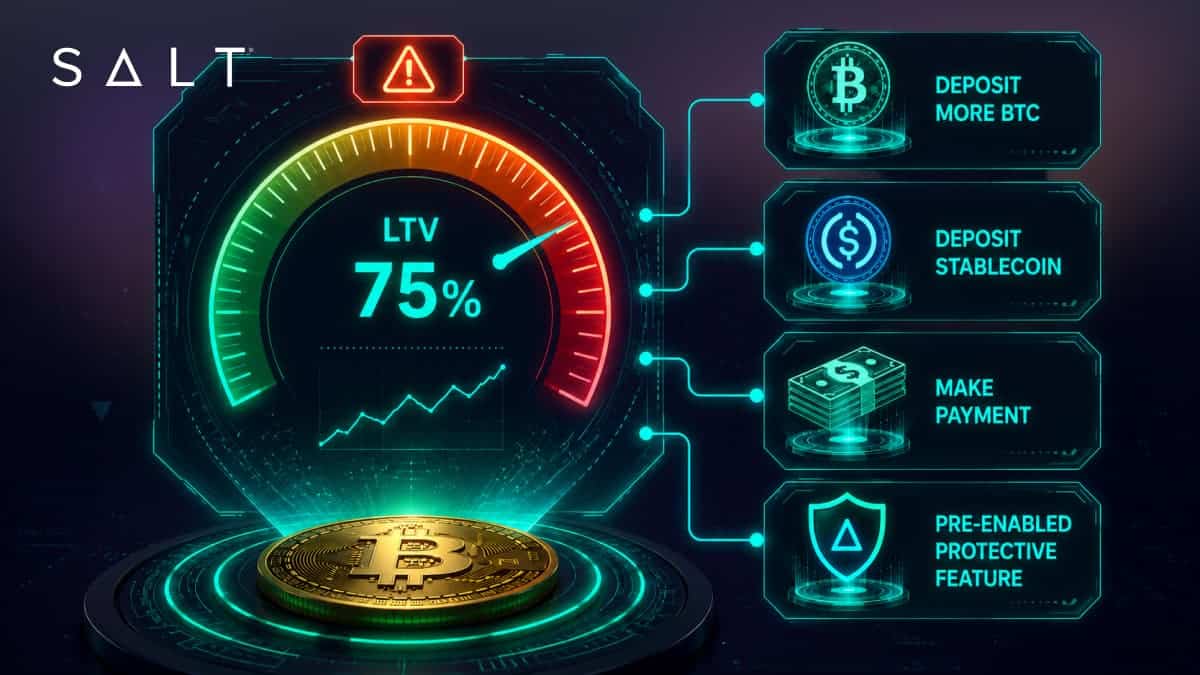
Loan-to-Value Ratio (LTV): The loan balance divided by the current market value of your collateral, expressed as a percentage. A $40,000 loan against $100,000 of bitcoin is a 40 percent LTV. LTV rises when crypto prices fall and falls when prices rise, which makes it the number to watch. The SALT loan calculator shows how much you can borrow at different LTVs.
Initial LTV: The loan-to-value ratio at the moment the loan is funded. Choosing a lower initial LTV means borrowing less against the same collateral, but it buys you more room before a price drop becomes a problem.
Maintenance LTV: The threshold your LTV must stay below during the life of the loan. Cross it and the lender will notify you that action is required.
Margin Call: A notice from your lender that your LTV has risen past the maintenance threshold and you need to restore it, either by adding collateral or paying down principal. It is a warning, not a seizure, and there is normally a defined window to respond. Our full explainer on margin calls and how to avoid one covers the mechanics.
Liquidation: The sale of some or all of your collateral to bring the loan back within acceptable limits, typically triggered only after a margin call goes unaddressed or after a severe price move. Liquidation is a taxable event, which is part of why avoiding it matters.
Stabilization: A feature that converts collateral into a stable asset when markets move against you, so the loan is protected without the position being sold off at a market bottom. Details on how SALT implements it are on the Stabilization page.
Taxable Event: A transaction that triggers a reporting obligation, most commonly the sale or disposal of an asset. Borrowing against crypto is generally not a taxable event because you have not sold anything, which is a core reason people use a loan instead of selling. A forced liquidation of collateral, however, usually is one. Treatment depends on your jurisdiction and circumstances, so confirm with your tax advisor.
Volatility: How sharply an asset’s price swings over time. Crypto volatility is the reason over-collateralization exists, and it is the variable that turns a comfortable LTV into an uncomfortable one within days.
Platform and Compliance Terms
CeFi Lending: Centralized finance lending, where a company underwrites the loan, holds the collateral, and is accountable to regulators. It usually means human support, fiat payouts, and identity verification. Compare the two models in our CeFi versus DeFi breakdown.
DeFi Lending: Decentralized finance lending, where the loan is executed by smart contracts on a blockchain with no company in the middle. It offers permissionless access, but liquidations are automated and there is no support desk if something goes wrong.
KYC and AML: Know Your Customer and Anti Money Laundering, the identity verification and monitoring requirements licensed lenders must follow. In practice this means providing government issued identification and, for business borrowers, entity documents. See how to get a bitcoin-backed loan for what the application actually involves.
How These Terms Fit Together
Most of the vocabulary above describes a single relationship. You pledge collateral, the lender sets an initial LTV that leaves a cushion, and that cushion absorbs volatility for the life of the loan. If prices fall far enough that the cushion thins, a margin call asks you to restore it. If it is never restored, liquidation follows.
The terms worth the most attention before you sign are custody, rehypothecation, and maintenance LTV. The first two tell you what happens to your bitcoin while it sits with the lender, and the third tells you how much price movement your loan can absorb before you have to act. Everything else, including rate and term, is easier to compare once those three are settled. If you want to see how the numbers change at different borrowing levels, our guide on how much you can borrow against your bitcoin works through examples.
Frequently Asked Questions
What does LTV mean on a crypto loan?
LTV, or loan-to-value ratio, is your loan balance divided by the current market value of your collateral. A $30,000 loan backed by $100,000 of bitcoin is a 30 percent LTV. Because collateral value changes with the market, your LTV changes daily even if your loan balance does not.
What is the difference between a margin call and a liquidation?
A margin call is a notification asking you to restore your LTV by adding collateral or paying down principal. A liquidation is the actual sale of collateral, and it generally happens only if a margin call is not addressed within the window your loan agreement defines, or if prices move violently enough that the cushion is exhausted.
Why do crypto loans have to be over-collateralized?
Because crypto prices can move significantly in a short period. The extra collateral is a buffer that lets the loan survive normal volatility without immediate action from either side. The lower your initial LTV, the larger that buffer is.
What is rehypothecation, and should I care about it?
Rehypothecation is a lender reusing your pledged collateral, often by lending it out to a third party. You should care, because it means the return of your bitcoin can depend on the performance of a transaction you were never party to. Ask any lender whether they rehypothecate, and get the answer in writing. Our post on vetting a crypto lender covers the other questions worth asking.
Is the interest on a crypto-backed loan tax deductible?
It depends on how the loan proceeds are used and on your specific situation, so this is a question for your tax advisor. We walk through the general framework in are bitcoin loan interest payments tax deductible.
Are crypto-backed loans available everywhere?
No. Availability depends on licensing in your jurisdiction, and terms can differ from one location to the next. You can check current availability on the SALT jurisdiction map.
Put the Terms to Work
Now that the vocabulary is clear, the fastest way to see what it means for your position is to run the numbers. Use the SALT bitcoin loan calculator to see borrowing amounts at different LTVs, or apply for a loan to get started.
Disclaimer
This content is provided for informational and educational purposes only and does not constitute financial, investment, tax, or legal advice. Borrowing against collateral involves risk and may not be appropriate for your needs. Rates and product terms are subject to change. Loan terms may vary or may not be available in your jurisdiction, for your requested loan amount, and/or preferred collateral type. SALT loans are subject to jurisdictional limitations and other restrictions, and SALT does not offer loans to all prospective borrowers. For current availability, see saltlending.com/map-list. Digital currency is not legal tender, is not backed by the United States or any other government, and SALT accounts are not subject to FDIC or SIPC protections. SALT loans are originated by SALT Lending LLC (f/k/a SALT Master Fund II, LLC), NMLS 1711910.