
One of the most common questions borrowers ask after taking out a bitcoin-backed loan is whether the interest they pay can reduce their tax bill. It is a fair question. Mortgage interest is famously deductible, business loan interest usually is, and a bitcoin-backed loan sits somewhere unfamiliar in between.
The honest answer is: it depends, and what it depends on is almost entirely how you use the loan proceeds, not the fact that bitcoin is the collateral. This guide walks through the general framework U.S. taxpayers face, the categories that matter, and the records you should keep. It is educational content, not tax advice, so treat it as preparation for a conversation with your tax professional rather than a substitute for one.
The Short Answer
Under U.S. federal tax rules, interest on a bitcoin-backed loan is generally not deductible if you use the funds for personal expenses, such as a car, a vacation, or paying down credit cards. It may be deductible if you use the proceeds to buy taxable investments, subject to the investment interest expense limitation, or if you use them for a legitimate business purpose. What controls the outcome is the use of the money, under what tax professionals call interest tracing rules. The collateral being bitcoin neither helps nor hurts you.
The Key Concept: Interest Tracing
U.S. tax rules classify interest by following where the borrowed money goes. The same loan can produce deductible or nondeductible interest depending entirely on what you spend it on. Tax professionals refer to this as tracing, and it is the framework that determines everything below.
This is why two SALT borrowers with identical loans can have completely different tax outcomes. One uses the proceeds to fund a brokerage account; the other buys a boat. Same loan, same collateral, same interest rate, different tax treatment.
Personal Use: Generally Not Deductible
If you borrow against your bitcoin to cover living expenses, buy a vehicle, take a trip, pay tuition, or consolidate consumer debt, the interest is classified as personal interest. Personal interest has not been deductible for individuals since the 1980s. Most bitcoin-backed borrowing falls in this category, so the default assumption should be that your interest is not deductible unless you can trace the funds to a qualifying use.
Worth noting: even nondeductible interest can still make borrowing the right move. As we covered in our guide to borrowing versus selling, taking a loan avoids realizing capital gains on your bitcoin, and for many holders that benefit alone outweighs the cost of the interest.
Investment Use: Potentially Deductible, With Limits
If you use loan proceeds to purchase taxable investments, such as stocks, bonds, or other income-producing assets, the interest may qualify as investment interest expense. A few important boundaries apply:
- The deduction is capped. Investment interest is generally deductible only up to your net investment income for the year, with the excess carried forward. It is claimed as an itemized deduction, so it provides no benefit if you take the standard deduction.
- The investment must produce taxable income. Interest traced to investments that generate tax-exempt income, such as municipal bonds, is not deductible.
- Buying more crypto is a gray area. Whether interest on funds used to purchase additional digital assets qualifies as investment interest involves unsettled questions, including how the property is classified for your situation. This is squarely a question for a tax professional before you rely on the deduction.
- Documentation is everything. To claim the deduction, you need to show the borrowed funds actually went into the investment. Commingling loan proceeds with everyday funds in one account can compromise the tracing and the deduction with it.
Business Use: Generally Deductible
If the loan funds a genuine business purpose, such as inventory, equipment, payroll, or expansion, the interest is generally deductible as a business expense. This applies whether you borrowed personally and injected the funds into your business or borrowed through the business entity itself, though the mechanics differ and entity-level borrowing is usually cleaner.
For companies exploring this route, SALT offers dedicated business loans, and our recent guide to bitcoin treasury management for private companies covers how borrowing fits into a broader corporate strategy.
What About Using a Bitcoin Loan to Buy a Home?
This one surprises people. The home mortgage interest deduction generally requires the loan to be secured by the home itself. A bitcoin-backed loan is secured by your bitcoin, not the property, so interest on a crypto loan used for a down payment or purchase typically does not qualify as deductible mortgage interest, even though the money bought a house. If you are weighing this route, read our full guide on buying a house with a bitcoin-backed loan and price the loan on its other merits: speed, no home lien, and keeping your bitcoin position intact.
Record-Keeping: What to Save
If you intend to claim any interest deduction, build the paper trail from day one:
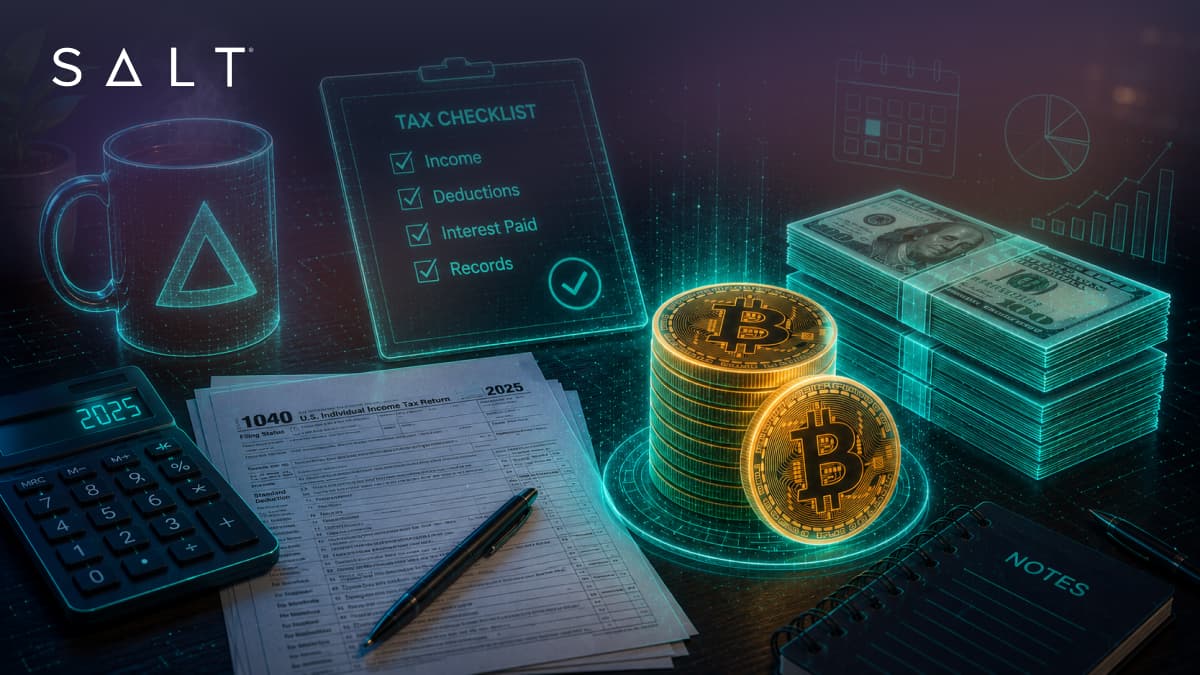
- Your loan agreement and payment history showing interest actually paid during the tax year.
- Statements tracing the loan proceeds from disbursement to their end use, ideally through a dedicated account rather than a commingled one.
- Purchase confirmations for any investments or business assets acquired with the funds.
- Notes on the date and purpose of each use, since memory fades faster than audit windows close.
The Bottom Line
Bitcoin loan interest is not automatically deductible, and it is not automatically nondeductible either. Personal use means no deduction. Investment use may support one, within limits and with clean tracing. Business use generally does. The collateral is irrelevant; the destination of the dollars is everything. Before you file, bring your loan documents and your tracing records to a qualified tax professional and let them apply the rules to your facts.
And if you have not yet taken the loan, remember that deductibility is only one line in the equation. Borrowing against bitcoin instead of selling it avoids a taxable sale altogether, which for long-term holders is often the larger prize.
Frequently Asked Questions
Is interest on a bitcoin-backed loan tax deductible?
Sometimes. Under U.S. federal rules, it depends on how you use the proceeds. Personal use is generally not deductible, investment use may be deductible up to your net investment income if you itemize, and business use is generally deductible. Consult a tax professional about your specific situation.
Does it matter that the loan is secured by bitcoin?
Generally no. Tax treatment of the interest follows the use of the borrowed funds, not the type of collateral. The one notable exception is the home mortgage interest deduction, which requires the loan to be secured by the home, a test a bitcoin-collateralized loan does not meet.
Can I deduct the interest if I use the loan to buy more crypto?
This is an unsettled area. Whether such interest qualifies as investment interest expense depends on classification questions that have not been fully resolved, so do not claim it without advice from a qualified tax professional.
Is taking out a bitcoin-backed loan itself a taxable event?
Borrowing is generally not a sale, so receiving loan proceeds does not by itself trigger capital gains the way selling your bitcoin would. Certain events during the loan, such as a liquidation of collateral, can have tax consequences. Our borrowing versus selling guide covers this in depth.
Do these rules apply outside the United States?
No, this guide describes the general U.S. federal framework. Interest deductibility rules vary significantly by country, so borrowers in other jurisdictions should consult local tax advisors.
What form is investment interest expense claimed on?
For U.S. individual taxpayers, investment interest expense is generally computed on IRS Form 4952 and claimed as an itemized deduction. Your tax preparer or software will handle the mechanics, but you must supply the tracing records that support the number.
Disclaimer
This content is for informational and educational purposes only and does not constitute financial, investment, legal, or tax advice. Tax rules are complex, change frequently, and apply differently depending on your facts and circumstances; nothing here should be relied upon to take a position on any tax return. Always consult a qualified tax professional. Loan products, terms, and availability vary by jurisdiction. SALT currently offers lending services in eligible jurisdictions across North America (including most U.S. states, Canada, and Puerto Rico), South America (Brazil), Europe (Portugal, Switzerland, and the United Kingdom), Asia (the United Arab Emirates and Viet Nam), and Oceania (Australia, New Zealand, and the Northern Mariana Islands). For the current list of eligible jurisdictions, visit saltlending.com/map-list. Borrowing against collateral entails risk and may not be appropriate for your needs. Digital currency is not legal tender, is not backed by the United States or any other government, and SALT accounts are not subject to FDIC or SIPC protections. SALT loans are originated by SALT Lending LLC, NMLS 1711910.