
A crypto-backed personal loan lets you borrow cash against Bitcoin or other digital assets you already own, without selling them. You pledge your crypto as collateral, the lender holds it for the life of the loan, and you receive fiat or stablecoin that you can spend on anything from a medical bill to a down payment. Because the loan is secured by an asset the lender can value instantly, approval does not depend on a high credit score, and funding is typically far faster than a traditional unsecured personal loan.
If you need money quickly in 2026 and most of your net worth is in crypto, this is one of the few options that does not force you to liquidate a long-term position at the worst possible moment. Below is a practical look at how fast these loans actually move, what they cost, how they stack up against other fast-cash products, and what to watch out for.
What Is a Crypto-Backed Personal Loan?
A crypto-backed personal loan is a secured loan where digital assets serve as collateral instead of a house or a car. The mechanics are closer to a securities-based line of credit than to a payday advance.
The basic structure looks like this:
- You choose a loan amount and a collateral asset, such as Bitcoin, Ethereum, or another supported coin.
- The lender sets a loan-to-value ratio, or LTV, which is the loan amount divided by the market value of your collateral. A 50% LTV on $20,000 of Bitcoin produces a $10,000 loan.
- You transfer the collateral to the lender, who confirms receipt and holds it in custody for the term of the loan.
- Your loan documents are issued against that confirmed collateral, and you review and sign them.
- You receive the loan proceeds in dollars or stablecoin and make interest payments on a set schedule.
- When you repay the principal, your collateral is returned to you in full.
The critical difference from selling: you keep your exposure to the asset. If Bitcoin appreciates during your loan term, that upside is still yours. If you had sold instead, you would be buying back at a higher price and paying tax on the gain.
You can model a scenario before you apply using the SALT loan calculator: https://saltlending.com/bitcoin-loan-calculator/
Why Speed Is the Main Reason Borrowers Choose Crypto Collateral
Traditional lending is slow because the underwriting is slow. A bank evaluating an unsecured personal loan has to build a picture of your income, employment history, debt-to-income ratio, and credit behavior, then price the risk that you simply stop paying. That process involves documents, verification, and often a human underwriter.
Collateralized crypto lending inverts the problem. The collateral is liquid, priced continuously on public markets, and verifiable on-chain in minutes. The lender does not need to predict your future income to feel comfortable, because the loan is protected by an asset that can be valued at any second of any day. That single fact removes most of the friction, and it is why funding timelines compress from weeks to days or even hours.
It also means a thin credit file, a recent job change, or self-employment income that is hard to document does not automatically disqualify you. Identity and compliance checks still apply, but the underwriting weight sits on the asset rather than on your paystubs.
How Fast Can You Actually Get Funded?
Speed varies by lender, loan size, and jurisdiction, but the stages are consistent. Here is a realistic view of where the time goes:
| Stage | Typical Duration | What Determines the Speed |
|---|---|---|
| Account creation and loan request | Minutes | How quickly you can supply basic information and choose your terms |
| Identity and compliance review | Same day to a few days | Document clarity, entity vs individual borrower, and jurisdiction requirements |
| Collateral transfer and confirmation | Minutes to hours | Network confirmation times for the asset you are pledging |
| Loan documents issued and signed | Same day to next business day | Loan size, collateral type, and whether terms need customization |
| Disbursement of funds | Same day to a few business days | Whether you take stablecoin or a bank transfer, plus banking cutoff times |
The single biggest lever you control is preparation. Borrowers who have their identification ready, their collateral sitting in a wallet they control, and a clear loan amount in mind routinely finish in a fraction of the time of borrowers who start the process and then go hunting for documents.
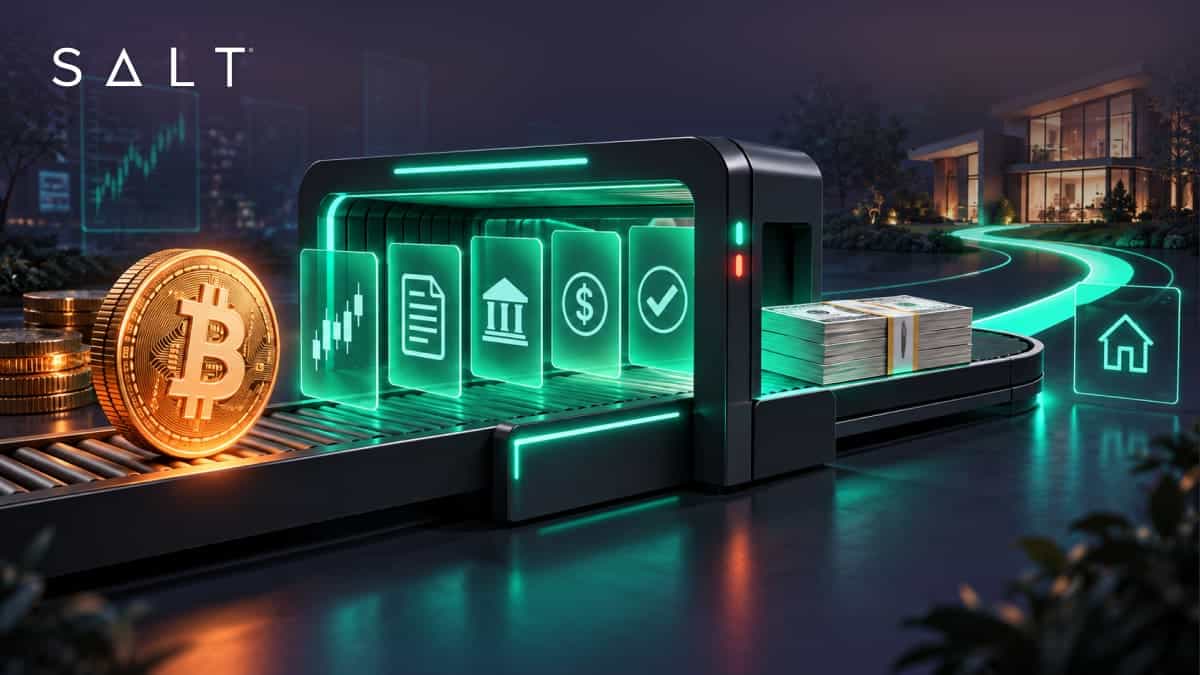
One part of the sequence surprises first-time borrowers: your collateral is transferred and confirmed before you sign the loan documents, not after. This is deliberate. Collateral value moves with the market, so the loan is documented against collateral that has actually been received and verified rather than against a balance that might look different an hour later. Practically, it means the funding clock does not really start until your transfer confirms on-chain, which is why having your collateral in a wallet you control before you begin makes a visible difference.
Two other factors matter. Stablecoin disbursement avoids banking hours entirely, so it is usually the fastest path to usable funds. And larger or more complex loans, particularly business or entity borrowing, involve more review by design.
For a step-by-step walkthrough of the application itself, see our guide on how to get a Bitcoin-backed loan: https://saltlending.com/how-to-get-a-bitcoin-backed-loan/
Crypto-Backed Loans vs Other Fast Cash Options
Fast money is usually expensive money. The value of a crypto-backed loan is that it can be both quick and reasonably priced, because it is secured. Here is how the common options compare on the dimensions that matter when you are in a hurry:
| Option | Typical Speed | Credit Check | Main Tradeoff |
|---|---|---|---|
| Crypto-backed loan | Hours to days | Usually not a hard inquiry | Collateral risk if the asset price falls sharply |
| Unsecured personal loan | Days to weeks | Hard inquiry | Rate depends heavily on credit score, and approval is not guaranteed |
| Credit card cash advance | Immediate | Already approved | High APR that starts accruing immediately, plus an advance fee |
| Payday or short-term loan | Same day | Often minimal | Extremely high cost and short repayment window |
| HELOC or home equity loan | Weeks | Hard inquiry | Requires home equity, an appraisal, and closing steps |
| Selling crypto | Hours to days | None | Realizes a taxable event and permanently ends your position |
| 401(k) loan | Days to weeks | None | Removes retirement assets from the market and can trigger issues if you leave your job |
Notice that the two fastest conventional options, a cash advance and a payday loan, are also the two most expensive. The two cheapest, a HELOC and a well-priced personal loan, are the slowest. Crypto collateral is one of the few ways to avoid that tradeoff, assuming you already hold the asset.
The Hidden Cost of Selling Your Crypto Instead
Selling feels like the simplest answer when you need cash. It is often the most expensive one, and the cost is easy to underestimate because most of it is invisible at the moment of sale.
Consider a holder who bought $10,000 of Bitcoin years ago that is now worth $50,000, and who needs $20,000 for a home repair.
- Selling roughly $20,000 of that position realizes a proportional share of the $40,000 gain, which is taxable in most jurisdictions.
- Depending on the holding period and local tax treatment, a meaningful slice of the proceeds goes to tax rather than to the repair.
- To end up with $20,000 in hand, the holder may need to sell noticeably more than $20,000 worth.
- If the asset later appreciates, that upside is permanently forfeited on the portion sold.
A loan against the same position sidesteps the taxable event, because borrowing is not a sale. You pay interest instead of tax, and you keep the position intact. Whether that math favors borrowing depends on your rate, your term, and your tax situation, which is exactly why this decision deserves a conversation with a tax professional rather than a rule of thumb.
We covered the tax side in more depth here: https://saltlending.com/are-bitcoin-loan-interest-payments-tax-deductible/
What You Need to Qualify in 2026
Requirements are lighter than most borrowers expect, but they are not nonexistent. Expect to provide:
- Eligible collateral. A supported digital asset in sufficient quantity to cover your requested loan amount at the available LTV.
- Identity verification. Regulated lenders are required to know who they are lending to, so government identification and basic personal information are standard.
- A qualifying location. Lending licenses are jurisdiction-specific, and availability differs by region.
- A destination for funds. A bank account for fiat, or a wallet address if you prefer stablecoin.
- The ability to service the loan. Interest payments still have to be made, and a plan for repayment matters even when credit is not the gating factor.
What you generally do not need: a specific credit score, a pay stub, a co-signer, or an explanation of what you intend to do with the money. Personal loans of this type are typically unrestricted in use.
For detail on how much your holdings can support, see: https://saltlending.com/how-much-can-you-borrow-against-your-bitcoin/
What Borrowers Actually Use Fast Crypto Loans For
The use cases cluster around situations where timing matters and liquidation would be costly:
- Real estate. Covering a down payment, a bridge between closings, or a renovation without touching a long-term position.
- Unexpected expenses. Medical bills, urgent home or vehicle repairs, or family emergencies.
- Debt consolidation. Replacing high-interest revolving balances with a single secured loan at a lower cost.
- Business needs. Payroll gaps, inventory purchases, or seizing a time-limited opportunity.
- Tax obligations. Paying a bill that comes due before other liquidity arrives.
- Major purchases. Education costs, a vehicle, or a life event with a fixed date.
The common thread is that the borrower views their crypto as a long-term holding and does not want a short-term cash need to permanently reduce that position.
Risks You Should Understand Before You Borrow
Borrowing against volatile collateral carries real risk, and any lender who downplays that is not being straight with you.
Price volatility and margin calls
If your collateral drops in value, your LTV rises. Past a defined threshold, the lender will ask you to post additional collateral or pay down principal. If that is not addressed, some collateral may be sold to bring the loan back into range. Borrowing at a conservative LTV leaves far more room for normal market swings.
Custody and counterparty risk
Your collateral sits with someone else for the life of the loan, so who holds it and what they are permitted to do with it is the most important question you can ask. Rehypothecation, meaning the lender lending out or trading your collateral, is the practice that caused the most damage in past cycles. Ask directly whether a lender rehypothecates and get the answer in writing.
Rate and term structure
Understand whether your rate is fixed or variable, what fees apply at origination, and whether early repayment carries a penalty. A low headline rate with an aggressive fee structure is not a bargain.
Our deeper piece on vetting a lender is here: https://saltlending.com/are-bitcoin-backed-loans-safe/
Tools that help manage the volatility side of this equation are worth understanding before you borrow. SALT Shield and Stabilization are both designed around exactly this problem.
SALT Shield: https://saltlending.com/salt-shield/
Stabilization: https://saltlending.com/stabilization/
How to Get a Crypto-Backed Personal Loan with SALT
SALT has been originating loans against digital assets since 2016, through multiple market cycles. The process is built to be quick without skipping the parts that protect you.
- Run the numbers first. Use the loan calculator to see what your holdings support at different LTVs, and note the monthly payment at each level.
- Create an account. Sign up and select your loan type.
- Submit your loan request. Choose your amount, collateral asset, and term.
- Complete verification. Provide identification and any documentation requested for your jurisdiction.
- Transfer your collateral. This step comes before your loan documents are issued, so make sure you are comfortable with your quoted terms, your LTV, and your payment schedule before you send anything.
- Review and sign your loan documents. Once collateral is confirmed, your agreement is issued. Read it carefully, including the LTV thresholds that trigger a margin call and any prepayment terms.
- Receive your funds. Disbursement proceeds to your bank account or wallet, depending on what you selected.
If your situation is more complex, whether that means a larger loan, business borrowing, or an unusual collateral mix, talking to the team directly will move faster than working through it alone.
Where Crypto-Backed Personal Loans Are Available
Lending is licensed regionally, so availability is not universal. SALT currently offers lending services across a broad set of jurisdictions, including 47 U.S. states plus Washington D.C. and Puerto Rico, along with Canada, Brazil, Portugal, Switzerland, the United Kingdom, the United Arab Emirates, Viet Nam, Australia, New Zealand, and the Northern Mariana Islands. Some of these support both personal and business loans, while others are limited to business loans only.
Confirm your specific jurisdiction and loan type on the full list here: https://saltlending.com/map-list/
If your location is not currently listed, you can still submit a loan request. Doing so adds you to the loan demand queue, which is how SALT identifies where to expand next, and you will be notified if lending becomes available in your area.
Frequently Asked Questions
How fast can I get a crypto-backed personal loan?
Timelines depend on your jurisdiction, loan size, and how quickly verification is completed, but the process is measured in hours to days rather than the weeks a traditional unsecured personal loan can take. Borrowers who have identification ready and collateral available move fastest, and choosing stablecoin disbursement avoids bank processing delays entirely.
Do I need good credit to qualify?
Credit is not the primary underwriting factor, because the loan is secured by your digital assets rather than by your future income. Identity and compliance verification are still required, but a thin credit file or a low score does not automatically disqualify you the way it might with an unsecured loan.
Will applying hurt my credit score?
Crypto-backed lending generally does not involve the hard credit inquiry that unsecured personal loans require, which is a meaningful difference if you are also shopping for a mortgage. We break down what lenders actually check in our post on whether Bitcoin-backed loans affect your credit score.
What can I use the money for?
Personal loans of this type are typically unrestricted. Borrowers use them for real estate down payments, medical expenses, debt consolidation, tuition, taxes, vehicle purchases, and business needs. You are generally not required to justify the purpose.
What happens if the price of my collateral drops?
A falling collateral value raises your LTV. If it crosses the threshold defined in your loan agreement, you will receive a margin call and can respond by adding collateral or paying down principal. If the call is not addressed, some collateral may be liquidated to restore the required ratio. Borrowing at a lower LTV than the maximum available is the simplest way to build in a buffer.
Do I transfer my collateral before or after signing the loan documents?
Collateral is transferred and confirmed first, and the loan documents are issued afterward. Because collateral value moves with the market, the agreement is written against collateral that has actually been received and verified rather than against an estimated balance. The practical implication is that you should be satisfied with your quoted loan amount, LTV, rate, and payment schedule before you send your assets, since the transfer is the point at which your collateral leaves your control. Ask any outstanding questions at the quote stage rather than waiting for the paperwork.
Which cryptocurrencies can I use as collateral?
Bitcoin is the most common collateral, but a range of other digital assets is supported, with LTV limits that vary by asset based on liquidity and volatility. Availability changes over time, so check current supported assets when you apply.
Do I keep the upside if my crypto appreciates during the loan?
Yes. Because you are borrowing against the asset rather than selling it, any appreciation over the loan term remains yours. Your collateral is returned in full when the principal is repaid. This is the central reason long-term holders choose borrowing over liquidation.
Is borrowing against crypto a taxable event?
In most jurisdictions, taking out a loan is not itself a taxable event, while selling crypto typically is. That distinction is often the largest financial factor in the decision. Tax treatment varies by jurisdiction and by individual circumstance, so consult a qualified tax professional about your specific situation.
Can I repay the loan early?
Repayment flexibility varies by lender and by loan structure, so confirm whether prepayment penalties apply before you sign. Review your loan agreement and the current rates and fees for specifics.
How is this different from a DeFi loan?
A centralized lender handles custody, compliance, and customer support, and provides a human counterparty and a legal agreement. A DeFi protocol runs on smart contracts with no intermediary, which suits some borrowers and not others. We compare the two in detail in our post on CeFi versus DeFi crypto loans.
The Bottom Line
If you hold crypto and need cash quickly in 2026, a crypto-backed personal loan is worth serious consideration. It is faster than a bank, cheaper than a cash advance or payday product, does not typically require a hard credit inquiry, avoids the tax consequences of selling, and keeps your long-term position intact.
The tradeoff is genuine and should not be glossed over. You are pledging a volatile asset, and a sharp decline can trigger a margin call. Borrow conservatively, understand your LTV thresholds and payment terms before you transfer collateral, and choose a lender who is transparent about custody.
Handled with discipline, this is a way to access liquidity without giving up the asset you spent years accumulating.
Start by modeling your loan: https://saltlending.com/bitcoin-loan-calculator/
Or review current rates and fees: https://saltlending.com/rates-and-fees/
Disclaimer
This article is provided for informational and educational purposes only and does not constitute investment, financial, tax, or legal advice. Nothing here should be construed as an offer, solicitation, endorsement, or recommendation regarding any security or digital asset. You are encouraged to conduct your own research and to consult your financial, tax, or legal advisors before making any borrowing or investment decision.
Loan terms may vary or may not be available in your jurisdiction, for your requested loan amount, or for your preferred collateral type. SALT loans are subject to jurisdictional limitations and other restrictions, and SALT does not offer loans to all prospective borrowers. Personal and business loan availability differs by region. For the current list of eligible jurisdictions, please refer to the SALT map list at https://saltlending.com/map-list/. Additional terms, conditions, requirements, suitability standards, and screenings may apply at the sole discretion of SALT.
Borrowing against collateral entails risk and may not be appropriate for your needs. Rates are subject to change. Digital currency is not legal tender, is not backed by the United States or any other government, and SALT accounts are not subject to FDIC or SIPC protections. Digital assets are highly speculative and the market is largely unregulated.
SALT loans are originated by SALT Lending LLC (f/k/a SALT Master Fund II, LLC), NMLS 1711910. Loans will be arranged or made pursuant to California Financing Law where applicable. In Idaho, SALT offers consumer loans and is doing business as SALT Lending LLC, a licensed regulated lender (License No. RRL-11258). Michigan Regulatory Loan License No. RL-0025865. See the SALT Licenses page for additional license information.