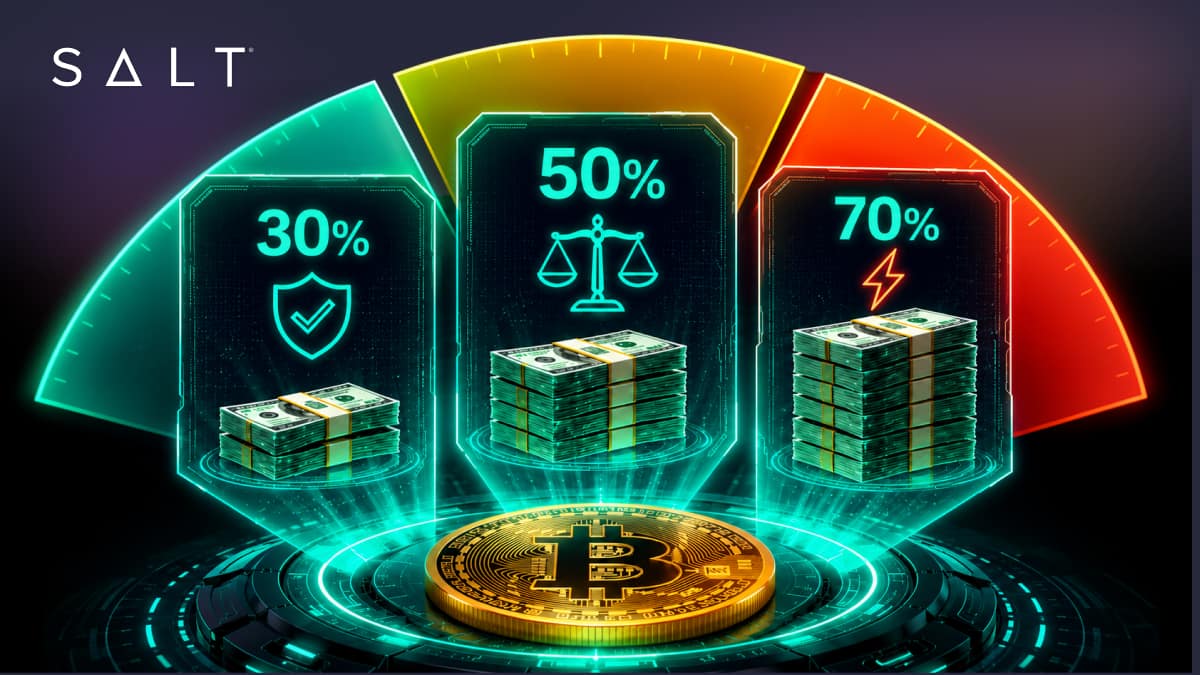

The amount you can borrow against your Bitcoin comes down to one simple formula: your collateral’s value multiplied by your loan-to-value (LTV) ratio. At SALT, LTV options range from 30% to 70%, so $100,000 of BTC can support a loan of $30,000 to $70,000, with loans starting as low as $5,000 (starting amounts vary by jurisdiction). To get your exact number in seconds, use the SALT Bitcoin loan calculator.
Below, we break down how the math works, show worked examples at every tier, and explain why the maximum you can borrow is not always the amount you should borrow.
The Formula: Collateral Value x LTV
Every crypto-backed loan is sized by loan-to-value, the ratio between what you borrow and what your collateral is worth. The formula is:
Loan Amount = Collateral Value x LTV
So if you hold $100,000 worth of Bitcoin and choose a 50% LTV, you can borrow $50,000. Because approval is based on your collateral rather than your income or credit score, this formula is the whole story: no debt-to-income calculations, no credit tiers, no income verification determining your limit.
SALT’s LTV Tiers and What They Let You Borrow
SALT offers three LTV starting points, and your choice sets both your borrowing power and your interest rate. Current rates are always listed on the Rates and Fees page.
| LTV Tier | You Can Borrow (per $100,000 of BTC) | 1-Year APR | Best For |
|---|---|---|---|
| 30% (Conservative) | $30,000 | 7.49% | Long-term holders who want the largest buffer against volatility |
| 50% (Standard) | $50,000 | 8.75% | Borrowers balancing liquidity with a reasonable safety margin |
| 70% (Max liquidity) | $70,000 | 10.50% | Borrowers who need maximum liquidity and actively monitor their loan |
Availability of specific tiers and terms varies by jurisdiction, loan term, and collateral type. Multi-year fixed terms of 3 and 5 years are available on the 30% and 50% tiers.
Worked Examples at Every Tier
Here is what different collateral amounts support at each LTV tier:
| Collateral Value | 30% LTV | 50% LTV | 70% LTV |
|---|---|---|---|
| $25,000 | $7,500 | $12,500 | $17,500 |
| $50,000 | $15,000 | $25,000 | $35,000 |
| $100,000 | $30,000 | $50,000 | $70,000 |
| $250,000 | $75,000 | $125,000 | $175,000 |
| $1,000,000 | $300,000 | $500,000 | $700,000 |
Bitcoin’s price changes constantly, so the dollar value of your holdings today is the input that matters, not the number of coins. The loan calculator pulls current pricing automatically and shows your available loan amounts across tiers in real time.
The Minimum: How Much Bitcoin Do You Need to Borrow at All?
SALT loan starting amounts vary by jurisdiction. In many jurisdictions, loans start as low as $5,000. Working the formula backward, here is roughly how much BTC you need to support a $5,000 loan at each tier:
| LTV Tier | Approximate Collateral Needed for a $5,000 Loan |
|---|---|
| 30% | About $16,700 in BTC |
| 50% | $10,000 in BTC |
| 70% | About $7,150 in BTC |
There is no fixed maximum loan size. Because loans are collateral based, borrowing power scales with your holdings, which is why SALT serves everyone from individual holders to businesses and private clients.
Why the Maximum Is Not Always the Right Amount
Borrowing at 70% LTV maximizes your cash today but leaves the smallest buffer if Bitcoin’s price falls. When your LTV rises past certain thresholds, you may face a margin call requiring you to add collateral or pay down your balance. At 30% LTV, Bitcoin’s price would need to fall much further before your loan comes under pressure. For a full explanation of the mechanics, see our guide to margin calls on crypto-backed loans.
A practical rule of thumb: decide how much cash you actually need first, then work backward to the LTV that delivers it with the most room to spare. If you need $50,000 and hold $170,000 in BTC, borrowing at roughly 30% LTV gets you there with a far larger cushion than taking the same $50,000 from a smaller collateral stack at 70%.
What Else Affects Your Borrowing Power
- Collateral type. SALT accepts BTC, ETH, USDC, and USDT. Stablecoin collateral does not swing in value the way BTC and ETH do, which changes the risk picture.
- Jurisdiction. Available LTV tiers, terms, and minimums vary by where you live.
- Loan term. 1-year terms are available at every tier; 3 and 5 year fixed terms are available at 30% and 50% LTV.
- Adding collateral later. You can deposit additional collateral during your loan to lower your LTV, and depending on your situation, refinancing can let you adjust your loan size as your holdings grow.
How to Get Your Exact Number
- Open the SALT Bitcoin loan calculator at saltlending.com/bitcoin-loan-calculator.
- Enter how much you want to borrow, or how much collateral you have.
- Compare loan amounts, rates, and monthly payments across the 30%, 50%, and 70% tiers.
- When you are ready, sign up and submit your loan request. Funding is often available within 24 to 48 hours of approval.
Try the calculator now or create your SALT account to get started.
Frequently Asked Questions
How much can I borrow with 1 BTC?
Multiply Bitcoin’s current price by your chosen LTV. If BTC is trading at $100,000, one coin supports a loan of $30,000 at 30% LTV, $50,000 at 50%, or $70,000 at 70%. Since the price moves constantly, the loan calculator gives you a live figure.
What is the minimum Bitcoin loan amount?
Starting loan amounts vary by jurisdiction. In many jurisdictions, SALT loans start as low as $5,000, which requires roughly $7,150 to $16,700 in BTC collateral depending on your LTV tier. Check the loan calculator or your borrower portal for the minimum that applies where you live.
Is there a maximum amount I can borrow against Bitcoin?
There is no fixed cap. Loan size scales with the value of your collateral, and SALT serves individual, business, and private client borrowers at a wide range of loan sizes, all at the same published rates.
Does my credit score affect how much I can borrow?
No. Loan size is determined by your collateral value and LTV tier, not your credit profile, and applying does not involve a hard credit inquiry. Learn more in our guide to Bitcoin-backed loans and credit scores.
Can I borrow more later if my Bitcoin increases in value?
Rising collateral value lowers your LTV, which strengthens your loan. Depending on your situation and jurisdiction, refinancing may allow you to access additional liquidity against that growth. Adding more collateral to an existing loan is also supported.
What happens to my loan amount if Bitcoin’s price drops?
Your loan balance does not change, but your LTV rises as your collateral loses value. If it climbs past certain thresholds, you may need to add collateral or pay down the loan to restore a healthy ratio. Borrowing at a conservative LTV is the simplest way to build in protection from the start.
The Bottom Line
How much you can borrow against your Bitcoin is a function of two numbers you control: how much collateral you post and which LTV tier you choose. The formula is simple, loans start as low as $5,000 depending on your jurisdiction with no fixed ceiling, and the smartest borrowers pick the tier that funds their need with the biggest buffer left over. Get your exact number in under a minute with the SALT Bitcoin loan calculator.
Disclaimer
This content is provided for informational and educational purposes only and does not constitute financial, investment, legal, or tax advice. Figures shown are illustrative examples only and do not represent an offer of credit. Loan terms, rates, and minimum loan amounts may vary or may not be available in your jurisdiction, for your requested loan amount, and/or preferred collateral type. SALT loans are subject to jurisdictional limitations and other restrictions and are available only in eligible jurisdictions; for the current list of jurisdictions where SALT can lend, visit saltlending.com/map-list. SALT does not offer loans to all prospective borrowers, and additional terms, conditions, requirements, and screenings may apply. Rates for SALT products are subject to change. Borrowing against collateral entails risk and may not be appropriate for your needs. Digital currency is not legal tender, is not backed by the United States or any other government, and SALT accounts are not subject to FDIC or SIPC protections. SALT loans are originated by SALT Lending LLC, NMLS 1711910.