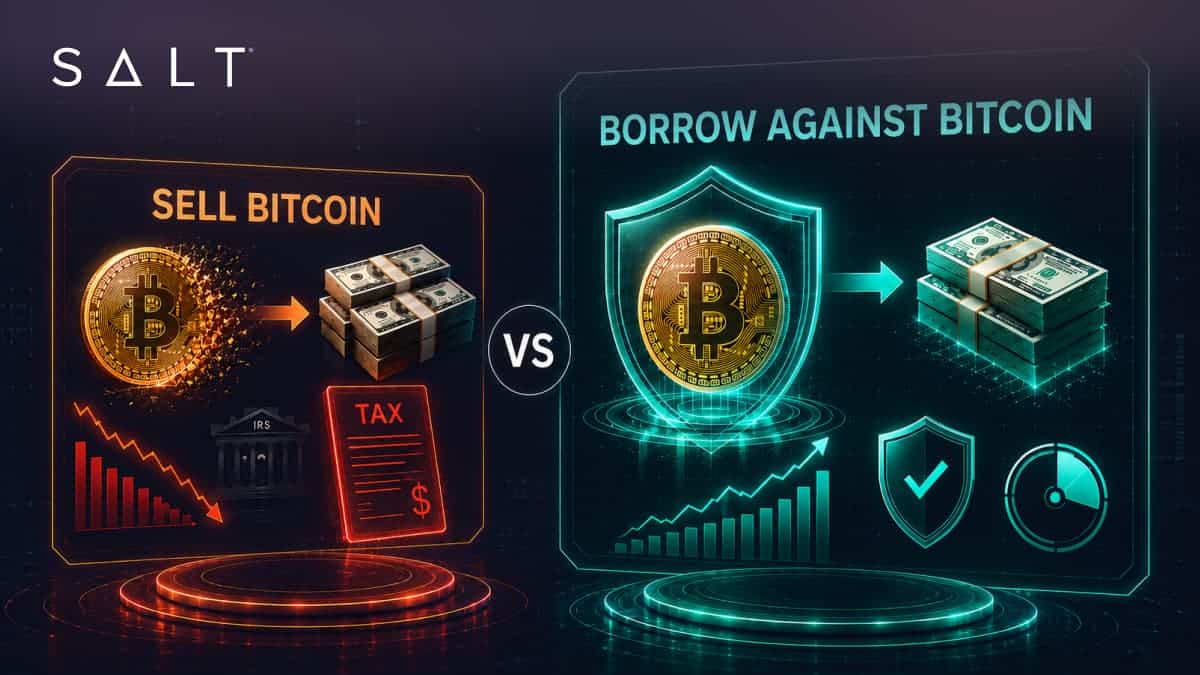

Short answer: TLDR Selling Bitcoin is generally a taxable event — it can realize a capital gain. Borrowing against your Bitcoin generally is not, because you’re pledging it as collateral rather than selling it. That difference is why many long-term holders use a Bitcoin-backed loan to access cash without triggering a tax bill on their gains.
This article is general information, not tax advice. Tax outcomes depend on your individual circumstances and jurisdiction. Consult a qualified tax professional before making any decision.
Why Selling Bitcoin Can Create a Tax Bill
In the U.S., the IRS treats cryptocurrency as property (under Notice 2014-21). That means when you sell, swap, or otherwise dispose of Bitcoin, you generally realize a capital gain or loss — the difference between what you paid (your cost basis) and what you received. Gains are typically reported on IRS Form 8949 and Schedule D.
How much you’d owe comes down to your gain and your personal tax situation, which a tax professional can walk through with you. The key takeaway is simpler: selling to raise cash generally means realizing that gain and paying tax on it, and it ends your exposure to Bitcoin. If the price keeps climbing after you sell, you no longer benefit from that upside.
Why Borrowing Against Bitcoin Generally Isn’t Taxed
A loan is not income — it’s money you have to pay back. When you take out a Bitcoin-backed loan, you pledge your BTC as collateral but keep ownership of it. Because there’s no sale or disposal at that moment, there’s generally no capital gain to report when the loan originates.
This is the same principle behind borrowing against other assets, like a home equity line of credit or a securities-backed loan: pledging an asset as collateral is not the same as selling it. The practical upshot is that you can access cash while keeping your Bitcoin — and your exposure to its future price.
What Can Still Trigger Taxes on a Bitcoin Loan
“Generally not taxable” is not the same as “never taxable.” A few situations tied to a crypto-backed loan can still create a taxable event, which is exactly why this is a conversation to have with a tax professional:
- Collateral liquidation. If your collateral is sold or liquidated — for example, because the value of your Bitcoin falls and your loan-to-value ratio rises too high — that sale may count as a taxable disposal of your Bitcoin.
- Repaying with appreciated Bitcoin. If you repay the loan using Bitcoin that has gone up in value since you acquired it, the IRS may treat that as a taxable disposition. Repaying in cash generally does not raise this issue.
- What you do with the funds. The loan itself isn’t taxed, but if you use the proceeds to buy assets and later sell them at a gain, those later sales follow their own tax rules.
Borrow vs. Sell: Side by Side
| Selling your Bitcoin | Borrowing against it | |
|---|---|---|
| Taxable event when you do it? | Generally yes | Generally no |
| Capital gains realized? | Yes, on the gain | Not at origination |
| Keep ownership & upside? | No | Yes |
| Time to access cash | After the sale settles | Often 1–2 business days |
| Main trade-off | Locks in tax; gives up future upside | Interest cost; liquidation risk if BTC falls |
For general illustration only. Your outcome depends on your cost basis, holding period, income, loan terms, and jurisdiction.
The Difference in Plain Terms
Say you bought Bitcoin years ago and it’s worth far more today. If you sell to raise cash, you generally owe capital gains tax on the increase — and you no longer hold the Bitcoin if it keeps climbing. If instead you borrow against that Bitcoin, you get cash now, you generally don’t realize a gain at that moment, and you keep your BTC. The actual numbers depend entirely on your situation, which is why this is a decision to make with a tax professional, not off a blog post.
How to Borrow Against Your Bitcoin Instead of Selling
With SALT, you can pledge your Bitcoin as collateral and receive a cash loan while keeping ownership of your BTC. Because one of the few things that can turn a loan into a taxable event is a forced liquidation, managing that risk matters. SALT’s Stabilization and SALT Shield™ features are designed to help protect your collateral during market swings and reduce the chance of a forced sale. You can also refinance and roll your loan over rather than repaying in full — keeping your liquidity working without selling.
Frequently Asked Questions
Is borrowing against my Bitcoin a taxable event?
Generally, no. Pledging Bitcoin as collateral for a loan is not a sale, so it typically doesn’t realize a capital gain when the loan originates. Tax treatment depends on your circumstances — consult a tax professional.
Do I pay capital gains tax when I sell Bitcoin?
Generally, yes. The IRS treats crypto as property, so selling or disposing of Bitcoin usually realizes a capital gain or loss based on your cost basis.
Can a Bitcoin-backed loan ever trigger taxes?
Yes. A taxable event can arise if your collateral is liquidated, or if you repay the loan using Bitcoin that has appreciated in value. These depend on the specifics of your loan and situation.
Is the interest on a Bitcoin loan tax-deductible?
It depends on how you use the funds. Interest on a personal loan is generally not deductible, while interest tied to business or investment use sometimes is. Ask your tax advisor whether it applies to you.
Does this apply outside the United States?
Tax treatment of crypto loans varies by country and even by state. This article reflects general U.S. principles; consult a tax professional in your own jurisdiction.
Keep Your Bitcoin. Access the Cash.
If selling would mean a tax bill and the loss of your upside, a Bitcoin-backed loan may be worth a look. See what your loan could look like and check availability on the map-list.
This article is for general informational purposes only and does not constitute tax, legal, financial, or investment advice. SALT does not provide tax or legal advice. Tax treatment of borrowing against or selling digital assets depends on your individual circumstances and jurisdiction and is subject to change; the IRS treats cryptocurrency as property (Notice 2014-21). You should consult a qualified tax professional and your own advisors before making any decision. Examples are illustrative only.
Available rates and terms are subject to change and may vary based on loan amount, qualifications, jurisdiction, and collateral profile. Other terms, conditions, and restrictions may apply. SALT loans are subject to jurisdictional limitations; for current availability, see saltlending.com/map-list. SALT loans are originated by SALT Lending LLC (f/k/a SALT Master Fund II, LLC) — NMLS 1711910. Digital currency is not legal tender, is not backed by any government, and SALT accounts are not subject to FDIC or SIPC protections.