
Before you can borrow against your crypto, you need to know whether the assets you actually hold will qualify. It is the first question most borrowers ask, and the answer is narrower than the size of the crypto market would suggest. There are thousands of tokens in circulation. Only a handful of them make sound loan collateral.
Here is what qualifies, why the list is short, and how your choice of collateral changes the loan you can get.
The Short Answer
- SALT accepts four collateral types: Bitcoin (BTC), Ethereum (ETH), USD Coin (USDC), and Tether (USDT).
- Why so few: collateral has to be liquid enough to price and sell reliably under stress. Most tokens are not.
- Your choice matters: the asset you pledge affects your available loan-to-value options, your margin call buffer, and in some cases your terms.
- You keep ownership: pledging collateral is not a sale. Repay the loan and the collateral comes back to you.
- Availability varies: specific collateral types may not be offered in every jurisdiction or at every loan size.
What Makes an Asset Good Loan Collateral
A secured lender is not making a bet on which token goes up. It is asking a much more boring question: if this loan goes sideways, can the collateral be valued accurately and sold quickly without moving the market? Four things drive the answer.
- Liquidity. The asset needs deep, continuous order books across multiple venues. Thin liquidity means a forced sale gets a bad price, which is bad for the borrower as well as the lender.
- Reliable pricing. There has to be a defensible market price at any hour, because loan-to-value is calculated continuously rather than once a month.
- Custody support. The asset has to be held in institutional-grade custody with proper key management and segregation.
- Regulatory clarity. A licensed lender has to be comfortable that holding the asset as collateral is consistent with the rules it operates under.
Bitcoin, Ethereum, and the two largest dollar stablecoins clear all four. The long tail of altcoins usually fails on the first two.
Which Crypto Assets SALT Accepts
SALT accepts BTC, ETH, USDC, and USDT as collateral. Here is how the four compare in practice.
| Collateral | Volatility Profile | What That Means for Your Loan |
|---|---|---|
| Bitcoin (BTC) | High, with the deepest liquidity in the asset class | The most common SALT collateral. Deep markets support reliable pricing, and a lower LTV widens your buffer against a drawdown. |
| Ethereum (ETH) | High, historically more volatile than Bitcoin | Works well for holders concentrated in ETH. A conservative LTV is worth considering given the wider price swings. |
| USD Coin (USDC) | Designed to track the US dollar | Price stability means margin risk is driven by the loan structure rather than collateral swings. |
| Tether (USDT) | Designed to track the US dollar | Same practical profile as USDC. Useful when your liquidity already sits in stablecoins. |
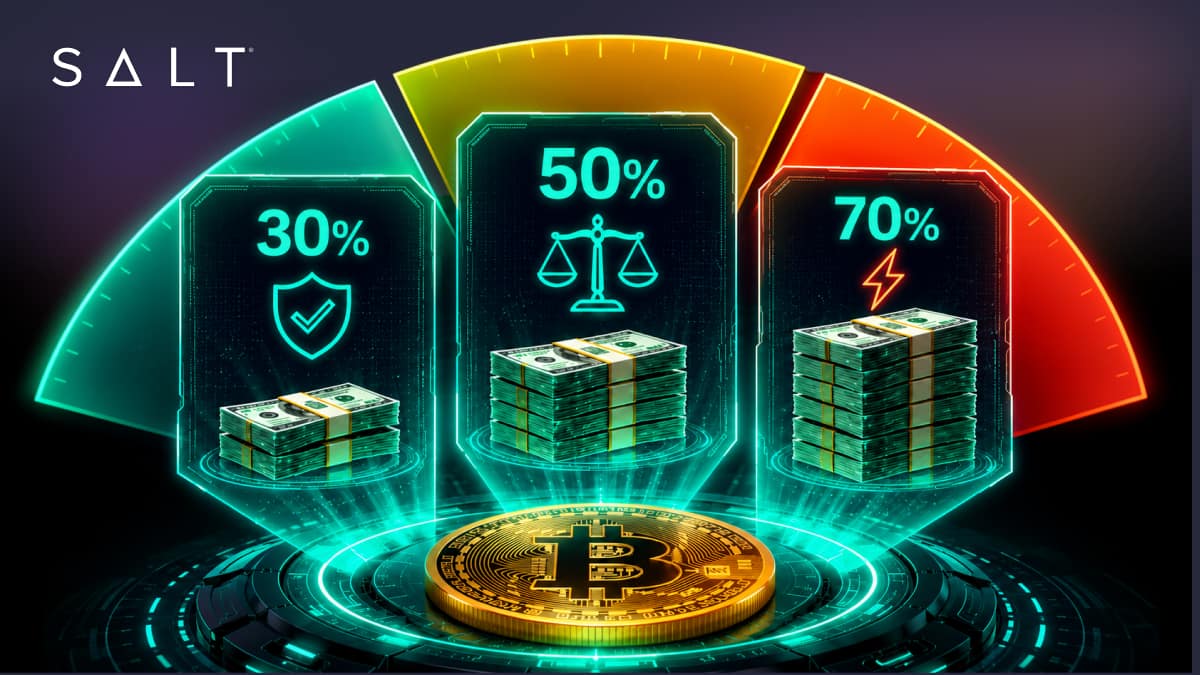
Available loan-to-value tiers of 30 percent, 50 percent, and 70 percent are subject to jurisdiction and term length. Collateral profile is one of the factors that can affect the rates and terms available to you.
Bitcoin as Collateral
Bitcoin remains the default collateral for crypto-backed lending, and for good reason. It has the deepest liquidity, the longest price history, the widest custody support, and the clearest regulatory treatment of any digital asset. That combination is why Bitcoin-backed loans exist as a mature product category while loans against most other tokens do not.
For long-term holders, the appeal is straightforward. Selling Bitcoin to raise cash is generally a taxable disposition and permanently ends your exposure. Borrowing against it leaves the position intact. If you want to size a loan against your holdings, the SALT loan calculator will show you what a given amount of collateral supports, and How Much Can You Borrow Against Your Bitcoin? walks through the math.
Ethereum as Collateral
Ethereum is the second most widely accepted collateral asset across the lending market. It has the liquidity and pricing infrastructure the underwriting process requires, and for holders whose portfolios are concentrated in ETH rather than BTC, it removes the need to sell one asset to borrow against another.
The practical difference is volatility. Ethereum has historically moved in wider ranges than Bitcoin, and volatility is what turns a comfortable loan-to-value into a margin call. Borrowers pledging ETH often choose a more conservative LTV tier for exactly that reason.
Stablecoins as Collateral
USDC and USDT are accepted collateral at SALT, but it is worth being clear about the mechanics first. Any asset you pledge is transferred to your loan and held for the life of the loan. It is not deployed, staked, or earning anywhere else while it secures your balance. That applies to stablecoins exactly as it applies to Bitcoin.
Given that, the case for stablecoin collateral is narrower than for BTC or ETH, and it comes down to two things.
- It removes price-driven margin risk. A dollar-pegged asset does not fall 30 percent in a week, so your loan-to-value stays where you set it rather than drifting with the market.
- It is the practical way to add collateral to an existing loan. If Bitcoin drops and your LTV climbs, posting stablecoins brings the ratio back down without selling any of the BTC you originally pledged.
That second use case is the one most borrowers care about, and it is why holding some stablecoin liquidity on the side is a sensible habit if you have an active crypto-backed loan. Blending stablecoins into a collateral pool alongside BTC or ETH also lowers the overall volatility of what you have pledged, which widens your buffer.
What stablecoin collateral does not do is let you borrow and keep earning on the same dollars. If your stablecoins are currently committed elsewhere, pledging them means pulling them out first.
Why Most Altcoins Are Not Accepted
If you hold a mid-cap or small-cap token, the honest answer is that almost no regulated lender will take it. That is not a judgment on the project. It is a function of how secured lending works.
- Liquidity concentrates on a small number of venues, so a large position cannot be valued or liquidated cleanly.
- Drawdowns are steeper and faster, which makes any workable loan-to-value ratio uneconomically low for the borrower.
- Custody and insurance coverage is thinner or unavailable.
- Regulatory classification is often unsettled, which a licensed lender cannot ignore.
Some decentralized protocols will accept a wider range of tokens, usually at aggressive collateral requirements and with automated liquidation and no human recourse. The tradeoffs are real in both directions. CeFi vs DeFi Crypto Loans compares the two models directly.
How Your Collateral Choice Affects Your Loan
Once you know what qualifies, the more useful question is how the asset you pledge shapes the loan itself.
- Loan-to-value. A lower LTV means more collateral for the same loan amount and a much wider cushion before a margin event. At 30 percent LTV, $30,000 of collateral supports a $9,000 loan.
- Margin risk. The more volatile the collateral, the more attention your LTV deserves. Stablecoin collateral largely takes this variable off the table.
- Terms and pricing. Available rates and terms may vary based on loan amount, qualifications, jurisdiction, and collateral profile.
- Minimum loan size. The SALT minimum is $5,000, subject to jurisdiction, which means roughly $10,000 in collateral at 50 percent LTV.
If a price drop pushes your loan-to-value past the threshold in your agreement, you receive a margin call and can respond by adding collateral or paying down principal. What Is a Margin Call on a Crypto-Backed Loan? covers the mechanics, and Stabilization and SALT Shield are built to soften it.
What Happens to Your Collateral During the Loan
Whatever asset you pledge, the structure is the same. You transfer collateral to your loan wallet, the lender holds it for the life of the loan, and you receive the loan proceeds in US dollars or stablecoin. Nothing is sold. When the loan is repaid, the collateral is returned.
What matters is how the lender treats that collateral while it holds it. Ask where it sits, who controls the keys, whether it is segregated, and whether it is ever lent out or reused. Are Bitcoin-Backed Loans Safe? Custody, Rehypothecation, and How to Vet a Crypto Lender lays out the questions worth asking of any platform, including this one.
Getting Started
SALT has been originating crypto-backed loans since 2016, with published rates from 7.49 percent to 10.50 percent APR, no origination or prepayment fees, and terms of 1, 3, or 5 years. Check availability in your area on the lendable jurisdictions list, size your loan with the loan calculator, or see How to Get a Bitcoin-Backed Loan for the full application timeline.
Frequently Asked Questions
What crypto can you use as collateral for a loan?
SALT accepts Bitcoin (BTC), Ethereum (ETH), USD Coin (USDC), and Tether (USDT) as collateral. Availability of specific collateral types can vary by jurisdiction and loan configuration.
Can I use altcoins as collateral?
Not at SALT. Regulated lenders limit collateral to assets with deep liquidity, reliable pricing, institutional custody support, and clear regulatory treatment. Most altcoins do not meet that standard, which is why the accepted list across the industry is short.
Can I use Ethereum instead of Bitcoin?
Yes. Ethereum is accepted collateral. Because ETH has historically been more volatile than BTC, many borrowers pledging Ethereum choose a lower loan-to-value tier to widen the buffer before a margin event.
Why would anyone use stablecoins as collateral?
Mainly for two reasons: a dollar-pegged asset does not swing in value, so price-driven margin risk largely disappears, and stablecoins are the most practical way to add collateral to an existing loan when your loan-to-value has drifted higher.
Can I keep earning yield on stablecoins I use as collateral?
No. Collateral is transferred to your loan and held for the term, so it is not deployed or earning elsewhere while it secures your balance. Pledging collateral is not a sale and the assets are returned when you repay, but they do have to sit as collateral in the meantime.
How much collateral do I need?
The SALT loan minimum is $5,000, subject to jurisdiction. At 50 percent LTV that is roughly $10,000 in collateral. At a more conservative 30 percent LTV you would pledge closer to $16,700 for the same loan, which buys a larger cushion against price swings.
Do I still own my crypto while it is pledged?
Yes. Pledging collateral is not a sale. The lender holds the assets for the term of the loan, and they are returned when the loan is repaid. Because there is no disposition, borrowing generally does not trigger a capital gains event the way selling does. Consult your own tax advisor.
What happens to my collateral if the market drops?
A falling collateral value raises your loan-to-value. If it crosses the threshold in your loan agreement, you receive a margin call and can respond by adding collateral, paying down principal, or using the risk tools available on your loan. Starting at a lower LTV is the simplest way to reduce the odds of getting there.
Can I choose which asset to get my loan proceeds in?
SALT funds loans in US dollars or stablecoin, subject to availability in your jurisdiction.
Disclaimer
This content is for informational purposes only and does not constitute financial, investment, tax, or legal advice. SALT loans are originated by SALT Lending LLC, NMLS 1711910. Loan terms may vary or may not be available in your jurisdiction, for your requested loan amount, or for your preferred collateral type. SALT loans are subject to jurisdictional limitations and other restrictions, and SALT does not offer loans to all prospective borrowers. For the current list of jurisdictions where SALT can lend, see https://saltlending.com/map-list/. Available rates and terms are subject to change and may vary based on loan amount, qualifications, jurisdiction, and collateral profile. Accepted collateral types are subject to change at SALT’s discretion. Borrowing against collateral entails risk and may not be appropriate for your needs. Digital currency is not legal tender, is not backed by the United States or any other government, and SALT accounts are not subject to FDIC or SIPC protections. Digital assets are highly speculative and the market is largely unregulated. Consult your own financial, tax, or legal advisors before making borrowing decisions.