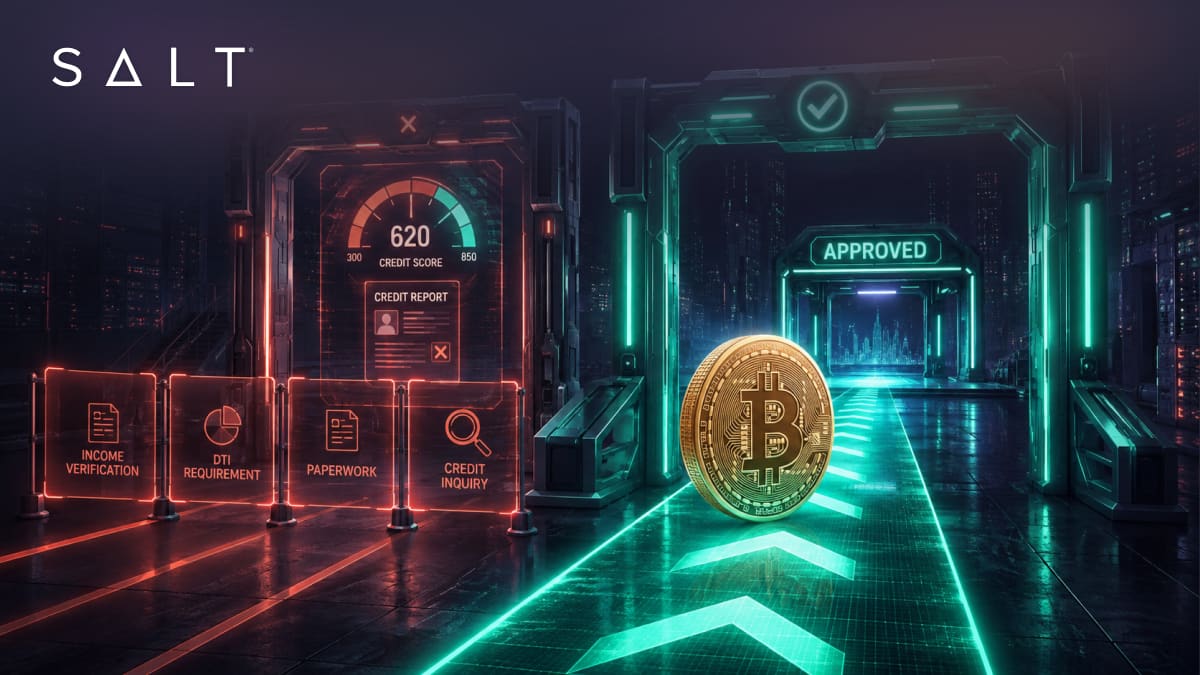

Short answer: you can pay a federal or state tax bill without selling bitcoin by borrowing against it. A bitcoin-backed loan turns collateral into dollars without disposing of the asset, so no capital gain is realized, your cost basis and holding period stay intact, and you keep the position. The other routes are an IRS payment plan, a card payment, an unsecured loan, or selling. All five have real costs, and the cheapest one depends on your basis, your timeline and how much collateral you can pledge.
This post walks through what each option actually costs on a $50,000 tax bill, how the IRS prices the option of paying late, and when selling is genuinely the smarter move.
Why Selling Bitcoin to Pay Taxes Creates a Second Tax Problem
Selling bitcoin is a disposition. The gain is the sale price minus your cost basis, and that gain is taxable in the year you sell. So if you sell bitcoin to satisfy a tax bill, you generate a new tax liability on the way to paying the old one, and you have to sell more than the bill to come out even.
Here is the arithmetic. Say you owe $50,000 and your bitcoin has a cost basis equal to 25 percent of its current value. A sale is 75 percent gain. At a 23.8 percent long-term rate (20 percent capital gains plus the 3.8 percent net investment income tax), the tax on the gain runs about 17.9 percent of whatever you sell. To be left with $50,000 after setting aside money for that gain, you need to liquidate roughly $60,900. That is about $10,900 of extra bitcoin sold purely to cover the tax on the tax, before any state income tax.
The second cost is the one people underestimate. That $60,900 of bitcoin is gone. If you were holding it for a reason, you have now converted a long-term position into a one-time payment, and the gain you triggered lands on next year’s return, which is how borrowers end up repeating the cycle. We covered the full comparison in Borrow vs. Sell Bitcoin: Tax Implications.
What the IRS Charges When You Do Not Pay in Full
Paying late is a financing decision, and the IRS prices it. Three separate charges can apply, and they stack:
- Underpayment interest. Set at the federal short-term rate plus three percentage points, reset every quarter, and compounded daily. For the quarter beginning October 1, 2026, the individual rate is 7 percent. It has been 7 percent for three of the four quarters of 2026.
- Failure-to-pay penalty. Half a percent of the unpaid balance per month, capped at 25 percent of the tax owed. It drops to a quarter percent per month while an installment agreement is in effect and your returns are filed on time.
- Estimated tax penalty. A separate charge that applies when quarterly estimated payments fall short, calculated from each quarterly due date rather than from April.
Setting up a payment plan reduces the penalty but does not stop it. A short-term plan that clears the balance within 180 days costs nothing to set up. A long-term installment agreement costs $22 online with direct debit, $69 online without it, and $107 to $178 by phone or mail, with waivers for taxpayers at or below 250 percent of the federal poverty guidelines. Add the interest and the reduced penalty together and a plan carries at roughly 10 percent annualized, which puts it in the same neighborhood as unsecured credit.
Two conditions worth knowing before you choose a plan. Any refund you are owed in future years gets applied to the balance until it is cleared. And a plan terminates if you file late or accrue a new balance, at which point the full amount comes due again. The IRS has also begun replacing its first-time abatement process with an automatic exemption from penalty for taxpayers who have filed and paid on time for the prior three years, so if this is a first miss, penalty relief may apply without you asking.
The Five Ways to Cover a Tax Bill
- Sell bitcoin. Simplest to execute, most expensive in total. You pay the bill, trigger a gain, and lose the position.
- Pay by card. Fast and requires no application. The processor fee is 1.75 percent at Pay1040 or 1.85 percent at ACI Payments for a personal credit card, and about 2.95 percent for a corporate card. Debit is a flat fee of roughly $2.10 to $2.15. The fee is the small part. Carrying a five-figure balance at a typical card APR is the expensive part.
- IRS installment agreement. No collateral, no credit pull, approval is usually immediate online. Costs roughly 10 percent annualized and puts you into a compliance arrangement with the IRS.
- Unsecured personal loan. Rates depend entirely on your credit profile, and origination fees of 1 to 8 percent are common. Requires a hard inquiry and income verification, which is a problem for borrowers whose income is mostly 1099 or capital gains. If that is you, see Bitcoin-Backed Loans for Self-Employed and 1099 Borrowers.
- Bitcoin-backed loan. You pledge bitcoin as collateral and receive dollars or stablecoin. No disposition, so no capital gain, and no credit-driven pricing. The trade-off is that you need collateral well in excess of the loan, and the loan is exposed to bitcoin’s price while it is open.
Cost Comparison on a $50,000 Tax Bill
Twelve-month figures, illustrative only. Card interest assumes a 22.5 percent APR. The personal loan assumes 14 percent APR amortized over a year. The bitcoin-backed loan range spans SALT’s 30 percent LTV tier at 7.49 percent APR and the 70 percent tier at 10.50 percent APR, paid interest only.
| Method | Estimated first-year cost | Taxable event | Speed | What it requires |
|---|---|---|---|---|
| Sell bitcoin | About $10,900 of extra bitcoin liquidated to fund the gain, plus the permanent loss of exposure | Yes | Minutes to days | Nothing, but you give up the position and owe tax on the sale next April |
| Credit card | $875 processor fee plus roughly $5,600 to $11,300 in card interest | No | Same day | Available credit. The IRS limits individuals to two card payments per balance due |
| IRS installment agreement | Roughly $2,700 to $5,000, plus a $22 to $178 setup fee | No | Online approval, often immediate | Filed returns and ongoing compliance. Future refunds are applied to the balance |
| Unsecured personal loan | About $3,900 in interest plus $500 to $4,000 in origination fees | No | 1 to 7 business days | Hard credit inquiry, income verification, debt-to-income review |
| Bitcoin-backed loan | $3,745 to $5,250 in interest, with no origination fee | No | As fast as 1 to 2 business days | Bitcoin collateral, roughly $71,500 to $167,000 depending on the LTV tier |
The pattern holds across most realistic inputs. Selling looks free because there is no interest line, but the liquidation cost and the surrendered position make it the most expensive choice for anyone who wanted to keep the bitcoin. Cards are the worst of the financing options once a balance carries. The IRS plan and a collateralized loan land in a similar range on paper, and the deciding factors are usually collateral availability, whether you want the IRS involved in your next several refunds, and how long you need the money.
How a Bitcoin-Backed Loan Covers a Tax Payment
The mechanics are the same as any secured loan, with collateral held in custody rather than a lien on a house:
- Run the numbers first. Pick a loan amount that covers the bill and decide which LTV tier you can support.
- Apply and complete identity verification. There is no hard credit inquiry driving your rate.
- Transfer collateral to your custody account and wait for network confirmations.
- Receive funds in US dollars or in USDC or USDT, typically within one to two business days once collateral is confirmed.
- Pay the IRS or your state directly from your bank account using Direct Pay, EFTPS or your state portal, which avoids card processor fees entirely.
- Service the loan. You can pay interest only, pay principal and interest, or accrue interest to maturity, subject to availability in your jurisdiction.
SALT’s current terms, for reference: a $5,000 loan minimum, LTV tiers of 30, 50 and 70 percent, APRs from 7.49 percent to 10.50 percent, zero origination fee, zero prepayment penalty, and terms of one, three or five years. Bitcoin, ether, USDC and USDT are eligible collateral. Full detail is on the Rates and Fees page, and you can model a specific amount with the Bitcoin Loan Calculator.
On collateral requirements: at the 50 percent tier, a $50,000 loan needs about $100,000 of bitcoin pledged. At 30 percent it is closer to $167,000, and at 70 percent about $71,500. Lower LTV means more collateral, a better rate, and far more room before a price drop becomes a problem. How Much Can You Borrow Against Your Bitcoin? walks through the tiers in detail.
Timing Your Loan Around the Tax Calendar
The estimated tax penalty accrues from each quarterly due date, not from the April filing deadline, so a payment made in April does not undo a shortfall from September. The dates that matter for the 2026 tax year:
- September 15, 2026. Third-quarter estimated payment for individuals.
- January 15, 2027. Fourth-quarter estimated payment.
- April 15, 2027. Return due, and the balance due. An extension to file is not an extension to pay.
Build in lead time. Between application, verification, collateral transfer and network confirmations, funding realistically takes a few business days, and quarter-end and mid-April are the busiest windows. Starting a week or more before the date you need the money is the difference between choosing this option and defaulting to a card because you ran out of runway.
One practical note for anyone who realized crypto gains earlier in the year: if you are trying to reach a safe harbor, the target is generally 90 percent of the current year’s tax or 100 percent of the prior year’s, rising to 110 percent above certain income levels. Your accountant can tell you which applies, and the answer changes how much you actually need to borrow.
When Selling Is the Better Choice
Borrowing is not automatically the right answer, and it is worth being clear about that. Selling usually wins when:
- Your cost basis is high, or you are sitting on a loss. If the gain is small or negative there is little tax to defer, and a loss may be worth harvesting.
- The bill is large relative to your holdings. If covering it would push you to a high LTV with no buffer, you are trading a tax problem for a liquidation risk.
- You no longer want the exposure. Paying interest to hold an asset you were planning to exit is just a more expensive exit.
- You cannot service the loan. Interest is due whether bitcoin rises or falls, and a loan you cannot pay is worse than a tax bill you can.
- The amount is small enough that a short-term IRS plan clears it in a few months for very little.
Risks to Understand Before You Borrow
Price risk and margin calls. If bitcoin falls, your LTV rises, and past a threshold you will need to add collateral or pay down principal or face liquidation. What Is a Margin Call on a Crypto-Backed Loan? explains the thresholds, and the BTC Margin Event Calculator shows the price at which yours would trigger.
Mitigation is available but priced. Stabilization lets you convert collateral to stablecoin during a drawdown instead of being liquidated at the bottom, and SALT Shield® offers additional protection. Both carry fees, listed on the rates page.
Interest deductibility is not automatic. Whether interest on a loan used to pay taxes is deductible depends on how the proceeds are traced and on your situation. Personal interest generally is not deductible. See Are Bitcoin Loan Interest Payments Tax Deductible? and confirm with your tax advisor.
Deferral is not elimination. Borrowing defers the capital gain, it does not erase it. When you eventually sell, the gain is still there. What you gain is control over the timing.
Availability varies. Loan terms, LTV tiers and payment options are not offered everywhere. Check the jurisdiction list before you plan around this, and see Can You Get a Bitcoin-Backed Loan in Your State? for how licensing affects what is available to you.
Frequently Asked Questions
Do I owe taxes on money I borrow against bitcoin?
No. Loan proceeds are not income, and pledging collateral is not a disposition, so borrowing does not create a taxable event or reset your holding period. You still owe tax on the gain whenever you eventually sell the bitcoin. This is general information rather than tax advice, so confirm the treatment of your specific situation with a tax professional.
Can I pay the IRS directly in bitcoin?
No. The IRS accepts payment in US dollars only, through bank transfer, card, check or cash at a participating retailer. That is precisely why a bitcoin-backed loan is useful here: it converts collateral into dollars the IRS will accept without requiring you to sell.
Is the interest deductible if I use the loan to pay taxes?
Not necessarily. Interest on personal debt is generally not deductible, and interest traced to paying personal income tax is usually treated as personal interest. The analysis can differ for business or investment purposes. Have your tax advisor look at the tracing rules before you assume a deduction.
How much bitcoin do I need to cover a $50,000 tax bill?
It depends on the LTV tier. At 70 percent you would need roughly $71,500 of bitcoin, at 50 percent about $100,000, and at 30 percent about $167,000. The lower tiers cost less in interest and give you a much larger cushion before a price decline becomes an issue.
How fast can I get the money before a deadline?
Funding can happen as fast as one to two business days after your collateral is confirmed on chain, but the full process includes application, identity verification and the transfer itself. For a hard deadline like a quarterly estimated payment, start at least a week ahead.
Is a bitcoin-backed loan cheaper than an IRS payment plan?
On a one-year horizon they are close. An installment agreement carries at roughly 10 percent annualized once you combine 7 percent interest with the reduced failure-to-pay penalty, while SALT’s rates run from 7.49 percent to 10.50 percent APR with no origination fee. The loan is usually cheaper at the lower LTV tiers and over longer horizons, and it keeps future refunds out of IRS hands. The IRS plan wins when you have no collateral to pledge or can clear the balance inside 180 days.
What happens if bitcoin falls while the loan is open?
Your LTV rises. If it crosses the margin threshold you will be asked to add collateral or pay down principal, and if you do not, collateral can be liquidated to bring the loan back into range. Borrowing at a lower LTV is the main defense, and Stabilization exists for exactly this scenario.
Can I use this for state taxes or quarterly estimated payments?
Yes. Once the loan funds, the money is yours to direct. It works the same for a federal balance due, a state income tax bill, or a quarterly estimated payment. Availability of the loan itself still depends on your jurisdiction.
Next Steps
Model your numbers with the Bitcoin Loan Calculator to see the payment at each LTV tier, then check the jurisdiction list to confirm availability where you live. If the numbers work, you can start an application and have funds in place well before your filing or estimated payment date.
Important Disclosures
This article is for general informational purposes only and is not tax, legal, financial or investment advice. Tax treatment depends on your individual circumstances, and you should consult a qualified tax professional or attorney before acting on anything described here.
IRS interest rates are set quarterly and change. The figures cited reflect the rate for the calendar quarter beginning October 1, 2026, along with penalty and user fee schedules in effect at the time of writing. Verify current amounts at IRS.gov before relying on them. The examples in this post, including the $50,000 tax bill, the 25 percent cost basis assumption and the 23.8 percent long-term rate, are illustrative and are not a projection of your outcome.
SALT loans are subject to jurisdictional limitations and other restrictions. Loan terms, LTV tiers, APRs, payment options and fees may vary, or may not be available, depending on your jurisdiction, your requested loan amount and your collateral type. Certain fees may not apply in all jurisdictions or may apply at a reduced amount. For the current list of jurisdictions where SALT can lend, see saltlending.com/map-list. SALT does not offer loans to all prospective borrowers, and a loan inquiry does not constitute an offer or an application. Rates and terms are subject to change.
Borrowing against collateral entails risk and may not be appropriate for your needs. Digital currency is not legal tender, is not backed by the United States or any other government, and SALT accounts are not subject to FDIC or SIPC protections. SALT loans are originated by SALT Lending LLC, NMLS 1711910.