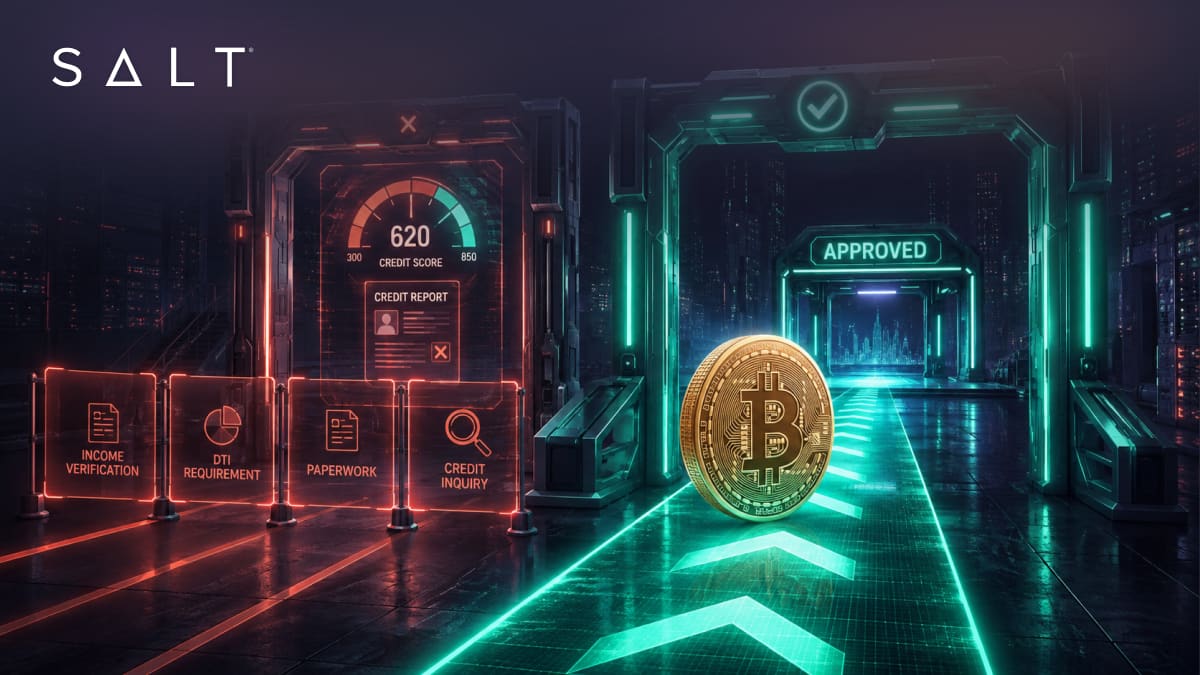

Quick answer: A no credit check Bitcoin loan is a secured loan where your Bitcoin acts as the collateral, so the lender never pulls your credit file. Approval depends on the value and type of crypto you pledge and the loan-to-value ratio you choose, not on your credit score, income documentation, or debt-to-income ratio. At SALT there is no credit check at any point in the application, which means no hard inquiry and no impact on your score. Identity verification still applies, because confirming who you are is a legal requirement and is separate from evaluating your creditworthiness.
If you hold Bitcoin and need cash, the credit-based lending system can feel like an obstacle course. A mortgage, a car loan, and a credit card all begin the same way: a lender pulls your file, scores your history, and decides whether you deserve access to money you already have the assets to repay. Collateralized crypto lending flips that sequence. This guide explains the mechanics behind no credit check Bitcoin loans in 2026, what lenders evaluate instead of a score, what the loan actually costs, and where the real risks sit.
What Is a No Credit Check Bitcoin Loan?
A no credit check Bitcoin loan is a loan secured by Bitcoin or other eligible digital assets, underwritten on the value of that collateral rather than on a borrower’s credit history. You transfer crypto into the lender’s custody, receive cash or stablecoin, make payments over an agreed term, and get your collateral back when the balance is repaid.
The structure is not new or exotic. It follows the same logic as a securities-based line of credit or a home equity loan: the asset secures the debt, so the lender’s primary question is not whether you are likely to repay but whether the collateral covers the exposure if you do not. Because that question is answered by market prices rather than by a credit bureau, the credit pull becomes unnecessary.
SALT has originated Bitcoin-backed loans since 2016, and the underwriting has always been collateral based. As we put it: your crypto is your credit. If you want the deeper explanation of what does and does not reach your credit report, read Do Bitcoin-Backed Loans Affect Your Credit Score? That post covers hard inquiries and bureau reporting. This one covers the approval mechanics.
Why Collateral Replaces the Credit Check
A credit score is a prediction tool. It exists to estimate the likelihood that someone repays a debt that is unsecured or only partly secured. The lender has no asset to fall back on, so it prices the risk of your behavior.
Overcollateralized lending removes most of that uncertainty. You pledge crypto worth more than you borrow. If the loan is not repaid, the lender looks to the collateral rather than to a collections process, a lawsuit, or a bureau furnishing report. The prediction problem shrinks to a valuation problem, and valuation is something a lender can monitor continuously rather than infer from your past.
That is why the phrase no credit check should not read as a warning sign in this category the way it does in payday or title lending. In subprime consumer credit, skipping the credit check usually means the lender has replaced underwriting with a very high interest rate. In collateralized crypto lending, the credit check is skipped because the collateral already did the underwriting.
How the Process Works, Step by Step
- Open an account. Signing up takes about a minute and does not involve a credit check or a hard inquiry.
- Run the numbers first. Use the Bitcoin loan calculator to model your collateral amount, loan size, term, and payment before you commit to anything.
- Choose your loan amount and loan-to-value ratio. LTV is the loan balance divided by the collateral value. SALT currently offers up to 70% LTV, and a lower LTV gives you more cushion against price swings.
- Select a term. SALT offers 1, 3, and 5 year terms, which is unusual in a category where most lenders stop at 1 or 2 years. Longer terms mean lower monthly payments and more room to ride out a full market cycle.
- Complete identity verification. This confirms who you are and satisfies anti-money-laundering obligations. It does not score your creditworthiness and does not touch your credit file.
- Transfer your collateral. Your crypto moves into custody with a qualified custodian for the life of the loan. You still own it, and it is not rehypothecated or lent out.
- Receive funds. Once approved and the collateral is confirmed, funding typically happens within one to two business days, and the money can be used for essentially any personal or business purpose.
- Manage the loan and repay. Make your scheduled payments, monitor your LTV, add collateral or pay down principal if prices fall, and receive your full collateral back at payoff.
For a longer walkthrough of documentation and timelines, see How to Get a Bitcoin-Backed Loan.
What Lenders Evaluate Instead of Your Credit Score
Nothing disappears from underwriting. It just moves from your history to your assets. A collateral-based lender is looking at:
- Collateral type. Not every token is eligible, and eligibility affects your terms. See What Crypto Can You Use as Collateral for a Loan? for the current picture.
- Collateral value and liquidity. Deep, liquid markets are easier to value and to liquidate in a stress scenario, which is why Bitcoin and Ethereum sit at the center of most eligible asset lists.
- Requested loan-to-value ratio. A 70% LTV loan carries less price cushion than a 30% LTV loan, and that difference shapes your margin call risk far more than any credit metric would.
- Volatility profile of the pledged asset. Thinner or more volatile assets generally support lower LTVs.
- Jurisdiction. Lending licenses are granted region by region, so your location determines whether a loan can be offered at all and on what terms.
- Loan purpose in some business cases. Personal loans generally do not require a stated purpose, while business and treasury structures may involve additional review.
How It Compares to Other No Credit Check Borrowing
The no credit check label covers products with wildly different economics. The table below shows why the comparison matters.
| Borrowing Option | Credit Check | Typical Cost | What Secures It |
|---|---|---|---|
| Bitcoin-backed loan | No | APRs from 7.49% at SALT | Your pledged crypto, held in custody |
| Payday loan | Often no | Frequently equivalent to 300% APR or higher | Your next paycheck and bank account access |
| Auto title loan | Often no | Commonly around 300% APR | Your vehicle title, and you may lose the car |
| Pawn shop loan | No | High monthly finance charges plus storage fees | A physical item you surrender |
| Credit card cash advance | Already done at approval | Cash advance APR near 30% plus a draw fee | Nothing, but interest starts immediately |
| Unsecured personal loan | Yes, usually a hard inquiry | Wide range tied to your score | Nothing, your credit file absorbs the damage |
The pattern is straightforward. Products that skip the credit check without taking meaningful collateral compensate with triple-digit annualized costs. Products backed by liquid collateral can price closer to secured lending, because the lender’s downside is covered by an asset rather than by a fee schedule.
SALT’s rates start from 7.49% APR with no origination, prepayment, or custody fees. Current pricing lives on the Rates and Fees page.
What Changed in 2026
The category looks different than it did during the 2022 lending failures, and a few shifts are worth knowing before you compare offers.
- Custody transparency became a baseline expectation. Borrowers now routinely ask who holds the collateral and whether it can be lent out. Lenders that cannot answer clearly have a harder time competing.
- Terms got longer. Multi-year Bitcoin loans have moved from a novelty to a genuine option, which changes the math for anyone whose thesis runs across cycles rather than quarters.
- Volatility tooling matured. Features that let borrowers convert collateral to stablecoins or protect against margin calls have shifted from advanced options to standard risk management.
- Licensing and jurisdiction disclosure tightened. Regulated lenders now publish where they can lend rather than leaving borrowers to find out at the application stage.
Risks You Should Understand Before You Borrow
Skipping the credit check does not remove risk, it relocates it. Instead of your credit score absorbing the consequence of a problem, your collateral does.
- Price declines can trigger a margin call. If Bitcoin falls far enough, your LTV rises and the lender may ask you to add collateral or pay down the balance. See What Is a Margin Call on a Crypto-Backed Loan? for the mechanics and the ways to avoid one.
- Liquidation is a real outcome. If a margin call is not cured, collateral can be sold, which may also create a taxable event. Tools like Stabilization and SALT Shield exist to give you options before that point.
- On-time payments generally will not build credit. Because most crypto-backed loans are not reported to consumer credit bureaus, they usually do not help a thin or damaged credit file the way a reported installment loan would.
- Counterparty risk is the risk. When you hand collateral to a lender, that lender’s solvency and custody practices become your exposure.
- Digital assets are not FDIC or SIPC protected. Borrowing against collateral entails risk and may not be appropriate for every situation. For a framework on vetting a lender, read Are Bitcoin-Backed Loans Safe?
How to Vet a No Credit Check Crypto Lender
Ask these questions before you transfer a single satoshi. A lender that answers all of them plainly is telling you something useful about how it operates.
- Is the collateral rehypothecated or lent to third parties?
- What licenses does the lender hold, and in which jurisdictions?
- What is the full fee schedule, including origination, custody, and prepayment?
- At what LTV does a margin call occur, how are you notified, and how long is the cure window?
- What is the operating history, and has the lender come through a full Bitcoin drawdown intact?
- Can you reach a human being, by phone, before you have a problem?
Where No Credit Check Bitcoin Loans Are Available
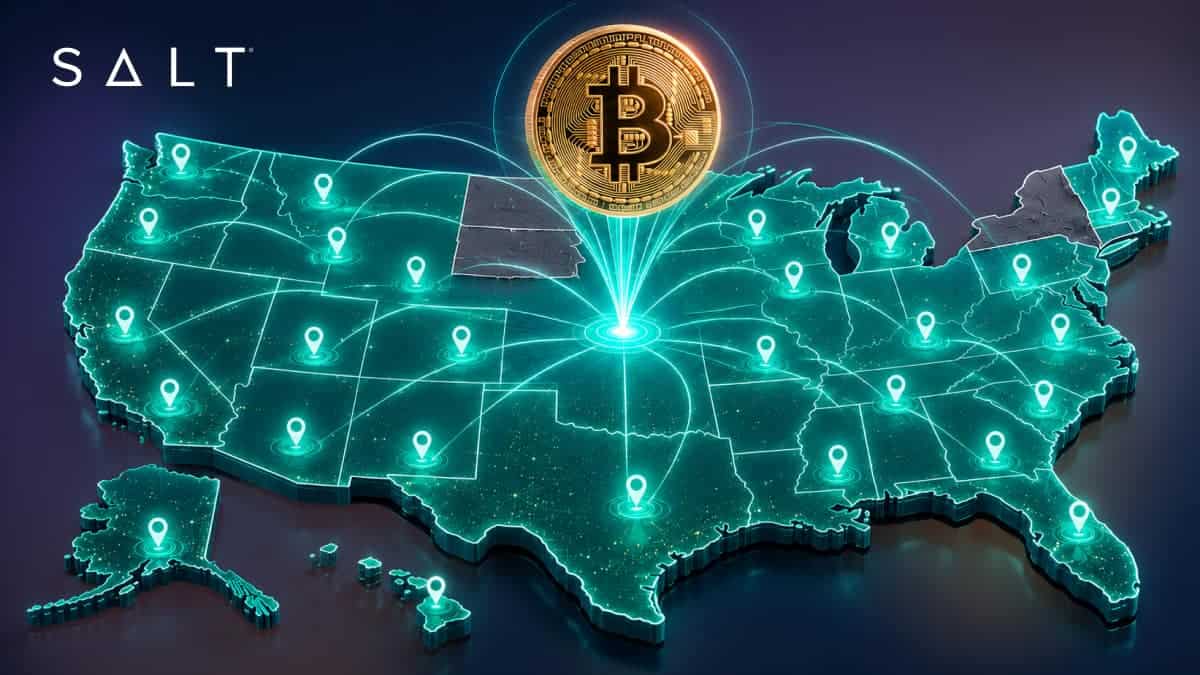
Availability is a licensing question, not a marketing one. SALT lends across most US states plus Canada, Puerto Rico, Brazil, Portugal, Switzerland, the United Kingdom, the United Arab Emirates, Viet Nam, Australia, New Zealand, and the Northern Mariana Islands. For the current list, check saltlending.com/map-list. If you want the state-level detail on why licensing shapes availability, see Can You Get a Bitcoin-Backed Loan in Your State?
If your jurisdiction is not listed, you can still open an account and submit a loan request to join the demand queue, which is how SALT prioritizes expansion.
Frequently Asked Questions
Do Bitcoin loans really require no credit check?
With SALT, yes. There is no credit check at any point in the application, so there is no hard inquiry and no impact on your credit score. The loan is underwritten on the crypto you pledge. Identity verification is still required, because it confirms who you are rather than evaluating your creditworthiness.
Can I get a Bitcoin loan with bad credit or no credit history?
Generally yes. Because approval is based on collateral rather than credit history, a low score, a thin file, a past bankruptcy, or no credit history at all does not disqualify you. What matters is holding eligible crypto and being in a jurisdiction where the lender is licensed.
How much can I borrow against my Bitcoin?
Your borrowing power is set by your collateral value and your chosen loan-to-value ratio. At up to 70% LTV, $100,000 of eligible collateral could support a loan of up to $70,000, though a lower LTV leaves more cushion against price declines. Model your own scenario with the loan calculator.
How fast can I get funded?
Once your account is open, your collateral is transferred, and the loan is approved, funding typically takes one to two business days. Timing can vary with collateral type, loan size, and jurisdiction.
Will a Bitcoin-backed loan show up on my credit report?
Typically not. Crypto-backed lenders are generally not furnishers of data to Equifax, Experian, or TransUnion, so the loan usually does not appear on your credit report. The tradeoff is that on-time payments normally will not help you build credit either.
Do I need to prove income or provide tax returns?
No. Income documentation, employment verification, and debt-to-income calculations are features of credit-based underwriting. Collateral-based underwriting looks at the assets you pledge instead.
What happens to my Bitcoin during the loan?
It is held by a qualified custodian for the life of the loan and returned to you when the balance is repaid. SALT does not rehypothecate collateral, meaning it is not lent out or used to generate returns for the lender.
Is a no credit check Bitcoin loan a taxable event?
Borrowing against Bitcoin is generally not a sale, so it typically does not trigger capital gains the way selling would. Liquidation of collateral, however, can create a taxable event. Tax treatment depends on your circumstances and jurisdiction, so consult a qualified tax professional.
What is the catch with no credit check crypto loans?
The catch is volatility. You are trading credit risk for price risk. If your collateral falls in value, you may need to add more or pay down the loan, and unresolved margin calls can lead to liquidation. Choosing a conservative LTV is the most direct way to manage that.
Borrow Against Your Bitcoin Without a Credit Check
SALT has been lending against Bitcoin since 2016, through multiple full market cycles, with no credit checks, no origination fees, and no rehypothecation of collateral. If you want to see what your holdings could support, run the numbers in the loan calculator or open an account and review the terms available for your situation. Opening an account takes about a minute and does not affect your credit.
Disclaimer
This content is for informational purposes only and does not constitute investment, financial, tax, or legal advice. SALT loans are originated by SALT Lending LLC (f/k/a SALT Master Fund II, LLC), NMLS 1711910. Loan terms may vary or may not be available in your jurisdiction, for your requested loan amount, and/or preferred collateral type. SALT loans are subject to jurisdictional limitations and other restrictions, and SALT does not offer loans to all prospective borrowers. For the current list of jurisdictions where SALT can lend, see saltlending.com/map-list. Available rates and terms are subject to change and may vary based on loan amount, qualifications, jurisdiction, and collateral profile. Rates from 7.49% APR are illustrative and not guaranteed. Borrowing against collateral entails risk and may not be appropriate for your needs. Digital currency is not legal tender, is not backed by the United States or any other government, and SALT accounts are not subject to FDIC or SIPC protections. Third-party cost figures for payday loans, title loans, pawn loans, and cash advances are illustrative market ranges and vary by lender and jurisdiction. Consult your financial, tax, or legal advisors before making borrowing decisions.