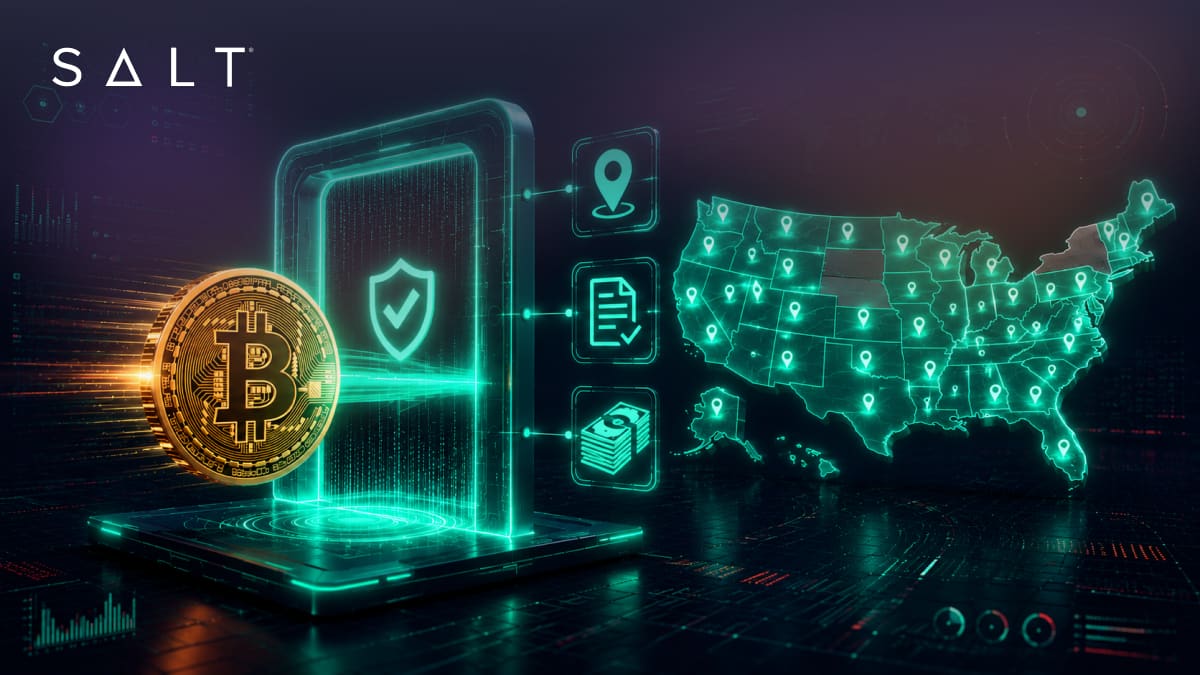

You can hold Bitcoin anywhere. Borrowing against it is a different question, because a crypto-backed loan is still a loan, and lending is regulated locally. A lender that can fund a borrower in Texas on Monday may not be able to fund an identical borrower in a neighboring state on Tuesday. That has nothing to do with your collateral, your credit, or how much you want to borrow. It has to do with where you live.
This guide explains why crypto loan availability varies by jurisdiction, what a state lending license actually means for you as a borrower, where SALT lends today, and how to confirm your own eligibility in about a minute.
The Short Answer
- SALT currently lends in 47 US states plus the District of Columbia and Puerto Rico. The current list is maintained on the Where We Lend page.
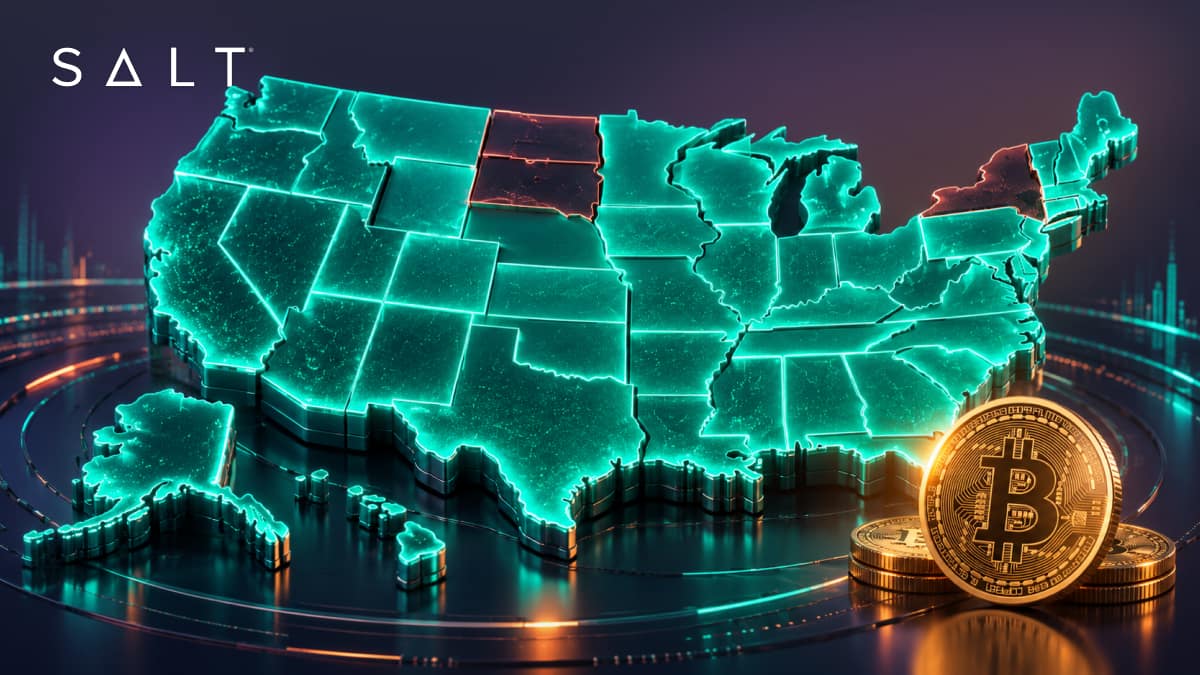
- As of publication, the three US states not on that list are New York, North Dakota, and South Dakota.
- Availability and licensing are two different things. A lender does not need a consumer lending license in every state where it lends, because not every state licenses this type of loan.
- Outside the United States, availability is jurisdiction by jurisdiction rather than region by region, and some jurisdictions are approved for business lending only.
- Jurisdiction lists change. Always confirm against saltlending.com/map-list before you plan around a loan.
Why Crypto Loan Availability Varies By State
In the United States there is no single national consumer lending license. Lending to consumers is regulated primarily at the state level, and each state decides for itself which loans require a license, what those licenses cost, what rate caps apply, what disclosures a borrower must receive, and how the lender is examined.
A crypto-backed loan sits on top of that framework and adds a second layer. The loan itself is regulated as consumer or commercial credit. The collateral, because it is a digital asset, may separately touch state virtual currency rules covering custody and transmission. A lender has to satisfy both layers in every state where it operates, and the two layers do not line up neatly.
That is the whole explanation for the map. Availability is not a measure of how much a lender wants your business. It is the intersection of two sets of state rules, one governing the credit and one governing the asset.
New York is the clearest example of the second layer in action. The state operates its own virtual currency licensing framework under 23 NYCRR Part 200, commonly called the BitLicense, which requires state authorization for virtual currency business activity involving New York residents. Fewer than two dozen BitLicenses were issued in the framework’s first six years, which is why so many digital asset companies, not just lenders, exclude New York while they operate everywhere else.
What A State Lending License Actually Means For You
When a lender holds a license in your state, a regulator there has reviewed the business, and that regulator has authority over how the lender treats you. In practice that gives you four things worth knowing about.
- A named regulator. There is a specific state agency you can contact about a complaint, and it is required to be disclosed to you.
- Examination. Licensed lenders are subject to periodic review of their books, disclosures, and servicing practices.
- Rate and fee rules. Many state licensing frameworks carry caps or restrictions that apply to your loan regardless of what the lender would otherwise charge.
- A public record you can check yourself. Most consumer lending licenses are recorded in the Nationwide Multistate Licensing System.
SALT loans are originated by SALT Lending LLC under NMLS ID 1711910, and you can look that up independently through NMLS Consumer Access. The full list of SALT’s state licenses and registrations, including the license type held in each state, is published on the Licenses page. Doing this check on any crypto lender you are considering takes two minutes and is the single fastest way to separate a regulated lender from an offshore one.
License types vary in name from state to state even when they do much the same work. Here is what the common ones mean.
| License Type | What It Generally Authorizes |
|---|---|
| Consumer lender or consumer finance lender | Making loans to individuals for personal, family, or household purposes |
| Supervised lender | Consumer lending above a state rate threshold, with ongoing regulator supervision |
| Consumer installment lender | Loans repaid in scheduled installments rather than a single balloon payment |
| Regulated lender or regulatory loan license | Consumer lending under a state statute with defined rate and fee limits |
| Money lender | Lending money in the jurisdiction, used in the District of Columbia and some states |
| Consumer credit notification or registration | A filing rather than a license, used where the state requires notice instead of approval |
Why A Lender Can Be Licensed In 25 States But Lend In 47 Plus DC
This trips people up, so it is worth stating plainly. SALT holds consumer lending licenses or registrations in 25 states plus the District of Columbia, and lends in 47 states plus the District of Columbia and Puerto Rico. Holding licenses in roughly half the states while lending in nearly all of them is normal and legal, for three reasons.
First, some states do not license this activity at all. If a state has no licensing framework that covers the loan type, there is no license to hold.
Second, many state frameworks exempt loans above a certain size. Consumer lending statutes were written to protect small borrowers, so a state may license lending under twenty five thousand dollars and leave larger loans outside the licensing framework entirely.
Third, commercial and business purpose loans are frequently exempt from consumer licensing. A loan to an operating company or a fund is usually governed by a different set of rules than a loan to an individual.
The practical takeaway is that you should not read the Licenses page as the availability list, or the Where We Lend page as the licensing list. They answer different questions. Availability tells you whether you can apply. Licensing tells you which regulator is watching.
Where Salt Lends In The United States
As of publication, SALT lends in the following 47 states plus the District of Columbia. Puerto Rico is also covered. This list is current as of the publication date of this post and the authoritative version lives on the Where We Lend page.
| Alabama | Alaska | Arizona | Arkansas |
| California | Colorado | Connecticut | Delaware |
| District of Columbia | Florida | Georgia | Hawaii |
| Idaho | Illinois | Indiana | Iowa |
| Kansas | Kentucky | Louisiana | Maine |
| Maryland | Massachusetts | Michigan | Minnesota |
| Mississippi | Missouri | Montana | Nebraska |
| Nevada | New Hampshire | New Jersey | New Mexico |
| North Carolina | Ohio | Oklahoma | Oregon |
| Pennsylvania | Rhode Island | South Carolina | Tennessee |
| Texas | Utah | Vermont | Virginia |
| Washington | West Virginia | Wisconsin | Wyoming |
Not currently listed: New York, North Dakota, and South Dakota. If you live in one of those three states, you cannot open a SALT loan today, and any lender telling you otherwise is worth a second look.
Where Salt Lends Outside The United States
International availability is jurisdiction specific rather than regional. Being in Europe does not mean you are eligible, and neither does being outside the United States. The current list includes:
- North America: Canada and Puerto Rico
- South America: Brazil
- Europe: Portugal, Switzerland, and the United Kingdom
- Asia: United Arab Emirates and Viet Nam
- Oceania: Australia, New Zealand, and the Northern Mariana Islands
Some jurisdictions are approved for business lending only rather than both personal and business lending. The Where We Lend page marks which is which, so check it against your own situation before you plan around a personal loan.
Ineligible Jurisdictions, And Why That List Exists
Separate from the countries where SALT lends, there is a published list of ineligible jurisdictions where SALT cannot provide services. These exclusions are driven by sanctions programs, anti money laundering requirements, and jurisdictional risk assessments rather than by commercial preference.
This is a compliance obligation for every regulated financial institution, not a crypto specific quirk. It is also not something a borrower can work around. Eligibility is determined by where you are legally resident or, for a business loan, where your entity is domiciled. Applying from a jurisdiction on the excluded list, or misrepresenting your residency to get around it, will surface during identity verification and puts you in breach of the loan agreement.
How To Check Whether You Can Borrow, In Three Steps
- Check the map. Open the Where We Lend page and find your state or country. If it is listed, you can apply.
- Check the license. Look at the Licenses page to see whether SALT holds a license in your state and what type it is, then verify it independently through NMLS Consumer Access. Do this for any lender you are comparing.
- If your jurisdiction is not listed, get in the queue. Create a free account, go to BORROW on the marketplace, and submit a loan request through the calculator. That puts you in the loan demand queue, which is how new jurisdictions get prioritized, and you will be notified if lending opens where you live.
Step three matters more than it sounds. Expansion decisions are driven by documented demand, so a submitted request from an unavailable state is a vote rather than a dead end.
Does Your State Affect Your Rate Or Your Terms?
It can. Rate caps, permitted fees, required disclosures, and minimum or maximum loan sizes are all set at the state level, so two borrowers with identical collateral and identical loan requests can receive different terms based purely on where they live. SALT’s rates and fees are published, and pricing is flat across loan sizes, but the terms available to you are still subject to your jurisdiction, your loan amount, and your collateral profile.
If you want to see what a loan would look like before you apply, the loan calculator will give you a payment estimate, and the margin event calculator will show you where your collateral would come under pressure. Neither depends on your state, but the offer you ultimately receive does.
What Federal Legislation Would And Would Not Change
Market structure legislation has been moving through Congress for more than a year without becoming law. The Digital Asset Market Clarity Act passed the House in July 2025 and cleared the Senate Banking Committee in May 2026, and the Senate adjourned in August 2026 without a floor vote, leaving a procedural vote as the next step when it returns. Separately, federal regulators have continued to act on their own, including a joint classification in March 2026 that named a set of digital assets as commodities outside securities laws.
For a borrower, the important nuance is that none of this would replace state lending law. Federal market structure legislation would clarify which regulator oversees which digital assets, which matters a great deal for exchanges and token issuers. It would not create a national consumer lending license. Whether you can borrow against Bitcoin where you live would still depend on your state, which is why the map is the thing to watch rather than the headlines.
Frequently Asked Questions
How many states can you get a SALT loan in?
As of publication, 47 states plus the District of Columbia and Puerto Rico. The three states not currently included are New York, North Dakota, and South Dakota. The current list is on the Where We Lend page.
Are crypto-backed loans legal in the United States?
Yes. Lending against digital assets is legal in the United States and is regulated primarily under existing state lending law, layered with state virtual currency rules and federal anti money laundering requirements. What varies is which lenders are authorized to operate in which states, not whether the product itself is permitted.
Does the lender need a license in my state for my loan to be valid?
Not necessarily. Some states do not license this type of loan, and others exempt loans above a certain size or loans made for business purposes. A lender operating without a license in a state that does not require one is compliant. What should concern you is a lender operating in a state that does require a license without holding one.
What if my state or country is not on the list?
Submit a loan request anyway. Create a free account, go to BORROW on the marketplace, and complete the calculator. That adds you to the loan demand queue, which is how expansion gets prioritized, and you will be notified if lending becomes available where you live.
Can I use an LLC in an eligible state to borrow if my home state is not eligible?
Business loans are evaluated on where the entity is legally domiciled and who controls it, and beneficial ownership is verified during onboarding. Forming an entity elsewhere for the sole purpose of routing around a jurisdiction restriction is not a workaround, and misrepresenting residency or control puts you in breach of the loan agreement. If you have a genuine operating business in an eligible jurisdiction, that is a different conversation worth having with the team.
What happens to my loan if I move to a state where SALT does not lend?
An existing loan continues under the terms you agreed to. Moving does not void a loan already in place. It may affect your ability to originate a new loan or refinance later, so if a move is coming and you are planning around further borrowing, raise it with support before you need it rather than after.
Can I borrow against Bitcoin if I live outside the United States?
In some jurisdictions, yes. The current international list covers Canada, Brazil, Portugal, Switzerland, the United Kingdom, the United Arab Emirates, Viet Nam, Australia, New Zealand, and the Northern Mariana Islands, and some of those are approved for business lending only. There is also a published list of ineligible jurisdictions where services cannot be provided at all.
How do I verify a crypto lender is licensed?
Ask for the legal entity name and NMLS ID, then look it up on NMLS Consumer Access. SALT loans are originated by SALT Lending LLC, NMLS 1711910. A lender that cannot give you an entity name and a license or registration number to check is telling you something.
Check Your Jurisdiction Before You Plan Around A Loan
Availability is the first gate, not the last one, and it takes a minute to clear. Find your state or country on the Where We Lend page, confirm the licensing on the Licenses page, and if you are eligible, open a free SALT account to see real terms against your own collateral. If you are not eligible yet, submit a request anyway and get counted.
Disclaimer: This post is for informational purposes only and is not legal, tax, or financial advice. It describes general regulatory concepts and does not constitute an interpretation of the law in any jurisdiction. SALT loans are subject to jurisdictional limitations and other restrictions, and loan terms may vary or may not be available in your jurisdiction, for your requested loan amount, or for your preferred collateral type. Jurisdiction lists change. For the current list of jurisdictions where SALT lends, see saltlending.com/map-list. For excluded jurisdictions, see saltlending.com/ineligible-jurisdictions. For current state licenses and registrations, see saltlending.com/salt-lending-licenses. Borrowing against collateral entails risk and may not be appropriate for your needs. Rates are subject to change. Digital currency is not legal tender, is not backed by the United States or any other government, and SALT accounts are not subject to FDIC or SIPC protections. Loans are originated by SALT Lending LLC, NMLS 1711910.