
Every crypto-backed lender has to answer the same question. What happens when the market falls far enough that a loan is no longer adequately collateralized? For most lenders the answer is liquidation, meaning your collateral gets sold, usually at the worst possible moment, and you lose both the asset and any upside from the recovery that follows.
SALT built Stabilization as a different answer. Instead of selling your collateral into a falling market, Stabilization converts it to a US dollar stablecoin, preserving the dollar value it had at the moment of conversion and giving you a defined path back into your original position. This post walks through exactly how it works, what triggers it, and what your options are once it happens.
What Stabilization Actually Does
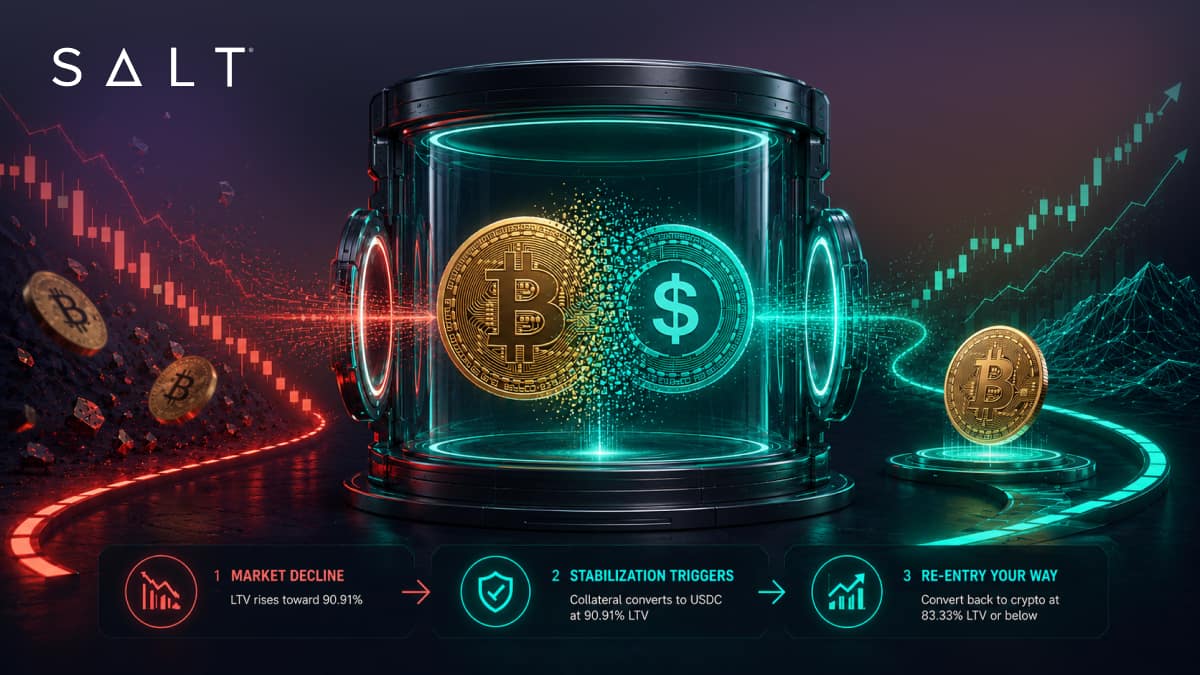
Stabilization is a proprietary feature that automatically converts your crypto collateral into USDC when your loan-to-value ratio crosses a defined threshold during a market decline.
The important distinction is between preserving value and losing the asset. A traditional liquidation ends your position permanently. Stabilization holds the dollar value of your collateral in a stable asset while your loan stays open, so you keep the ability to convert back into your original crypto mix when you choose to.
The Problem Stabilization Solves
Bitcoin trades continuously, which means declines do not pause overnight or over a weekend. What tends to happen during a serious drawdown is a slow grind lower followed by a sharp drop during a period of thin liquidity. Automated liquidation engines fire during exactly that window, which is why forced sales so often land near a local bottom.
The cost is not just the collateral. It is the recovery you no longer participate in, plus a disposal you did not choose to make. Based on three years of market data, SALT’s own modeling puts the likelihood of a liquidation over a one year loan term at:
- 67 percent at a 70 percent LTV
- 49 percent at a 50 percent LTV
- 8 percent at a 30 percent LTV
Those estimates are based on historical averages, and individual results vary based on collateral type, loan terms, and how actively a borrower manages the loan. The pattern they illustrate is the point. The higher your starting LTV, the more likely a normal market cycle is to force a decision you did not want to make.
How Stabilization Works Step by Step
The Trigger
If the market declines and your loan-to-value ratio reaches 90.91 percent, Stabilization automatically converts your portfolio to USDC, locking in its value at that point. That threshold corresponds to collateral worth roughly 110 percent of your outstanding loan balance, which is the cushion the feature is designed to preserve rather than exhaust.
The Hold
Once converted, your collateral sits in a stable asset. Further declines in the crypto market no longer push your LTV higher, because the collateral is no longer moving with the market. Your loan remains open and your payment obligations continue as normal. What changes is that the clock pressure is gone.
The Re-Entry
To convert back into your chosen crypto portfolio, you bring your LTV down to 83.33 percent or below, either through a payment against the principal or by depositing additional collateral. That threshold corresponds to collateral worth roughly 120 percent of your loan balance. Once you are at or below it, the timing of the swap back is yours to choose.
Re-entry is subject to market values at the time of the transaction, and transaction fees apply.
Why Timing Control Matters
This is the part that separates Stabilization from a delayed liquidation. Because your collateral value was preserved in dollars at the conversion point, and because you choose when to swap back, the amount of crypto you re-enter with depends on where the market is when you decide to act.
If you re-enter while prices are still depressed, the same dollar value buys more of the underlying asset than you pledged originally. That is not a guaranteed outcome, and markets can continue falling after you convert back, which is a real risk worth naming. But it is a fundamentally different position from having your collateral sold and the relationship ended.
Stabilization Compared to Other Protections
Stabilization is not the same thing as SALT Shield®, and borrowers sometimes conflate them. Stabilization is a conversion mechanism that responds to a market decline by moving collateral into a stable asset. SALT Shield® is an optional overcollateralization buffer that a borrower activates for a one time fee at the outset, designed to protect against margin calls and forced liquidations for the loan term.
They address the same underlying anxiety from different directions. It is also worth understanding both in the context of ordinary loan management, since the simplest protection remains choosing a conservative initial LTV. Our guide on how much you can borrow against your bitcoin covers that tradeoff.
Who Should Pay Attention to This
Stabilization matters most to borrowers who are holding crypto for the long term and using a loan for liquidity rather than leverage. If your intention is to still own your bitcoin in five years, the worst outcome is not a margin call. It is a forced sale that permanently removes you from the position you were trying to keep.
It also matters to borrowers who took a higher initial LTV to access more cash. The liquidation probability figures above show how sharply risk scales with LTV, and Stabilization is the mechanism that keeps a higher LTV loan from becoming an all or nothing bet on short term price action. If you are weighing a loan against selling outright, our post on borrowing versus selling bitcoin works through the comparison.
Frequently Asked Questions
At what LTV does Stabilization trigger?
Stabilization activates automatically when your loan-to-value ratio reaches 90.91 percent during a market decline. At that point your crypto collateral is converted to USDC and its dollar value at conversion is locked in.
How do I get back into my original crypto?
You bring your LTV to 83.33 percent or below, either by making a payment toward your principal or by depositing additional collateral. Once you are at or under that threshold, you can swap back into your chosen portfolio at a time you select. Re-entry is subject to market values at the time of the transaction, and transaction fees apply.
Is Stabilization the same as being liquidated?
No. A liquidation sells your collateral to satisfy the loan and ends your position. Stabilization converts your collateral into a stable asset while your loan stays open, and it preserves a defined path back into your original crypto mix. The purpose is to keep a market decline from permanently ending your position.
Does a Stabilization conversion create a tax obligation?
Converting one digital asset into another can have tax consequences depending on your jurisdiction and your individual circumstances, so this is a question for your tax advisor rather than a general rule. Related reading on the tax side is available in our post on bitcoin loan interest deductibility.
Are there fees associated with Stabilization?
Transaction fees apply to conversions, and amounts are subject to market values at the time of the transaction. Current fee details are listed on the SALT rates and fees page.
What is the difference between Stabilization and SALT Shield®?
Stabilization responds to a decline by converting collateral into USDC to preserve its value. SALT Shield® is an optional feature a borrower activates up front for a one time fee, structured as an overcollateralization buffer that protects against margin calls and forced liquidations for the loan term. One is a response mechanism and the other is a prepurchased protection.
Is Stabilization available in every jurisdiction?
Loan terms and features may vary or may not be available in your jurisdiction, for your requested loan amount, or for your preferred collateral type. You can check current availability on the SALT jurisdiction map.
See How It Applies to Your Loan
The practical starting point is knowing where your LTV sits and how much room it gives you. Use the SALT bitcoin loan calculator to model borrowing amounts at different LTVs, or the margin event calculator to see what price movement would move you toward the Stabilization threshold. If you have questions about how the feature applies to an existing loan, our loan managers can walk you through it.
Disclaimer
This content is provided for informational and educational purposes only and does not constitute financial, investment, tax, or legal advice. Descriptions of product features are summaries and are qualified in full by your loan agreement. Borrowing against collateral involves risk and may not be appropriate for your needs. Rates, fees, and product terms are subject to change. Conversions are subject to market values at the time of the transaction and transaction fees apply. Loan terms may vary or may not be available in your jurisdiction, for your requested loan amount, and/or preferred collateral type. SALT loans are subject to jurisdictional limitations and other restrictions, and SALT does not offer loans to all prospective borrowers. For current availability, see saltlending.com/map-list. Liquidation probability estimates referenced above are based on historical averages over a three year period, and individual results vary based on collateral type, loan terms, borrower maintenance, and other factors. Digital currency is not legal tender, is not backed by the United States or any other government, and SALT accounts are not subject to FDIC or SIPC protections. SALT loans are originated by SALT Lending LLC (f/k/a SALT Master Fund II, LLC), NMLS 1711910.