
If you need cash and plan to own your Bitcoin again later, you have two main options. You can sell now and buy back later, or you can borrow against your Bitcoin and keep it the whole time.
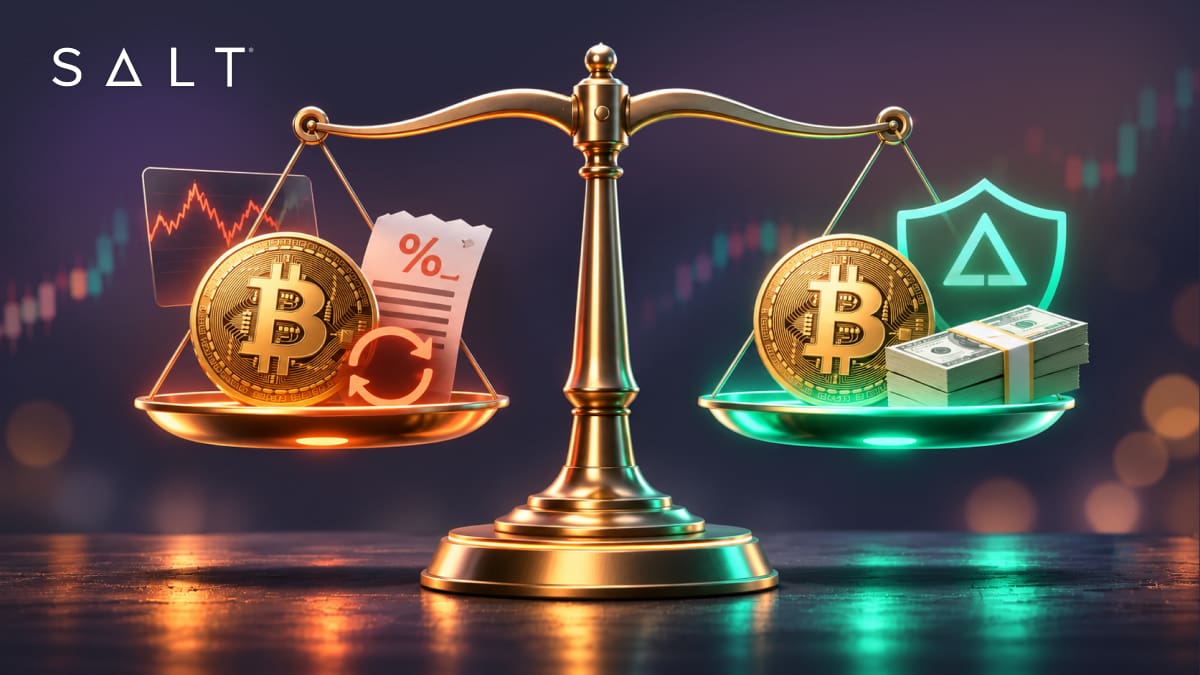
The short answer: selling and rebuying usually costs more than people expect. The sale can create a capital gains tax bill right away. It also resets your holding period, and you are betting that Bitcoin will be cheaper when you buy back. A Bitcoin-backed loan replaces those unknowns with a fixed interest cost, but it adds margin call risk and a balance you must repay. In our example below, selling and rebuying only comes out ahead if Bitcoin falls during the time you are out of the market.
This guide covers the real costs of each path, a worked example with break-even math, and how to decide which one fits your situation.
What “Sell and Rebuy” Really Means
Selling and rebuying sounds simple. You sell some Bitcoin, use the cash, then buy the same amount back when you have money again or when the price looks right. In practice, the plan has three separate costs that are easy to overlook:
- The tax on the sale. In the U.S., the IRS treats Bitcoin as property. Selling it for more than you paid is a taxable event, and you owe capital gains tax on the profit.
- The rebuy price. Nobody knows where Bitcoin will trade in six or twelve months. If the price rises while you are out, you get back less Bitcoin for the same dollars.
- The reset clock. When you buy back, your cost basis and your holding period start over. Bitcoin you had held for years becomes Bitcoin you have held for one day.
Trading fees and spreads add a little more on each side of the trade.
What a Bitcoin-Backed Loan Does Instead
A Bitcoin-backed loan lets you pledge your Bitcoin as collateral and receive cash, without selling. You keep ownership of the Bitcoin, and it is returned to you when you repay the loan. If you want a full walkthrough of the mechanics, see Bitcoin-Backed Loans Explained.
With SALT, published pricing is the same at every loan size. As of this writing, a 1-year loan at 50% loan-to-value (LTV) carries an 8.75% APR, with no origination fee on new loans and no prepayment penalty. You can find the full rate table in our flat-rate pricing announcement.
The tradeoff is risk of a different kind. If Bitcoin falls far enough, your LTV rises and you may face a margin call. That means you would need to add collateral or pay down the balance. Our guide to margin calls on crypto-backed loans explains how that works.
Side-by-Side Comparison
| Factor | Sell and Rebuy Later | Bitcoin-Backed Loan |
|---|---|---|
| Taxable event today | Yes, if you sell at a gain | Generally no; borrowing is not a sale |
| Upfront cost | Capital gains tax plus trading fees | No origination fee on new SALT loans |
| Ongoing cost | None while you are out of the market | Interest at a fixed APR |
| Exposure to Bitcoin price | None until you rebuy | Full; you still own the Bitcoin |
| Biggest risk | Bitcoin rises before you buy back | Bitcoin falls enough to trigger a margin call |
| Holding period | Resets when you rebuy | Unchanged |
| Cost basis | Resets to the rebuy price | Unchanged; the tax is deferred, not erased |
How Much Tax Does Selling Bitcoin Trigger?
How much you owe depends on how long you have held the Bitcoin and on your income.
- Held one year or less: short-term capital gains, taxed at your ordinary income rate, which runs up to 37%.
- Held more than one year: long-term capital gains, taxed at 0%, 15%, or 20%.
For the 2026 tax year, the 0% long-term rate applies to taxable income up to $49,450 for single filers and $98,900 for married couples filing jointly. The 20% rate begins above $545,500 for single filers and $613,700 for joint filers. Higher earners may also owe the 3.8% net investment income tax, and most states add their own income tax on top.
Long-term holders with a low cost basis usually feel this the most. Their gain is a large share of the sale price, so a large share of every dollar they sell is taxable.
Does the Wash Sale Rule Apply to Bitcoin?
Not under current law. The wash sale rule blocks you from claiming a loss on a security if you buy it back within 30 days. Because the IRS treats Bitcoin as property rather than a security, the rule has not applied to it. Congress has considered proposals to extend it to digital assets, but as of this writing none has been enacted.
This matters less than people think for sell-and-rebuy decisions. The wash sale rule only affects losses. If you are selling Bitcoin at a gain to raise cash, you owe tax on that gain whether or not you rebuy. If you want to sell at a loss on purpose to lower your tax bill, see our guide to crypto tax-loss harvesting.
Worked Example: $100,000 of Cash Needed for One Year
Here is a simplified example that compares the two paths directly. These figures are illustrative only.
The setup:
- You own 3 BTC. Bitcoin trades at $100,000.
- Your cost basis is $30,000 per BTC, so 70% of any sale price is taxable gain.
- You have held it more than a year and pay the 15% long-term federal rate. We leave out state tax, the net investment income tax, and trading fees to keep the math clear.
- You need $100,000 in cash now. You expect to have the money to restore your position in 12 months.
Path A: Sell and rebuy. To net $100,000 after federal tax, you would need to sell about 1.117 BTC for about $111,732. About $11,732 of that goes to federal capital gains tax. In 12 months, you buy back 1.117 BTC at whatever the price is then.
Path B: Borrow. You pledge 2 BTC ($200,000) as collateral and borrow $100,000 at 50% LTV and 8.75% APR for one year. Assuming the full balance is outstanding for the year, interest comes to about $8,750, so you repay about $108,750. You keep all 3 BTC throughout and keep 1 BTC unpledged as a buffer.
Both paths give you $100,000 today and leave you holding 3 BTC in a year. The only question is which one costs less to get there:
| BTC Price in 12 Months | Cost to Rebuy 1.117 BTC (Path A) | Cost to Repay Loan (Path B) | Lower-Cost Path |
|---|---|---|---|
| $70,000 (down 30%) | $78,212 | $108,750 | Sell and rebuy, by about $30,500 |
| $90,000 (down 10%) | $100,559 | $108,750 | Sell and rebuy, by about $8,200 |
| $100,000 (flat) | $111,732 | $108,750 | Loan, by about $3,000 |
| $110,000 (up 10%) | $122,905 | $108,750 | Loan, by about $14,200 |
| $130,000 (up 30%) | $145,251 | $108,750 | Loan, by about $36,500 |
The break-even point: in this example, selling and rebuying only wins if Bitcoin falls below about $97,330, a drop of roughly 2.7%, during the year. If Bitcoin is flat or higher, the loan costs less.
If the Bitcoin had been held for less than a year and taxed at a 24% ordinary rate, you would need to sell about 1.2 BTC and pay about $20,200 in tax. The break-even price drops to roughly $90,480. Bitcoin would need to fall about 9.5% for selling to win.
The Fine Print on Both Sides
The table above is only part of the picture. A few factors push the decision one way or the other:
- The loan defers tax; it does not erase it. Under Path B you keep your original $30,000 cost basis. If you sell that Bitcoin someday, the gain is still taxed. Under Path A, your rebuy resets your basis higher, which lowers the tax on a future sale. If you never plan to sell, this matters less.
- A sharp drop affects the loan too. In the down 30% row, 2 BTC of collateral would be worth $140,000 against a $100,000 balance, pushing LTV above 70%. That could trigger a margin call. Keeping unpledged Bitcoin in reserve, like the third BTC in our example, or borrowing at a lower LTV gives you room to respond.
- Interest may be deductible. Depending on how you use the loan proceeds, some interest may be deductible. See Are Bitcoin Loan Interest Payments Tax Deductible? for more.
- Plans to rebuy often slip. Many sellers intend to buy back on a dip and then watch the price climb instead. A loan removes the timing decision because you never leave the market.
- Early repayment changes the math. With no prepayment penalty, paying the loan off in six months instead of twelve cuts interest roughly in half and lowers the break-even price further.
When Selling and Rebuying Can Make Sense
Borrowing is not always the better choice. Selling may fit better if:
- Your Bitcoin is near or below your cost basis, so selling creates little or no tax.
- Your income puts you in the 0% long-term capital gains bracket for the year.
- You have a strong, specific reason to expect lower prices and are comfortable being wrong.
- You do not have a clear plan to repay a loan by the end of the term.
- You do not want to monitor LTV or respond to a possible margin call.
When a Bitcoin-Backed Loan Usually Wins
- You have a large unrealized gain and a long holding period you want to keep.
- You fully intend to keep or rebuy the same amount of Bitcoin.
- You need the cash for a defined period and have a plan to repay it.
- You want to stay exposed to Bitcoin’s upside while you use the cash.
- You can keep a collateral buffer or choose a conservative LTV.
To see how much you could access with your holdings, read How Much Can You Borrow Against Your Bitcoin? or compare the full tax picture in our post on borrowing vs. selling Bitcoin.
Frequently Asked Questions
Is it better to sell Bitcoin or borrow against it?
If you plan to own the same Bitcoin again later, borrowing usually costs less unless Bitcoin falls during the time you would have been out of the market. Selling triggers capital gains tax right away and exposes you to a higher rebuy price. Borrowing costs interest and carries margin call risk.
Is taking a loan against Bitcoin a taxable event?
Generally, no. Borrowing against Bitcoin is not a sale, so it does not typically trigger capital gains tax. If your collateral is ever sold to cover a margin call or a default, that sale can be taxable. Confirm your situation with a tax professional.
Does buying Bitcoin back reset my holding period?
Yes. Rebuying starts a new holding period and sets a new cost basis at the rebuy price. If you sell the new coins within one year, any gain is short-term and taxed at ordinary income rates.
Can I sell Bitcoin and buy it back immediately?
Under current U.S. law, the wash sale rule does not apply to Bitcoin, so rebuying right away does not disallow a loss. If you sell at a gain, however, you still owe tax on that gain no matter when you rebuy.
What happens to my Bitcoin loan if the price drops?
As Bitcoin’s price falls, your LTV rises. If it crosses the threshold in your loan agreement, you may receive a margin call asking you to add collateral or pay down the balance. If the margin call is not met, some collateral may be sold.
How fast can I get funds from a Bitcoin-backed loan?
SALT loans typically fund within 24 to 48 hours after approval, depending on verification and jurisdiction.
Can I repay a SALT loan early?
Yes. SALT does not charge a prepayment penalty, so you can repay early and pay less in total interest.
The Bottom Line
Selling and rebuying Bitcoin bundles a tax bill, a reset holding period, and a bet on future prices into one decision. A Bitcoin-backed loan keeps your position in place and swaps those unknowns for a known interest cost and a margin call risk you can manage with a conservative LTV. If your long-term plan is to keep holding Bitcoin, run the numbers for your own cost basis and tax bracket before you sell.
Ready to see your options? Explore SALT Bitcoin-backed loans.
Disclosures
This article is for educational purposes only and is not financial, investment, legal, or tax advice. Tax treatment depends on your individual circumstances and may change. Consult a qualified tax professional before making decisions.
All examples are hypothetical and for illustration only. They exclude state taxes, the net investment income tax, trading fees, and other costs, and they do not predict the future price of Bitcoin or any outcome.
Rates and terms shown are as of the date of publication, are subject to change, and may not reflect current offerings. Origination or administrative fees may apply to refinances or in certain jurisdictions. Loan minimums and maximums vary by jurisdiction and are confirmed at application. SALT does not offer loans to all prospective borrowers.
Loans are available only in eligible jurisdictions. For a current list of where SALT lends, visit saltlending.com/map-list.
Bitcoin-backed loans carry risk. If the value of your collateral declines, you may be required to add collateral or repay part of your loan, and your collateral may be sold. Digital currency is not legal tender, and SALT accounts are not subject to FDIC or SIPC protections. Loans are originated by SALT Lending LLC, NMLS #1711910.