
Bitcoin spent the final week of July 2026 doing the one thing almost nobody enjoys watching: very little. Price hovered around $64,000, the Crypto Fear and Greed Index sat at 28, and spot Bitcoin ETFs snapped a seven-session inflow streak with roughly $225 million in net outflows on July 24.
Looking at a chart alone, that reads as stagnation. I read it differently. I keep coming back to the same phrase to describe this market: we are in a really bullish bear market, one where the fundamentals keep strengthening while the price refuses to cooperate.
I have spent more than three decades in financial services, much of it in deeply technical areas of software, and I am still learning something new about this asset class all the time. I do not think anyone holds both the full technical picture of Bitcoin and the full macroeconomic picture driving its price. So take what follows as my working view rather than a forecast, and come to your own conclusions.
Every Friday I join Mr. M on The Bitcoin Global Show to zoom out on Bitcoin: institutional adoption, regulatory shifts, mining fundamentals, and what all of it means for long-term holders. This is roughly where I landed on the most recent episode.
My Base Case: Choppy and Sideways for Several More Months
My expectation is for things to continue to be choppy and to move predominantly sideways over the next several months. That is not a statement about waning interest in Bitcoin. It is a statement about how many unresolved milestones are stacked into a short window.
What the market is waiting on:
- Escalation or resolution in the Middle East conflict, which feeds straight into oil prices, inflation expectations, and appetite for risk assets. It feels like more countries keep getting pulled in, which only adds to the anxiousness about when and how this ends.
- The path of US interest rates, plus second-half decisions around refinancing US debt
- The November midterm elections and what they mean for the digital asset legislation still in play
It is this uncertainty about what happens with the next milestone that is causing people to sit on the sidelines. In my conversations with people across different markets, the posture is the same: wait until there is more clarity on the war, wait until there is more clarity on the election. That keeps capital parked until there are more definitive answers about which way things move.
Headwinds and Tailwinds in the Same Week
There have been both headwinds and tailwinds lately. It has really been a mixed bag.
Working against price: ETF flows turned negative after a positive stretch, sentiment retracted from neutral into fear, oil climbed on renewed US and Iran tension, and the 10-year Treasury yield pushed higher. Working in its favor: Bitcoin still closed July up roughly 10 percent, recovering ground lost during a punishing May and June, and the institutional infrastructure around the asset kept expanding.
My read is not that one side wins. It is that a market absorbing conflicting signals of roughly equal weight tends to go nowhere in particular. Much of the current chop is simply a reflection of broad uncertainty.
The Fed Held Rates, but Three Dissents Matter More
On July 29, the Federal Open Market Committee voted 9 to 3 to hold the federal funds rate at 3.5 to 3.75 percent. I do not think anyone expected otherwise. The part worth attention was the opposition.
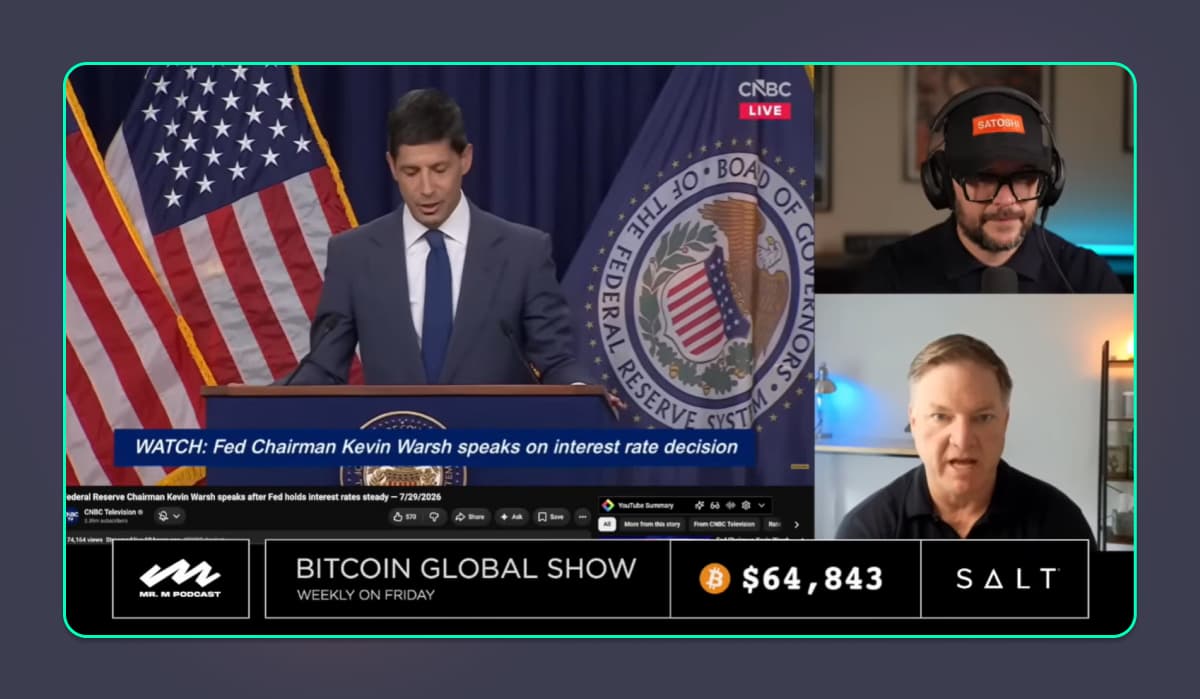
Cleveland’s Beth Hammack, Minneapolis’s Neel Kashkari, and Dallas’s Lorie Logan each dissented in favor of a quarter-point hike. Inflation has now run above the Fed’s 2 percent target for more than five years. To me, three votes to raise is an indication that an increase becomes more likely when the committee next meets.
That tracks with what I see underneath the numbers. Inflation is harder to keep steady, let alone bring down, when spending on conflicts increases and the global economy struggles. Layer in the debt refinancing decisions and milestones coming in the second half of the year, and rate policy stops being settled and becomes a live variable again.
Here is why that matters for Bitcoin specifically. This macro backdrop will continue to show us how people are thinking about Bitcoin in the context of their other investments: as a hedge against inflation, or as diversification away from the US dollar. Those questions get answered in environments like this one, not in easy ones.
For anyone tracking catalysts, the next FOMC decision lands September 16, and Fed Chair Kevin Warsh speaks at Jackson Hole from August 27 to 29.
Why August Deserves Respect, Not Obedience
Mr. M pulled up the monthly return data on the show, and it does lean one way. Going back to 2013, August has closed red in 9 of 13 years. The average August return sits near negative 3 percent, and the median is closer to negative 7.5 percent. October and November are historically Bitcoin’s two strongest months by a wide margin.
Some people put real weight behind these patterns and are explicitly waiting for a seasonal trough, which has historically tended to form somewhere between October and mid-November. Others do not care at all. I would not treat any of it as a recommendation, and I am not making one here.
What I would say is that seasonality is a probability, not a schedule. Roughly one August in four has still closed higher, and August 2013 delivered one of the strongest months in Bitcoin’s history. There is a basket of variables people are weighing right now, and the calendar is only one of them.
Markets Reward Predictability
If I had to compress my view into one idea, it would be this: markets generally reward predictability, whether that is predictability of decision making, of value, or of execution.
The US dollar is the clearest example. In many respects it has been valued for so long because of confidence in the way the dollar gets managed and the way the US government is both elected and run. Some of that is now being questioned, and that creates uncertainty.
I think the same standard will end up being applied to Bitcoin. The more the community can overcome challenges and show that even with difficult questions it can resolve them and move forward, with predictability around decision making and stability in how the asset is run, the more the market will reward it. In my opinion, that ends up being more predictable and more stable than the management of a private company.
Consider that Apple is worth more than $5 trillion, and yet its direction could be changed fairly easily by a much smaller group of people. Bitcoin’s rules cannot be changed that way. That difference is not a footnote. It is a large part of why the network has value at all.
The BIP 110 Debate Is a Feature, Not a Bug
The clearest live test of that idea right now is BIP 110.
Formally titled the Reduced Data Temporary Soft Fork, BIP 110 would apply seven restrictions to data-heavy transactions for one year, effectively reversing the larger OP_RETURN data limits introduced with Bitcoin Core v30. Supporters want the chain focused on sound money rather than arbitrary data storage. Critics, including Michael Saylor, who published a 110-point essay opposing it, argue that consensus rules should not attempt to judge the intent behind valid, fee-paying transactions.
The activation design is contested in its own right. BIP 110 would lower the miner signaling threshold to 55 percent, down from the 95 percent used in earlier soft forks, and its mandatory signaling window opens in early August. Miner support has been running below 1 percent. Bitcoin Knots, the node software the BIP 110 client is based on, accounts for roughly 2.9 percent of hashrate when measured across the most recent 1,000 blocks rather than a cherry-picked handful of them.
Mr. M made this point well on the show. People will quote whichever hashrate figure suits their argument, but if you measure ten blocks instead of a thousand you can produce almost any number you want. The mechanic underneath it is simple: without consensus, there are no new rules.
What I appreciate about this whole argument is what it reminds people of. There was real ingenuity in the original design of this network: how mining works, how the difficulty adjustment maintains consistency in the time and effort required to mine blocks, and how consensus is reached on policy for the network as a whole. Some of it moves slowly by design. Some of it self-corrects by design, because we cannot guarantee that people will behave the same way or that market forces will stay constant, but we do want consistency in the software and the network.
So the battles happening on the surface, the ones that determine what ultimately happens to the code, are an important dynamic for people to understand. Yes, I think it probably affects price and creates some nervousness in the short term. Over time I think it solidifies things and creates a stronger foundation, precisely because it demonstrates how hard Bitcoin is to change.
Institutional money has arrived alongside that debate without gaining any authority over it. In July 2026, nine firms formed the Bitcoin Security Consortium: Anchorage Digital, ARK Invest, BlackRock, Block, Blockstream, Coinbase, Fidelity Digital Assets, Galaxy, and Strategy. Members pledged a combined $15 million over three years toward security research and open-source development, with post-quantum work as an early priority. The money is not pooled. Each member directs its own funding, and the consortium states plainly that it takes no position on protocol changes and does not speak for Bitcoin’s developers. Galaxy separately committed up to $5 million to quantum-resistant development.
I think that is a healthy development, and I would point out what it does not buy. For anyone worried about large holders steering the protocol, a funding pledge at any size does not purchase influence over consensus. If capital alone could change Bitcoin, Bitcoin would have changed already. It is worth separating two threads that often get conflated, too: the post-quantum work centers on proposals such as BIP 360, which is a different matter entirely from BIP 110.
Where the CLARITY Act Actually Stands
The Digital Asset Market CLARITY Act has passed the House, cleared the Senate Banking Committee by a 15 to 9 vote in May 2026, and now sits on the Senate Legislative Calendar as Calendar No. 423. It has not passed the Senate, and it is not law.
The Senate remains in Washington until August 7. Majority Leader John Thune has signaled the bill will likely miss that window, while indicating he would like to at least begin floor consideration before recess. Clearing the Senate requires 60 votes, which means meaningful Democratic support that has not yet materialized.
Over the past several weeks a number of large companies have endorsed the bill, including Wall Street firms with real stature and lobbying power. What I hope to see is more bipartisan participation in support of regulatory action like this.

I am in the camp that thinks the CLARITY Act is a step forward, in terms of greater transparency and greater understanding of what the regulatory requirements actually are. But it does not directly impact Bitcoin. It moves the collective token economy forward more broadly, and there is still a lot more work to be done.
I was hoping it would pass before the October recess, and I would still like to see it pass before the end of the year. That said, I am not a doomsayer about it. I do not take the view that failing to pass CLARITY sets Bitcoin back in any meaningful way. Bitcoin’s regulatory footing in the US is comparatively settled. What a bill like this affects most is sentiment across the wider sector.
Adoption Keeps Moving While Price Stands Still
This is the substance behind the phrase bullish bear market. Bitcoin is now part of almost every regulatory conversation in every major region of the world. More laws are being passed. More businesses are starting to accept it, use it, and think about it. For me that is a real net positive, even when it arrives as a headwind in the short term.
A concrete example from the same week: Emirates launched Crypto.com Pay on July 28, letting eligible UAE residents pay for flights directly from a crypto wallet. The mechanics are worth understanding rather than glossing over. Bookings are priced and settled in Emirati dirham, so the airline never actually holds Bitcoin or any other digital asset, and the option is currently limited to UAE residents. The UAE is one of the jurisdictions where SALT is able to lend.
Whether it is Bitcoin as a means of exchange or a stablecoin used at checkout, having people use digital assets in their everyday lives for real transactions is a net positive in my view. I am a big believer that stablecoin usage will actually help on-ramp more people into Bitcoin. Once people are comfortable with digital wallets and holding more than one token, they start comparing them. They begin to notice where value is being eroded and where it is being preserved. You do not get that comparison unless you are holding both and watching the value change, and then going to understand why it changed.
There is a challenge in here for those of us who build in this space. New capital has to come in for the price to go up. That is on us as a community: to advocate for the value of the network, to demonstrate it by building products and services people actually use, and to keep doing the educational work.
On that note, Jack Mallers stepped down as CEO of Twenty One Capital on July 20 to refocus on Strike, and Tether’s proposed three-way merger of Twenty One, Strike, and Elektron Energy was abandoned. Twenty One, which holds 43,514 BTC, has said it will now be judged on cash flow generation and capital discipline. I listened to Jack afterward recommitting to his own role in education, not so much on the technical elements of Bitcoin but on its role in the macroeconomic environment. That matters, because that understanding is becoming more critical for everyone, as individuals, as employees, and as business owners.
I Do Not Try to Call the Bottom
I find myself trying not to get frustrated by short-term movement, and trying not to predict or anticipate the bottom.
My anchor is the network rather than the chart. Even at the most basic level, I come back to the value of the software that runs this network being at least indicative of what we assign to Mastercard and Visa. The ability to make global peer-to-peer payments has intrinsic value in that capability alone, before you account for censorship resistance, scarcity, or its longer-term utility as a store of value and a means of exchange. Those fundamentals are not changing. If anything they are getting stronger.
That belief creates a practical problem, though. If you think the fundamentals are strengthening, then selling into a choppy market is the one move that permanently forecloses the upside you are waiting for. But life does not pause for a sideways market. Tax bills, payroll, property purchases, and time-sensitive opportunities all arrive on their own schedule.
That gap is the reason SALT exists, and it is the problem we have been working on since 2016. Instead of selling, you pledge Bitcoin as collateral and borrow against it, keeping your exposure intact, with no credit check required. We also offer Stabilization and SALT Shield® to help manage volatility risk in exactly the kind of environment I have described above.
I want to be clear-eyed about the tradeoff, because I would rather you understand it than take my word for it. Borrowing against volatile collateral carries real risk. If Bitcoin falls, your loan-to-value ratio rises, and a sustained decline can trigger a margin call. If that mechanic is unfamiliar, start with our guides on margin calls and LTV and how much you can borrow against your Bitcoin. Understanding the downside first is the difference between using leverage as a tool and being used by it.
Frequently Asked Questions
Why is Bitcoin moving sideways in 2026?
Because the market is waiting on several unresolved catalysts at once: the trajectory of the Middle East conflict and its effect on oil and inflation, the direction of US interest rates and second-half debt refinancing, and the November midterm elections along with the digital asset legislation tied to them. Conflicting signals of similar weight tend to produce range-bound price action rather than a clear trend, and capital stays on the sidelines until there are more definitive answers.
Is August historically a bad month for Bitcoin?
Historically it has been weak, though it is not a guarantee. Since 2013, August has closed red in 9 of 13 years, with an average return near negative 3 percent and a median closer to negative 7.5 percent. September has also been weak, while October and November are historically Bitcoin’s strongest months. Roughly one August in four has still closed higher, so seasonality is best treated as a probability rather than a forecast.
What does bullish bear market mean?
It describes a market where price is flat or falling while the underlying fundamentals improve. In this case: real-world payment integrations expanding, more jurisdictions passing digital asset legislation, institutions funding network security research, and the blockchain itself demonstrating resilience, all while price chops sideways. The bull case strengthens even though the chart does not reflect it yet.
Did the Fed raise interest rates in July 2026?
No. On July 29, 2026, the FOMC voted 9 to 3 to hold the federal funds rate at 3.5 to 3.75 percent. The three dissenters, Beth Hammack of Cleveland, Neel Kashkari of Minneapolis, and Lorie Logan of Dallas, each preferred a quarter-point increase because inflation has remained above the 2 percent target for more than five years. The next decision comes on September 16.
Does the CLARITY Act directly affect Bitcoin?
Not directly. The Digital Asset Market CLARITY Act would establish a federal framework dividing regulatory jurisdiction over digital assets between the CFTC and the SEC, which matters most for the broader token economy. Bitcoin’s regulatory status in the US is comparatively settled. As of late July 2026 the bill had passed the House and cleared the Senate Banking Committee, but had not passed the full Senate and was not law.
Will BIP 110 change Bitcoin?
Not without consensus. BIP 110, the Reduced Data Temporary Soft Fork, would restrict data-heavy transactions for one year and would activate at a 55 percent miner signaling threshold, lower than the 95 percent used historically. Miner support has been running below 1 percent, and the node software behind the BIP 110 client represents a small share of hashrate. Bitcoin’s rules do not change because a proposal exists or because prominent people argue about it. They change when miners, node operators, and users align.
Should I sell my Bitcoin during a sideways market?
That depends entirely on your own situation, time horizon, and risk tolerance, and nothing here is advice. What is worth understanding is that selling is a permanent decision about a temporary condition. If you need liquidity but want to keep your exposure, borrowing against your Bitcoin is one alternative to selling, though it carries its own risks including margin calls. Consult your own financial, tax, or legal advisors before making any decision.
How does a Bitcoin-backed loan work if the price keeps falling?
Your loan-to-value ratio rises as collateral value falls. Cross a defined threshold and you face a margin call, which typically means adding collateral, making a payment, or having some collateral liquidated to restore the ratio. A lower starting LTV gives you more room to absorb a decline before that happens. Tools such as Stabilization and SALT Shield are designed to help manage that risk, but no tool eliminates it.
The Bottom Line
Sideways markets feel like nothing is happening. In practice this one is doing a lot of work: pricing in unresolved macro risk, testing Bitcoin’s governance in public, and quietly extending adoption into places like airline checkout flows.
Markets reward predictability, and the harder Bitcoin is to change, the more predictable it becomes. That case gets built over quarters and years, not over a single choppy August. My job, and the job of everyone building here, is to keep raising good questions and keep making it easier for people to reach their own conclusions.
Thanks as always to Mr. M for having me on. You can watch the full episode on his channel, where we go deeper on the Fed decision, BIP 110, and the CLARITY Act timeline.
If you want the rest of our weekly conversations in one place, along with a promotional offer we put together specifically for Bitcoin Global Show viewers, that is where to find them. You can also check whether we lend in your jurisdiction before you apply.
Disclaimer
This post reflects the personal views of the author and is for informational purposes only. It does not constitute investment, financial, trading, tax, or legal advice, and nothing here is an offer, solicitation, endorsement, or recommendation to buy, sell, or hold any security or digital asset. Digital assets are highly speculative, the market is largely unregulated, and anyone considering digital assets should be prepared to lose their entire investment. Historical price patterns, including seasonality, are not indicative of future results. You are encouraged to conduct your own research and to consult your financial, tax, or legal advisors before making any decisions.
Borrowing against collateral entails risk and may not be appropriate for your needs. Loan terms may vary or may not be available in your jurisdiction, for your requested loan amount, and/or your preferred collateral type. SALT loans are subject to jurisdictional limitations and other restrictions, and SALT does not offer loans to all prospective borrowers. For the current list of jurisdictions where SALT is able to lend, see saltlending.com/map-list. Rates for SALT products are subject to change. Additional terms, conditions, requirements, suitability, and screenings, among other restrictions, may apply at the sole discretion of SALT.
Digital currency is not legal tender, is not backed by the United States or any other government, and SALT accounts are not subject to FDIC or SIPC protections.
SALT loans are originated by SALT Lending LLC (f/k/a SALT Master Fund II, LLC), NMLS 1711910.