

Every Friday I join Mr. M on The Bitcoin Global Show to zoom out on Bitcoin. Three weeks ago I was on that same show explaining why the market felt stuck. This week we opened with the opposite problem. Bitcoin had climbed close to 30 percent in a matter of days and was pressing against $80,000 again, after a stretch where a move into the $50,000 range looked like a live possibility.
So what changed? Not the thing most people assume. Very little happened inside Bitcoin itself. Almost everything that moved the price came from outside it.

The Liquidity Move Behind the Rally
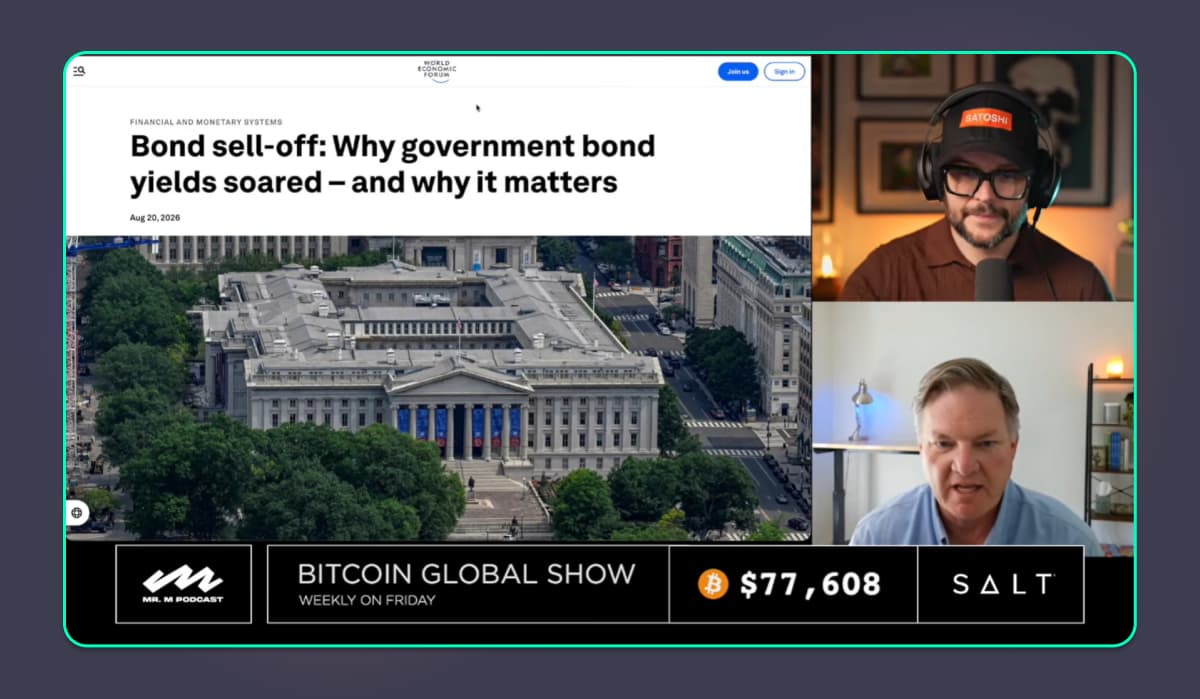
The single most important driver, in my view, was the Treasury buying back longer term bonds.
This is worth understanding precisely, because it gets described incorrectly all the time. The buyback does not add new money to the system. Nobody printed anything. What it does is change where existing money sits. Capital that was locked up in long duration instruments gets moved into shorter term vehicles, and shorter term money behaves very differently. It is money that can act.
So the effect is the same as adding liquidity even though the quantity of money has not changed. And when that capital starts looking for somewhere to go, it flows down the risk ladder. That is why gold and Bitcoin moved together rather than in opposition. Gold was up roughly 15 percent over three weeks. Bitcoin ran harder over a shorter window. Two assets, one cause.
Bitcoin ETFs took in about $1.6 billion over the same seven day stretch, which is consistent with the same story: capital rotating out of bonds and into assets people believe will hold value through what comes next.
If you want the one sentence version: this rally was less a referendum on Bitcoin and more a referendum on the bond market.
Forty Trillion Dollars and No Plan
The backdrop to all of it is the number that crossed a threshold this month. Total US public debt passed $40 trillion for the first time, and it got there months earlier than forecasters expected.
The stat that stopped me was the pace. It took less than five years to go from $30 trillion to $40 trillion. Interest costs on that debt now run over a trillion dollars a year, which puts debt service ahead of defense spending. And the honest part, the part that should bother people more than it does, is that there is no serious plan on the table to slow it down.
There are only two levers. Cut spending dramatically or find new revenue. Neither is being seriously pursued. Anyone who has run a company through a deficit knows how this goes: the conversation you avoid gets more expensive every quarter you avoid it.
Here is why that matters for anyone holding Bitcoin. If the response to unsustainable debt and persistent inflation is to put more liquidity into the market, then what we just watched over seven days is not the event. It is a preview. The same mechanism, at a larger scale, points in the same direction.
August Was Supposed to Be a Bad Month
Every year around this time, seasonality comes back into the conversation. The historical record does lean negative. Mr. M pulled up the monthly data on the show, and the average August return sits around negative 7 percent.
This August is up roughly 23 percent. On his numbers, that makes it the third strongest August in Bitcoin’s history.
I want to be careful here, because the lesson is not that seasonality is inverted now. The lesson is that seasonality was never a strategy. Bitcoin is a seventeen year old asset. If you are building a position around a pattern that showed up three or four times in a data set that small, you are not doing analysis. You are gambling with extra steps.
The deeper problem is that a monthly return tells you nothing about why it happened. Every one of those red Augusts had its own macro context, its own liquidity conditions, its own news cycle. Averaging them together produces a number that describes no actual month. Look at what is happening now instead: war and conflict, inflation, the cost of servicing the debt, midterm elections approaching. Those pressures are real and they are specific. They will not care what the calendar says.
What This Week Says About Timing the Market
Bitcoin fell roughly 55 percent from its $126,000 high. That is a genuine discount by any measure. Plenty of people said they were waiting for exactly that kind of entry.
Then a lot of them waited for another 10 percent, and the market left without them.
I am not claiming the bottom is in. I do not know that, and neither does anyone else. Bitcoin could revisit the $50,000 range. Volatility is clearly back on, and it cuts in both directions. That is the point. In a market that trades 24 hours a day, seven days a week, timing entries well requires either being awake constantly or being lucky, and the stress rarely pays for itself.
What works instead is unglamorous. Steady accumulation. A managed position rather than a timed one. Being in a position where a 30 percent week is something you benefit from rather than something you watch. Note that this is general commentary rather than financial advice, and your own situation should drive your decisions.
One thing worth watching: demand tends to be thinnest exactly when the bargains are best. Interest was low in the $50,000 range. It is high near $80,000. That relationship is worth sitting with.
Citi and Schwab Are Widening the Door
Two pieces of news landed this week that I think pair well together. Citi signaled it wants into this market. And Schwab moved further along its rollout of spot Bitcoin buying for retail clients, a phased launch that began earlier this year and keeps expanding.
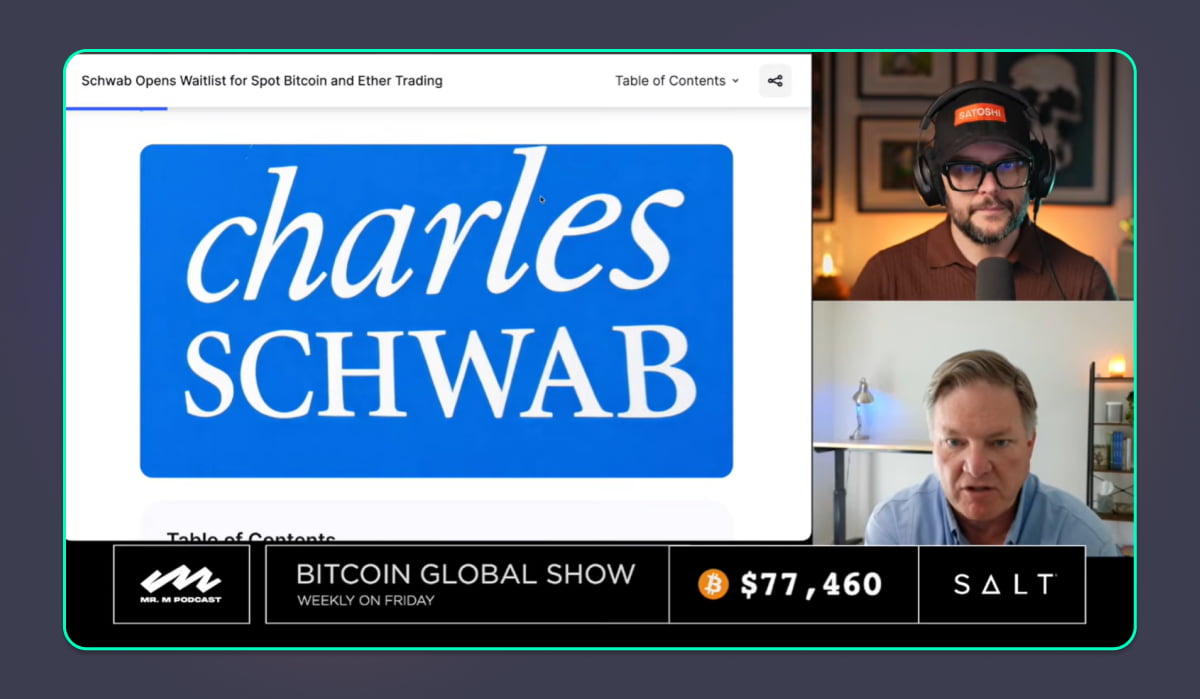
Neither moved the price. That is not what makes them important. What makes them important is that they widen the funnel.
My expectation is that broader brokerage access does for retail what the ETFs did for institutions: it removes friction between wanting exposure and having it. Somebody with a Schwab account and no interest in learning about exchanges or self custody can now act on a Bitcoin thesis in the same place they hold their equities.
That changes the composition of who can move the price. And it sets up the question I find most interesting right now. The last data I saw suggested ETF flows were still 60 to 70 percent retail. If the retail base gets meaningfully larger, and if that base increasingly treats Bitcoin the way this week’s buyers treated it, as somewhere to move capital when the macro picture looks unstable, then the next round of macro turbulence may push money into Bitcoin rather than out of it. Midterms are coming. The conflicts have no clear resolution. We will find out.
Price Reflects Capital Willing to Move, Not Conviction
This is a distinction I keep coming back to, and this week made the case for me.
Price does not measure what holders believe. It measures what capital is willing to do right now. The people who held through the entire drawdown and did nothing this week are invisible in the chart, even though their conviction never wavered. Price only prices the marginal buyer and the marginal seller.
Which is why a 30 percent week and a 55 percent drawdown can both be true descriptions of the same asset with the same fundamentals. Nothing about Bitcoin changed in seven days. What changed was how much capital was willing to act, and where it could park.
Why Saylor Sold, and What It Proves About Bitcoin Credit
Michael Saylor sat down for a long interview that has done close to two million views, and he addressed the question that got him the most criticism this year: why sell any Bitcoin at all?

His answer was better than the criticism. He said selling proved two things at once. First, that a large holder can sell without tanking the market, which is a claim people had been making against him for years. Second, and more usefully, that the position is genuinely worth what he says it is worth. If you want to borrow against an asset, someone has to believe the collateral has real, realizable value. Demonstrating that you can convert it establishes exactly that.
He then put the proceeds behind MSTR and behind Stretch rather than out the door. Stretch has since worked its way back toward par. Whatever you make of the vehicles, the actions have been consistent with the stated conviction.
I care about this because it is the Bitcoin credit thesis in miniature, and it is the thesis SALT was built on. The interesting question for a long term holder was never whether Bitcoin goes up. It is how you access the value of an asset you do not want to part with. If Bitcoin is a store of value, then it should function as collateral, and functioning as collateral means you can live your life, fund a business, or handle an opportunity without selling the position and without triggering a taxable event in most jurisdictions.
That is what a Bitcoin backed loan does. You keep the upside. You keep the position. You get liquidity. It is the same structure Saylor is operating at institutional scale, available to individuals. If you want to see the mechanics, you can run your own numbers on the calculator or read how SALT Shield® protects collateral through exactly the kind of volatility we saw this month.
The broader point about 2026 is this. It has been a punishing year for anyone watching the price daily. But it has also stress tested every financial instrument built on top of Bitcoin, and most of them held. That is not a small thing. The lessons from a year like this are what carry the ecosystem into the next one.
What I Am Watching Next
- Whether the Treasury adds more liquidity. If the debt response involves putting more capital into the market, this week’s move looks like a rehearsal rather than a conclusion.
- Who is actually buying the ETFs? Splitting inflows into institutional versus retail would tell us far more about market structure than the headline number does. I would like to find a way to track it.
- Regulatory clarity. The SEC proposal and the White House meeting were positive signals rather than price events. My concern is durability. An SEC approach is not law, and it can be reversed by the next administration. Legislation that actually gets voted on is what changes corporate behavior.
- How the market decides to value treasury companies. There are live proposals to exclude firms without operating revenue from major indices. That debate is unresolved, and it matters for anyone holding those vehicles as Bitcoin proxies.
- Fear and greed at 72. A reading that high after a move this fast is normal, but it is worth knowing where sentiment sits before you make a decision you would not have made three weeks ago.
Next week I will be in Hong Kong for the conference, and I am genuinely curious how the room reads all of this. There is a real difference between how this week looks on a chart and how it feels to people allocating capital. I will report back.
Frequently Asked Questions
Why did Bitcoin rally almost 30 percent in a week?
The primary driver was macroeconomic rather than anything specific to Bitcoin. The US Treasury’s buyback of longer term bonds shifted capital into shorter term instruments, which had the practical effect of increasing available liquidity. That capital rotated into assets seen as stores of value, lifting both Bitcoin and gold. Bitcoin ETFs took in roughly $1.6 billion over the same seven day period.
Does a Treasury bond buyback add money to the economy?
No. A buyback does not create new money. It changes the duration profile of existing money by moving it out of long dated bonds and into shorter term vehicles. Because shorter term capital is more readily deployed, the effect on asset prices can resemble an increase in liquidity even though the total money supply is unchanged.
Is August historically a bad month for Bitcoin?
Historically, yes. The average August return has been around negative 7 percent. August 2026 broke that pattern with a gain of roughly 23 percent, making it one of the three strongest Augusts on record. With only seventeen years of data, monthly seasonality is a weak basis for any position, because each month’s outcome was driven by its own specific conditions rather than by the calendar.
What does $40 trillion in national debt mean for Bitcoin?
Rising debt raises the cost of servicing it and increases pressure to add liquidity to the market, which historically has supported hard assets. It also strengthens the argument for holding assets outside the fiat system. None of this guarantees Bitcoin appreciation, and the relationship between fiscal policy and Bitcoin price is correlational rather than mechanical.
Does wider brokerage access change Bitcoin’s market structure?
It changes who can act on a Bitcoin thesis and how quickly. Spot access inside a mainstream brokerage removes the friction of using a separate exchange or managing self custody. The likely effect resembles what the spot ETFs did: a larger pool of participants able to move capital into Bitcoin during periods of macroeconomic uncertainty.
Why would a long term holder borrow against Bitcoin instead of selling?
Selling ends the position and, in many jurisdictions, creates a taxable event. Borrowing against Bitcoin provides liquidity while the collateral stays yours, so any future appreciation still belongs to you. This is the reasoning behind the Bitcoin credit thesis, and it is how SALT has structured lending since 2016. Consult a tax professional about your own circumstances, and check availability in your jurisdiction before applying.
Watch the Full Conversation
Thanks as always to Mr. M for having me on. You can watch the full episode on his channel, where we go deeper on the bond market mechanics, the treasury company debate, and the Saylor interview. He also built a power law corridor visualization for the episode, including a 3D interactive version, which is worth seeing for yourself.
Our weekly conversations are collected in one place, along with a promotional offer put together specifically for Bitcoin Global Show viewers. If you are holding through this volatility and want liquidity without selling, you can run the numbers on a Bitcoin backed loan and check whether we lend in your jurisdiction.
Disclaimer
This article is for informational purposes only and does not constitute financial, investment, tax, or legal advice. Market commentary reflects the author’s views as of the recording date and may not reflect current conditions. Prices and figures cited were accurate at the time of the conversation and change constantly. Borrowing against collateral entails risk and may not be appropriate for your needs. Rates for SALT products are subject to change. Loan terms may vary or may not be available in your jurisdiction, for your requested loan amount, or preferred collateral type. SALT loans are subject to jurisdictional limitations and other restrictions. For the current list of jurisdictions where SALT lends, see saltlending.com/map-list. Digital currency is not legal tender, is not backed by the United States or any other government, and SALT accounts are not subject to FDIC or SIPC protections. SALT loans are originated by SALT Lending LLC, NMLS 1711910. Consult a qualified financial, tax, or legal advisor before making any decision.