
Quick answer: Not entirely, but it is changing. Bitcoin’s October 2025 all-time high landed right on the historical schedule, about 18 months after the April 2024 halving. The bear market that followed broke the pattern, though. Bitcoin fell a little over 50% instead of the 77% to 85% drops of past cycles. Most analysts now describe the cycle as weaker and less predictable rather than dead. For anyone borrowing against Bitcoin, that uncertainty is the point: plan your loan for a wide range of outcomes instead of betting on a calendar.
This guide explains how the four-year cycle has worked, what was different this time, the strongest arguments on each side of the debate, and how to structure a Bitcoin-backed loan when the old playbook is less reliable.
What Is the Bitcoin Four-Year Cycle?
The four-year cycle starts with the halving, a rule written into Bitcoin’s code. Every 210,000 blocks, roughly every four years, the reward miners receive for each new block is cut in half. That slows the rate at which new Bitcoin enters circulation.
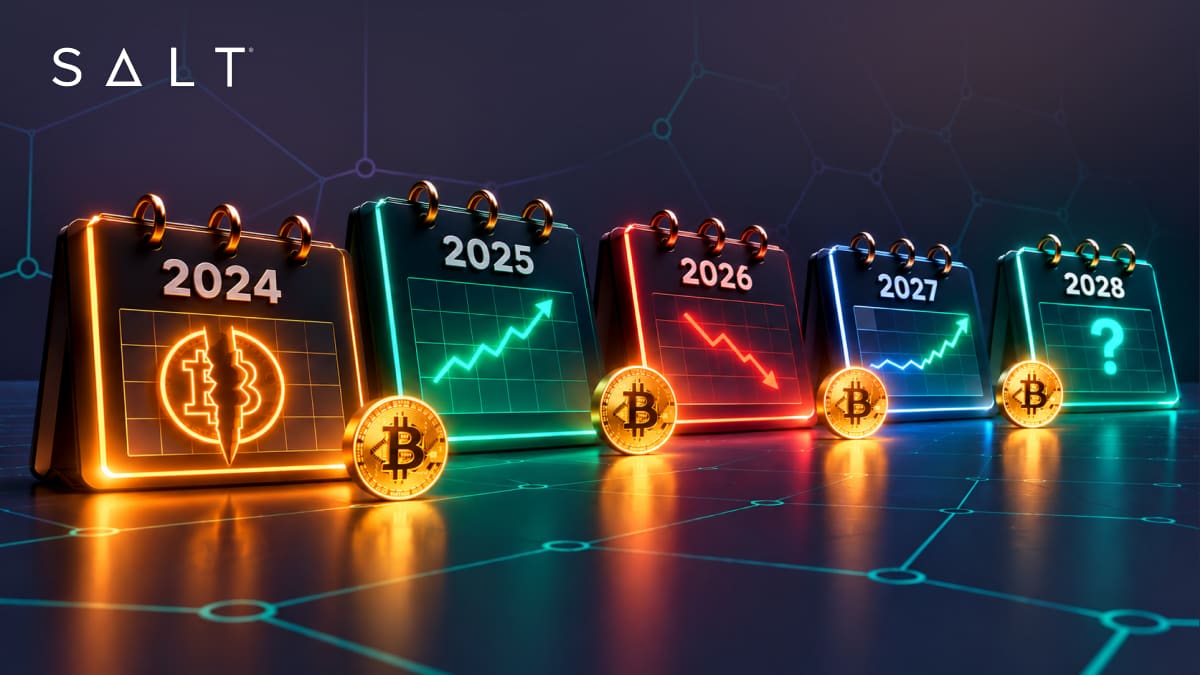
The halving itself is guaranteed. The price pattern that has followed it is not. Historically, each halving was followed by a bull market that peaked 12 to 18 months later, a steep bear market, and a recovery leading into the next halving. That pattern is an observation of past behavior, not a protocol rule.
The most recent halving, in April 2024, cut the block reward from 6.25 to 3.125 BTC. The next is expected around April 2028, when it will drop to 1.5625 BTC.
How Every Past Cycle Played Out
Peak timing has been remarkably consistent. Drawdown depth is where the latest cycle stands apart.
| Halving | Cycle Peak | Months After Halving | Peak-to-Trough Drawdown |
|---|---|---|---|
| November 2012 | December 2013 | About 12 | About 85% |
| July 2016 | December 2017 | About 17 | About 84% |
| May 2020 | November 2021 | About 18 | About 77% |
| April 2024 | October 2025 (about $126,000) | About 18 | About 52% to 54% so far |
Figures are approximate. Recent-cycle data via NYDIG’s Q2 2026 Review and Fidelity Digital Assets.
What Was Different About the 2024 to 2026 Cycle
The timing fit the old model almost perfectly. Bitcoin peaked near $126,000 on October 6, 2025, inside the 12 to 18 month window where the previous three cycles topped. Nearly everything else looked different:
- A smaller run-up. Earlier bull markets each included at least one year where Bitcoin gained 1,000% or more. This cycle’s best year-over-year gain topped out around 240%, according to Grayscale’s 2026 Digital Asset Outlook.
- A shallower drawdown. Bitcoin fell 54.3% at its low, near $58,000, according to NYDIG. Every prior bear market fell at least 77%.
- Calmer volatility. Fidelity Digital Assets counted 17 new all-time lows in one-year realized volatility in January 2026, just months after the price peak. In past cycles, volatility hit new lows before a peak, not right after one.
- New kinds of buyers. Spot Bitcoin ETFs, public companies, and other institutions now hold a meaningful share of supply. Their buying and selling follows different logic than the retail-driven markets of 2017 and 2021.
By mid-September 2026, Bitcoin had recovered to roughly 40% below its high. That is still a large gap, so the debate is far from settled. For the near-term seasonal picture, see Does Bitcoin Rally in Q4?
The Case That the Cycle Is Over
Several major firms argued heading into 2026 that the old pattern no longer applies. Bitwise titled its 2026 predictions memo The Four-Year Cycle Is Dead, and Grayscale Research predicted 2026 would mark the end of the apparent four-year cycle. Both expected new all-time highs in 2026. Their reasoning generally comes down to three points:
- The halving matters less each time. Each halving removes a smaller share of total supply, so its effect on price should shrink.
- Institutional flows now set the price. ETF inflows and outflows, corporate treasury purchases, and credit conditions can outweigh a change in miner issuance.
- Macro liquidity drives risk assets. Interest rates, dollar liquidity, and global money supply move Bitcoin alongside other risk assets, regardless of where the halving calendar sits.
The weakness in this view so far: a 50%+ drawdown still happened, right on the old schedule, and the predicted 2026 all-time highs have not arrived.
The Case That the Cycle Still Holds
Other researchers see 2026 as a textbook post-peak year. In February 2026, NYDIG published research titled Bitcoin’s Cycle Reasserts Itself, arguing the market was in a cyclical drawdown consistent with past four-year cycles. Before the year began, Fidelity’s Jurrien Timmer had suggested 2026 could be an “off year” for Bitcoin. Fidelity Digital Assets’ September outlook added that if the pattern repeats, another low could arrive around November 2026, while cautioning that the cycle is not a precise timing tool.
Supporters point to the peak landing in the usual window, the decline arriving on schedule, and investor sentiment moving through the same fear-driven phases seen in past bear markets. In their view, the drawdown was shallower because the market is larger and more mature, not because the cycle disappeared.
The Middle Ground: A Compressing Cycle
The view that fits the record best so far may be the middle one. Galaxy Research argued in June 2026 that the cycle is real but shrinking in amplitude: smaller rallies, smaller crashes, and timing that still roughly follows the halving. Galaxy also cautioned that the bottom may not be in yet. Its historical analogies pointed to a possible low between $40,000 and $46,000 by late 2026, which the firm noted was not a price prediction. In this scenario, the four-year clock remains a useful frame but a poor tool for timing exact tops and bottoms.
Nobody can say with confidence which camp is right, and SALT does not make price predictions. What borrowers can control is how their loan holds up across all three scenarios.
What the Cycle Debate Means If You Borrow Against Bitcoin
A Bitcoin-backed loan is sensitive to price, so the drawdown question matters more than the timing question. Your loan-to-value (LTV) rises as Bitcoin falls. The table below shows what happens to a loan’s LTV if Bitcoin drops and the borrower takes no action, such as adding collateral or paying down the balance.
| Starting LTV | After a 30% Drop | After a 54% Drop (2026-Style) | After a 77% Drop (2022-Style) |
|---|---|---|---|
| 30% | 43% | 65% | 130% |
| 50% | 71% | 109% | 217% |
| 70% | 100% | 152% | 304% |
Illustrative only. Margin calls and other lender actions begin well before LTV reaches 100%, so in practice a borrower would need to act much earlier. See how thresholds work in What Is a Margin Call on a Crypto-Backed Loan? and Crypto Loan Liquidation Thresholds Compared.
Three takeaways stand out:
- A shallower cycle still hurts high-LTV loans. Even this cycle’s smaller drop would push a 50% LTV loan past the value of its collateral without intervention.
- Conservative LTV buys time. A 30% LTV loan survives a 2026-style drawdown with room to spare, and gives you more time to respond if the next one is deeper.
- A fixed rate removes one variable. When price and macro conditions are uncertain, knowing exactly what your loan costs makes the rest of your plan easier to manage.
How to Plan a Bitcoin-Backed Loan Around the 2028 Halving
- Stress test against the worst historical drawdown, not the latest one. Plan as if a 77% to 85% decline is possible, even if the cycle is compressing. The BTC Margin Event Calculator shows the price at which your loan would hit a margin event.
- Match your term to your time horizon. SALT’s 3 and 5 year loans are built for holders who think in cycles. A 5-year fixed loan taken today would extend beyond the expected 2028 halving, so you would not need to refinance in the middle of a volatile stretch.
- Choose an LTV you can defend. At 30% LTV, current SALT rates start at 7.49% APR on a 1-year term and 8.49% APR fixed for 5 years. Full pricing is on the Rates & Fees page.
- Keep dry powder for a margin call. Set aside extra Bitcoin, stablecoins, or cash you could post as collateral or use to pay down the loan if prices fall.
- Decide on protection before you need it. Stabilization can convert your collateral to USDC during a sharp decline to help preserve its dollar value, and SALT Shield® offers no-liquidation protection for the rest of your term for a one-time fee, subject to eligibility.
Frequently Asked Questions
When is the next Bitcoin halving?
The next halving is expected around April 2028, when the block reward will fall from 3.125 BTC to 1.5625 BTC. The exact date depends on how quickly miners produce blocks, since the halving is triggered every 210,000 blocks rather than on a set calendar day.
Does the halving cause Bitcoin’s price to go up?
Not directly. The halving reduces the flow of new supply, and in past cycles major rallies followed within 12 to 18 months. Many analysts now believe ETF flows, institutional demand, and macro liquidity have as much influence on price as the halving does.
Is the Bitcoin four-year cycle dead?
The evidence is mixed. The 2025 peak arrived on the historical schedule, but the 2026 drawdown was far shallower than past bear markets. The most common view in late 2026 is that the cycle is weakening and becoming less predictable rather than disappearing entirely.
Has Bitcoin bottomed for this cycle?
No one can say for certain. Bitcoin hit a low near $58,000 in June 2026 and recovered part of its losses afterward. Some analysts believe that was the bottom, while Galaxy Research and NYDIG both published scenarios in which a lower low arrives later in 2026. SALT does not make price predictions, which is why stress testing your loan against a range of outcomes matters.
Is it better to borrow against Bitcoin or sell it during a downturn?
It depends on your goals and tax situation. Selling locks in the current price and may trigger capital gains tax, while borrowing lets you keep your Bitcoin but adds interest costs and price risk. Our guide on borrowing vs. selling Bitcoin covers the tradeoffs, and a tax professional can help with your specific situation.
Should my loan term match the Bitcoin cycle?
For many long-term holders it helps. A loan that runs through a full cycle means you are less likely to face refinancing or repayment during a bear market. SALT offers 1, 3, and 5 year terms, with fixed rates on the 3 and 5 year options.
What happens to my Bitcoin-backed loan if the price drops 50%?
Your LTV roughly doubles. A loan that started at 30% LTV would move to about 60%, while one that started at 50% would reach about 100%. Before that point, you would typically receive a margin call asking you to add collateral or pay down the balance, unless your loan is protected by a feature like SALT Shield®.
The Bottom Line
Bitcoin’s halving schedule is as predictable as ever. Its price cycle is not. The 2024 to 2026 cycle kept the old timing but broke the old magnitude, and serious researchers disagree about what comes next. For borrowers, the smartest response is to plan for every version of the story. That means choosing a conservative LTV, matching your term to your time horizon, and putting protection in place before the market tests it.
Disclosures
This article is for informational purposes only and does not constitute investment, financial, tax, or legal advice. Nothing in this article is a prediction or guarantee of future Bitcoin prices or market performance. Historical cycle data and third-party research are cited for educational purposes, and past performance does not indicate future results. Digital assets are highly speculative, and you should consult your own financial, tax, or legal advisors before making any decisions.
SALT loans are originated by SALT Lending LLC (f/k/a SALT Master Fund II, LLC), NMLS 1711910. Loan terms, rates, minimums, LTV options, and product availability vary and may not be available in your jurisdiction, for your requested loan amount, or for your preferred collateral type. SALT loans are subject to jurisdictional limitations and other restrictions. See where SALT currently lends at saltlending.com/map-list. SALT does not offer loans to all prospective borrowers, and eligibility is subject to KYC/AML requirements and other screening at SALT’s sole discretion.
Rates shown are current as of the publish date and are subject to change. APRs range from 7.49% to 10.50% and are inclusive of interest and origination fees where applicable. For example, a one-year $10,000 loan with a rate of 6.00% APR would have 12 scheduled monthly payments of $861. LTV scenarios are illustrative only and do not reflect the timing of margin calls or other actions under your loan agreement. SALT Shield® and Stabilization are optional features subject to eligibility, terms, and fees.
Borrowing against collateral entails risk and may not be appropriate for your needs. If the value of your collateral declines, you may be required to add collateral or repay part of your loan, and your collateral may be liquidated. Digital currency is not legal tender, is not backed by the United States or any other government, and SALT accounts are not subject to FDIC or SIPC protections. You should review the terms and conditions described in your loan agreement.