
Most people shopping for a loan against their Bitcoin compare two numbers: the interest rate and the maximum LTV. Neither one tells you the thing that matters most in a bad market, which is how far Bitcoin has to fall before someone else decides to sell your collateral.
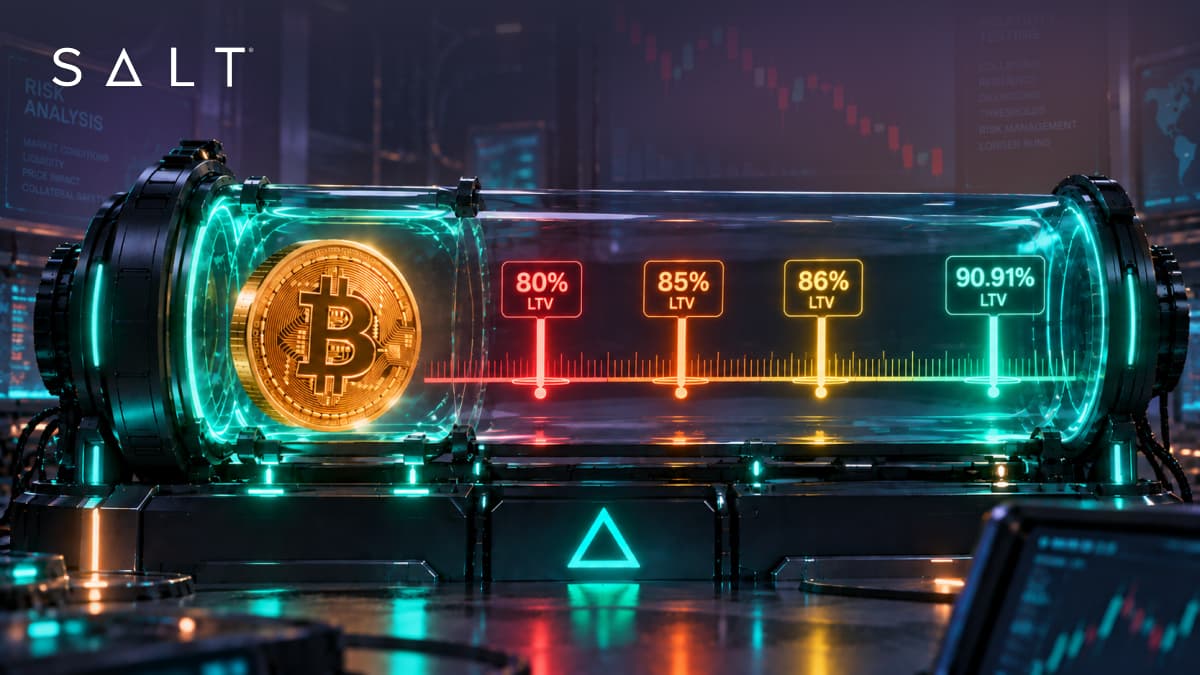
That number is the liquidation threshold, and among lenders who publish it, it currently ranges from 80% to 90.91% LTV. On an identical loan, that spread is the difference between surviving a 37% drawdown and surviving a 45% one. It is the single most consequential term in the agreement, and it is the one most often left out of comparison charts.
Here is what the published thresholds actually are, what the gaps between them buy you, and why most lenders will not give you the number at all.
The Three Numbers That Matter, Not One
Comparison articles usually treat LTV as a single figure. In practice there are three, and they do very different jobs:
- Maximum initial LTV. The most you can borrow against your collateral at the start. This is the number lenders advertise, because a higher figure looks generous.
- Margin call LTV. The point at which you are told to act, by adding collateral or paying down principal. A margin call is a notice, not a sale.
- Liquidation threshold. The point at which the lender can sell or convert your collateral. This is the number that decides whether you keep your Bitcoin.
A lender advertising a generous maximum LTV alongside a tight liquidation threshold is offering you more rope and a shorter drop. The two numbers have to be read together, and the gap between your margin call and your liquidation threshold is the window you actually have to respond.
What the Published Thresholds Look Like
Below are the thresholds from lenders that publish them in their own documentation, current as of September 2026. Terms change, so verify with the lender before you borrow.
| Lender | Warning | Margin Call | Liquidation | What Happens at Liquidation |
|---|---|---|---|---|
| SALT | 75% LTV | 83.33% LTV | 90.91% LTV | Collateral converted or liquidated only if the margin call was not cured |
| Strike (standard loan) | 65% LTV | 70% LTV, 72-hour window | 85% LTV | Partial liquidation, enough to restore the 65% recovery threshold |
| Arch (Bitcoin) | Early notifications | 70% LTV, 24-hour cure | 80% LTV | Partial liquidation back to 60%, with a 2% fee on the amount sold |
| Ledn | 70% and 75% LTV | Not published separately | 80% LTV | Automatic and irreversible, with a 0.50% trade spread applied |
| Coinbase (via Morpho) | App warnings, no published level | Not published separately | 86% LTV | Automatic on-chain liquidation, with a 4.38% penalty included |
Sources: each lender’s published product documentation and help pages, reviewed September 2026.
Three things stand out. The thresholds span nearly eleven percentage points from one end of the range to the other. The mechanism differs as much as the number: some liquidate automatically the moment the line is crossed, while others treat it as the end of a process that began with a curable margin call. And the cure window itself is defined two different ways, either as a clock, such as 24 or 72 hours, or as a distance in LTV between the margin call and the liquidation point.
That last difference is easy to miss and matters in a fast market. A fixed clock gives you a known amount of time but no protection if the price keeps falling during it, since most lenders liquidate on reaching the threshold even if the cure window is still running. A gap defined in LTV gives you room measured in price rather than minutes.
Most Lenders Will Not Tell You the Number
The lenders above are the transparent end of the market. Step outside the Bitcoin-native specialists and disclosure falls off sharply. When an independent review in September 2026 checked the public product, terms, and FAQ pages of eleven crypto lending providers, a set drawn mostly from exchanges and general crypto platforms, only two published a specific liquidation threshold and one more published starting ratios.
Two out of eleven, for the term that determines whether you keep the asset you pledged. The pattern is worth noticing: lenders built specifically around Bitcoin collateral tend to publish their thresholds, while platforms where lending is one feature among many often do not.
The reasons vary. Some lenders set thresholds case by case and do not want to be held to a published figure. Some treat it as a risk parameter they may want to change. Some simply have not thought about it as borrower-facing information. Whatever the reason, the effect on you is identical: you cannot compare what you cannot see, and you will not learn the number until it is in your loan agreement, or worse, until you are close to it.
If a lender will not state its liquidation threshold before you apply, treat that as a material answer rather than an oversight. Ask directly, in writing, and ask whether the threshold can be changed during your loan term.
What Ten Percentage Points Actually Buy You
Thresholds sound abstract until you convert them into a price. Take a straightforward case: you pledge $100,000 of Bitcoin and borrow $50,000, opening at 50% LTV. Assume the balance stays flat for simplicity. Here is when each threshold would be reached:
| Liquidation Threshold | Collateral Value at Trigger | Decline Required |
|---|---|---|
| 80% LTV | $62,500 | 37.5% |
| 85% LTV | $58,824 | 41.2% |
| 86% LTV | $58,140 | 41.9% |
| 90.91% LTV | $55,000 | 45.0% |
Same loan, same collateral, same opening LTV. At an 80% threshold, a 37.5% drawdown is enough to trigger a sale. At 90.91%, Bitcoin has to fall 45% before the same thing happens. That is 7.5 percentage points of additional drawdown tolerance, bought with nothing except choosing a lender whose line is drawn further out.
For context on why that gap matters: drawdowns of 30% or more have occurred repeatedly within single quarters in Bitcoin’s history, and a 37% decline is well inside the range of a normal cycle correction. A 45% decline is a much rarer event. The threshold is what determines which of those two your loan has to survive.
One caveat worth stating plainly, because it cuts against the comparison. Interest accrues, and on loans where interest is added to the balance rather than paid monthly, your LTV rises even when Bitcoin does nothing at all. A loan that looks comfortable at open drifts toward its threshold on its own. Ask whether interest capitalizes, because it silently shortens every buffer described above.
Automatic Liquidation Versus a Cure Window
The threshold number is only half the story. What happens when you reach it varies more than the number itself.
Some lenders liquidate automatically the moment the line is crossed, with no human step and no opportunity to intervene. That is the norm for on-chain lending, where a smart contract executes the liquidation and no party can stop it, and it applies to some centralized lenders too. The advantage is predictability. The disadvantage is that a brief price wick can cost you collateral you would have recovered an hour later.
Other lenders structure the threshold as the end of a process rather than the start of one. Arch issues a margin call at 70% LTV on Bitcoin loans with a 24-hour cure period, and Strike issues one at 70% with a 72-hour window, extended in early 2026 from the 24 hours it previously allowed. In both cases the clock is the protection, and in both cases liquidation can still occur if the threshold is reached before the clock runs out.
SALT defines the window differently. A warning arrives at 75% LTV, a margin call at 83.33%, and the margin event does not occur until 90.91%. The protection is the distance between those numbers rather than a countdown, which means the room you have is measured in price movement rather than in hours.
That distinction matters more in fast markets than in calm ones. During sharp declines, network congestion can push confirmation times from minutes to hours, which means a borrower who acts at the right moment can still arrive too late on a platform that liquidates instantly. Our margin call guide covers the mechanics, and the margin event calculator will show you the price at which your own loan would cross each line.
The Costs That Come With Liquidation
Liquidation is rarely just a sale at the market price. Most lenders attach a cost to it, and those costs are disclosed in very different places and with very different prominence:
- Trade spreads applied to the sale, which reduce what your collateral realizes
- Liquidation or penalty fees charged on top of the amount sold
- The tax consequence, since a forced sale of appreciated Bitcoin is a disposal and generally a taxable event even though you did not choose it
Among the lenders above, Ledn applies a 0.50% trade spread on liquidation, Arch charges 2% on the amount sold, and Coinbase includes a 4.38% penalty. SALT charges a 5% liquidation fee, the highest of the group, and publishes it alongside every other fee on our rates and fees page. On a six-figure position, any of these is a meaningful sum arriving at the worst possible moment.
Read the fee against the threshold rather than on its own, because the two describe different things. A 0.50% spread at an 80% threshold and a 5% fee at 90.91% are not comparable costs: the first is cheaper if it happens, and the second requires a substantially deeper drawdown to happen at all. The question worth asking is not only what liquidation costs, but how likely your loan is to get there.
Can You Take Liquidation Off the Table Entirely?
Partly, and it depends on the tool.
Automatic top-up features, offered by several lenders, move additional collateral in before you reach a margin call. These reduce the chance of liquidation but require you to hold spare collateral on the platform. Stabilization takes a different approach, converting collateral to USDC at the margin event threshold to preserve its dollar value rather than allowing a sale into a falling market. Electing it costs nothing. A 3% fee applies only if it actually triggers, plus 2% to convert back to Bitcoin afterward if you choose to.
SALT Shield® goes further. It is an optional upgrade with a one-time fee under which SALT agrees not to enforce its margin call liquidation rights for the remainder of the loan term, so your Bitcoin stays Bitcoin through a deep drawdown. It is available on BTC-only loans, must be purchased at least three months before maturity, and does not permit collateral withdrawals while active. What SALT Shield® covers.
Strike takes a third approach with its volatility-proof loans, launched in July 2026, which remove price-triggered liquidations entirely rather than raising or forbearing a threshold. The tradeoffs are structural rather than a fee: initial LTV is capped at 45% against 50% on the standard product, the rate carries a premium of roughly 2.95%, terms are shorter, the product is not offered in every state, and a loan cannot be switched into it mid-term. Missed payments can still trigger liquidation after a grace period.
The common thread across all of these is worth stating plainly. None of them change what you owe at maturity, and none of them are insurance. What they change is whether a price move during the term can cost you the asset, and each one charges for that differently: in collateral held back, in rate, in a one-time fee, or in flexibility given up.
Questions to Ask Any Lender
- 1. What is your liquidation threshold, as a specific LTV? If the answer is not a number, that is your answer.
- 2. At what LTV do I get a margin call, and how long do I have to cure it? The gap between call and liquidation is your actual protection.
- 3. Is liquidation automatic or discretionary? Automatic means no one can stop it, including you.
- 4. Is it partial or full? Some lenders sell only enough to restore the ratio; others close the position.
- 5. What does liquidation cost me? Ask about spreads and penalty fees, not just the threshold.
- 6. Can the threshold change during my loan? A parameter the lender can move is not really a term.
- 7. Does interest capitalize into the balance? If it does, your buffer shrinks on its own over time.
Frequently Asked Questions
What is a liquidation threshold on a crypto loan?
It is the loan-to-value ratio at which a lender can sell or convert your collateral to cover the loan. Because LTV rises as collateral value falls, the threshold effectively sets the price at which your Bitcoin is at risk. Among lenders that publish the figure, it currently ranges from about 80% to 90.91% LTV.
What is a good liquidation threshold?
Higher is better for the borrower, because it means Bitcoin has to fall further before your collateral is at risk. A threshold of 90% or above gives meaningfully more room than one at 80%. But read it alongside the margin call level and whether liquidation is automatic, since a high threshold with no cure window is not necessarily safer than a lower one with a real opportunity to respond.
Is the liquidation threshold the same as the margin call level?
No, and conflating them is the most common mistake in this area. A margin call is a notice that your LTV has risen past a defined point and that you need to act. The liquidation threshold is the later point at which the lender can sell. On some platforms the two are effectively the same because liquidation is automatic. On others there is a real gap between them.
Can I avoid liquidation by borrowing at a low LTV?
It is the most effective thing you can do. Opening at 30% LTV rather than 70% means a far larger decline is required to reach any threshold, and it usually earns a lower rate as well. Borrowing conservatively improves your cost and your risk position at the same time, which is unusual in lending.
Do lenders warn you before liquidating?
Most send notifications as your LTV rises, though the levels and the delivery vary. What differs more is whether the warning arrives with enough time and enough of a gap to act on. During sharp market moves, network congestion can delay a collateral transfer past the point where it would have helped, which is why the size of the cure window matters as much as the notice itself.
Is a forced liquidation a taxable event?
Generally yes. A liquidation is a sale of your collateral, and in most jurisdictions selling appreciated crypto is a taxable disposal regardless of whether you chose to sell. This is one reason the threshold matters beyond the collateral itself: a forced sale can create a tax bill in the same year the market fell. Consult a qualified tax professional about your circumstances.
Why do some lenders not publish their liquidation threshold?
Reasons vary, from case-by-case underwriting to a preference for retaining flexibility over risk parameters. From a borrower perspective the reason matters less than the consequence, which is that you cannot compare the term or plan around it. Ask for it in writing before you transfer collateral.
The Bottom Line
Rate is the number borrowers shop on. The liquidation threshold is the number that determines whether they still own their Bitcoin at the end of a bad quarter. Among lenders who publish it, the range spans roughly eleven percentage points, which on an identical loan is the difference between surviving a 37% drawdown and a 45% one.
Ask for the threshold, the margin call level, the cure window, and the liquidation cost before you compare a single interest rate. A lender that answers all four clearly is telling you something useful about how it operates, and a lender that will not answer them is telling you something too.
SALT publishes all three of its LTV thresholds, sets its margin event at 90.91%, and offers both Stabilization and SALT Shield® for borrowers who want to reduce the risk further. See current rates and fees or model your own position with the loan calculator.
Disclosures
Information about other lenders is drawn from those lenders’ own publicly available product documentation, help pages, and terms as reviewed in September 2026, and is provided for general comparison only. SALT does not represent that this information is complete, current, or accurate, and does not endorse or disparage any other provider. Thresholds, fees, and terms change, are frequently subject to individual loan agreements, and may differ from what is published. Verify all terms directly with the applicable lender before borrowing.
All loan examples, liquidation prices, and drawdown figures in this article are illustrative calculations provided for the purpose of comparison only. They assume a constant loan balance, exclude interest accrual and any applicable fees, and do not represent an offer of credit, a quote, or a prediction of market prices. Actual outcomes will vary.
Interest rates, terms, and fees posted herein are subject to change at any time without notice and may not reflect current offerings. Loan terms may vary or may not be available in your jurisdiction, for your requested loan amount, or for your preferred collateral type. SALT loans are subject to jurisdictional limitations and other restrictions, and SALT does not offer loans to all prospective borrowers. For current jurisdictional availability, see saltlending.com/map-list.
SALT Shield® is a proprietary product of SALT Lending LLC. It represents a temporary forbearance of Lender’s right to enforce margin call rights under the Loan Documents for a fixed, predetermined period of time. SALT Shield® is not insurance, nor an insurance product, and no representation is made that it is insurance against, or coverage for, any risk of loss. SALT Shield® does not alter any of Borrower’s payment obligations and terminates at the Maturity Date. Availability and pricing are based upon loan-specific terms, LTV minimums, term length, jurisdictional restrictions, and other requirements, and are subject to change.
Borrowing against collateral entails risk and may not be appropriate for your needs. Digital assets are highly volatile and a decline in collateral value may result in a margin call, the requirement to post additional collateral, or the liquidation of collateral. Digital currency is not legal tender, is not backed by the United States or any other government, and SALT accounts are not subject to FDIC or SIPC protections.
Nothing in this article constitutes investment, financial, trading, legal, or tax advice, and nothing herein should be construed as an offer, sale, endorsement, or recommendation regarding any security or digital asset. You are encouraged to conduct your own research and to consult your financial, tax, or legal advisors before making any decisions.
SALT loans are originated by SALT Lending LLC (f/k/a SALT Master Fund II, LLC), NMLS 1711910. Loans are issued pursuant to private agreements. You should review the representations, warranties, and other terms and conditions described in the loan agreement.