
You need cash this week. Maybe it is a tax bill, a contractor invoice, a medical expense, or a short window to close on something you have been eyeing for months. You also hold Bitcoin that you have no interest in selling, especially not at today’s price or today’s tax basis.
At that point most people reach for the fastest tool in the drawer, which is usually a credit card cash advance. It works. It is also one of the most expensive forms of consumer credit available, and the cost compounds from day one. Crypto-backed personal loans solve the same problem from a different direction: your digital assets stay yours, your credit score stays untouched, and the interest rate is a fraction of what a card charges for cash.
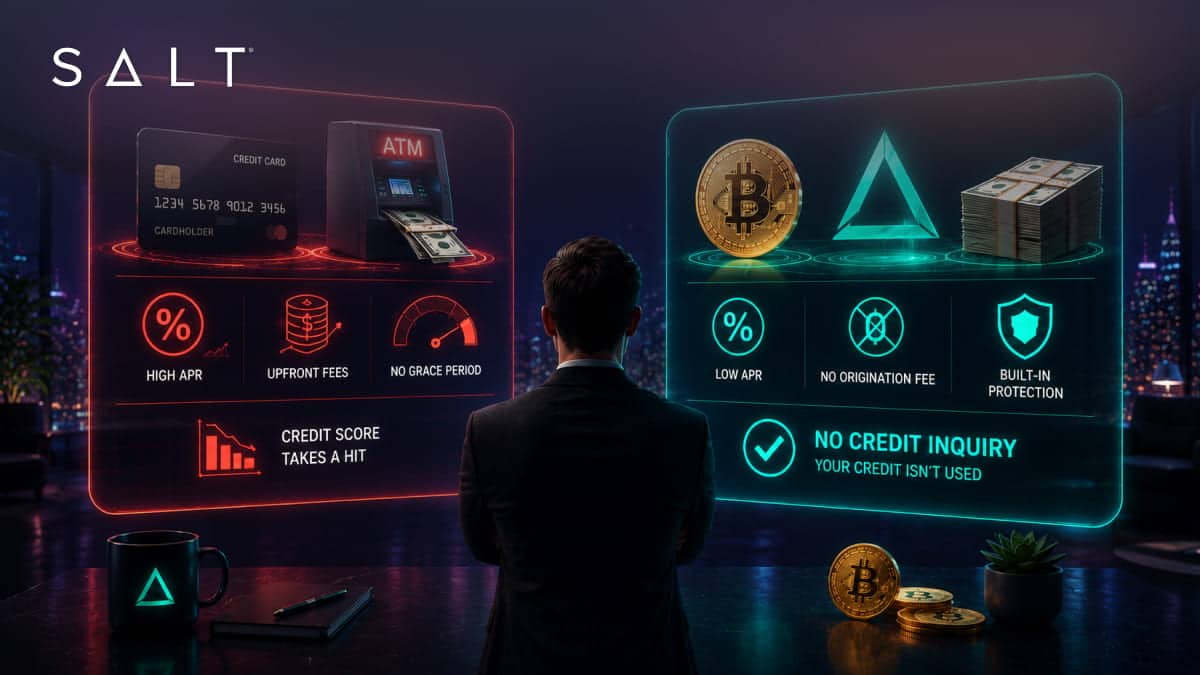
Here is how the two options compare on the things that actually matter, including cost, funding speed, credit impact, and what happens to your Bitcoin.
The Short Answer
- Cost: Cash advances typically run 24% to 30% APR plus a 3% to 5% upfront fee, with no grace period. SALT crypto-backed loans range from 7.49% to 10.50% APR with no origination fee.
- Speed: A cash advance is faster in the first hour. A crypto-backed loan is usually funded within a day or two and gives you far more capital.
- Amount: Cash advance limits are a slice of your card limit, often a few hundred to a couple thousand dollars. Crypto loan size scales with your collateral.
- Credit: A cash advance spikes your utilization ratio. A crypto-backed loan is underwritten against your cryptocurrency collateral rather than your credit file.
- Your assets: Neither option requires you to sell, but only one of them lets you borrow at single digit rates while your position stays intact.
What a Credit Card Cash Advance Really Costs
A cash advance is not a purchase. Card issuers price it as a separate, riskier product, and the terms reflect that.
- An upfront fee, typically 3% to 5% of the amount withdrawn, or a $10 minimum, whichever is greater. On $2,000 that is $60 to $100 before you have borrowed the money for a single day.
- A separate cash advance APR that is higher than your purchase APR. Many major issuers sit near 29.99%.
- No grace period. Interest starts accruing the moment the transaction posts and compounds daily.
- A low ceiling. Most cards cap cash advances at roughly 20% to 40% of your total credit line, and ATM withdrawals are usually limited to $500 to $1,000 per day.
- Utilization pressure. The advance lands on your revolving balance, and if it pushes utilization above 30% it can drag on your score.
There is also a payment allocation quirk worth knowing. When you pay more than the minimum, issuers generally apply the extra to your highest rate balance first, which is usually the advance. That helps, but only if you are paying well above the minimum. Pay the minimum and the advance can sit on your statement for months at close to 30%.
How Crypto-Backed Personal Loans Work
A crypto-backed loan is secured lending, structurally closer to a home equity line than to a credit card. You pledge digital assets as collateral, the lender holds them for the life of the loan, and you receive cash or stablecoin. Repay the loan and the collateral comes back to you.
At SALT the mechanics look like this:
- Collateral: BTC, ETH, USDC, and USDT are accepted.
- Loan-to-value: 30%, 50%, or 70% LTV, subject to jurisdiction and term length. A conservative 30% LTV means $30,000 of collateral supports a $9,000 loan and leaves a wide buffer before a margin event.
- Terms: 1, 3, or 5 years, with rates fixed for the full term.
- Payout: US dollars or stablecoin.
- Payment structure: Choose interest only, principal and interest, or accrue interest and settle at maturity, subject to availability in your jurisdiction.
- Fees: No origination fee, no prepayment penalty, no custody fee, and no withdrawal fee.
The tradeoff is price exposure. Because the loan is collateralized by a volatile asset, a sharp drawdown can push your LTV toward a margin call. That risk is manageable, and it is worth understanding before you borrow. See What Is a Margin Call on a Crypto-Backed Loan? for the mechanics, and SALT Shield and Stabilization for the tools built to soften it.
Crypto Loans vs Cash Advances, Side by Side
| Factor | Credit Card Cash Advance | Crypto-Backed Personal Loan |
|---|---|---|
| Typical cost | Around 24% to 30% APR, plus a 3% to 5% upfront fee | SALT rates run 7.49% to 10.50% APR with no origination fee |
| Grace period | None. Interest accrues the day the advance posts | Interest accrues over a set 1, 3, or 5 year term |
| How much you can access | Usually capped at roughly 20% to 40% of your card limit | Based on the value of your collateral, starting at a $5,000 minimum in most jurisdictions |
| Credit requirements | Requires an approved card and available credit | Approval is driven by collateral value, not a credit score |
| Credit score impact | Raises utilization, which can pull your score down | No hard inquiry and no revolving utilization added |
| Speed | Minutes at an ATM, within your advance limit | Often same day to a few business days after the loan is approved |
| Do you keep your Bitcoin? | Yes, but you pay a premium for the convenience | Yes. Collateral is returned when the loan is repaid |
| Repayment flexibility | Revolving balance with high minimums and daily compounding | Interest only, principal and interest, or accrue and pay at maturity |
| Prepayment penalty | None, but the upfront fee is already spent | None. Repay early at any time |
Rates, fees, LTV tiers, and payment options are current as of publication and are subject to change. Cash advance figures reflect commonly published issuer terms and will vary by card and cardholder.
The Cost of $10,000, Two Ways
Numbers make the gap concrete. Assume you need $10,000 for twelve months.
Credit card cash advance. A 5% fee costs $500 the day the money lands. At a 29.99% APR, paying the balance down in equal monthly installments over a year means an average outstanding balance around $5,400 and roughly $1,600 in interest. Total cost lands near $2,100. That also assumes your card even permits a $10,000 advance, which most do not.
Crypto-backed loan at 50% LTV. A one year loan at 8.75% APR with interest only payments costs about $875 in interest, with no origination fee and the principal due at maturity. Choose principal and interest instead and total interest drops to roughly $480 because the balance amortizes down each month.
That is a difference of $1,200 to $1,600 on the same $10,000, and the crypto loan gives you a defined payoff date rather than a revolving balance that can linger.
Run your own numbers with the SALT loan calculator or review the full rates and fees schedule.
Illustrative examples only. Actual costs depend on your rate, term, payment election, loan amount, and jurisdiction.
Which One Actually Funds Faster?
Cash advances win on raw speed for small amounts. Walk to an ATM, enter a PIN, and you have a few hundred dollars in hand. If you need $400 tonight, that is hard to beat.
The advantage disappears the moment the amount grows. Daily ATM caps force multiple trips or a teller visit, and your total advance limit may not reach what you need at all. Fast funding loans backed by cryptocurrency work differently: the timeline is driven by identity verification and blockchain confirmation, not by a withdrawal cap.
The practical sequence is short. Create an account, request your loan through the calculator, complete verification, transfer collateral to your loan wallet, and receive funds once the collateral is confirmed. Many borrowers move from application to funded within one to two business days, and existing borrowers with verified accounts often move faster because the compliance work is already done.
For a step by step walkthrough, read How to Get a Bitcoin-Backed Loan: Requirements, Steps, and Timeline.
Are Crypto-Backed Loans Really No Credit Check Loans?
This is where the marketing language in the digital asset lending space gets loose, so it is worth being precise.
Crypto-backed loans are collateral driven. Your loan amount is a function of the value of the assets you pledge, not a function of a FICO score. SALT does not underwrite based on your credit score, and taking a loan does not add a revolving balance or a hard inquiry that dents your credit file.
What crypto loans are not is unregulated or identity free. Borrowers complete know your customer and anti money laundering verification, and eligibility is assessed case by case and varies by jurisdiction and loan size. Any crypto lending platform that promises zero verification of any kind should raise your eyebrows, not your confidence.
More detail here: Do Bitcoin-Backed Loans Affect Your Credit Score?
The Cost You Do Not See on Either Statement
There is a third option people consider in a liquidity crunch, which is simply selling Bitcoin. On the surface it looks like the cheapest path because there is no interest at all. In practice it is often the most expensive.
- Selling appreciated crypto is generally a taxable event in the United States, and the resulting capital gains bill can dwarf a year of loan interest.
- You give up any future appreciation on the coins you sold.
- Buying back later means paying whatever the market asks, which may be materially more than you received.
Borrowing against your position sidesteps the disposition entirely. Loan proceeds are generally not treated as income, and in certain circumstances interest may even be deductible depending on how the funds are used. See Are Bitcoin Loan Interest Payments Tax Deductible? for the nuance, and talk to your own tax advisor before you act on any of it.
When a Cash Advance Still Makes Sense
Being fair to the alternative matters, because sometimes the card is the right tool.
- You need a small amount, under roughly $500, and you can clear it within days.
- You do not hold enough crypto to meet your jurisdictions loan minimum at a comfortable LTV.
- You need physical cash in the next fifteen minutes.
- You are in a jurisdiction where crypto-backed lending is not available to you.
The moment the number climbs into the thousands, or the repayment horizon stretches past a few weeks, the arithmetic tilts hard toward secured borrowing.
How to Compare Crypto Lending Platforms
Not all digital asset loans are structured the same way, and the differences show up under stress rather than at signup. Ask these questions before you pledge anything.
- Custody: Where does your collateral sit, who controls the keys, and is it segregated?
- Rehypothecation: Does the lender lend out or otherwise reuse your collateral? A clear no is what you want in writing.
- Licensing: Is the lender licensed where you live, and can you verify it?
- Margin call policy: What LTV triggers a call, how much notice do you get, and what remediation options exist?
- Fee transparency: Is there a published fee schedule, or do costs surface only in the loan agreement?
- Track record: How long has the platform operated, and how did it perform through prior market cycles?
For a deeper framework, see Are Bitcoin-Backed Loans Safe? Custody, Rehypothecation, and How to Vet a Crypto Lender and CeFi vs DeFi Crypto Loans.
Getting Started
SALT has been originating Bitcoin-backed loans since 2016, with published rates from 7.49% to 10.50% APR, no origination or prepayment fees, and terms of 1, 3, or 5 years. Check availability in your area on the lendable jurisdictions list, size your loan with the loan calculator, or explore personal loan options to see what fits.
Frequently Asked Questions
Is a crypto-backed loan cheaper than a credit card cash advance?
In most cases, yes, and often by a wide margin. Cash advances commonly carry a 3% to 5% upfront fee plus an APR near 30% that begins accruing immediately. SALT crypto-backed loans range from 7.49% to 10.50% APR with no origination fee. On a $10,000 twelve month borrowing need, the difference can exceed $1,200.
Can I get a crypto loan with no credit check?
SALT does not underwrite based on your credit score. Loan size is determined by the value of your cryptocurrency collateral and your selected LTV. Taking a loan does not create a hard inquiry or add revolving utilization to your credit file. Identity verification through KYC and AML processes is still required, and eligibility varies by jurisdiction and loan amount.
How fast can I get funded?
Timelines depend on how quickly you complete verification and transfer collateral, plus blockchain confirmation. Many borrowers go from request to funded within one to two business days. Accounts that are already verified typically move faster.
How much crypto do I need to borrow?
The SALT loan minimum is $5,000, subject to jurisdiction. At 50% LTV that means roughly $10,000 in collateral. At a conservative 30% LTV you would pledge closer to $16,700 for the same loan, which buys you a larger cushion against price swings.
What happens if Bitcoin drops while I have a loan?
A falling collateral value raises your LTV. If it crosses the threshold in your loan agreement, you receive a margin call and can respond by adding collateral, paying down principal, or using available risk tools. Starting at a lower LTV is the simplest way to widen your buffer.
Do I owe taxes when I take a crypto-backed loan?
Pledging collateral is generally not a sale, so borrowing typically does not trigger a capital gains event the way selling does. Tax treatment depends on your circumstances and jurisdiction, so consult a qualified tax professional. Nothing here is tax advice.
What assets can I use as collateral?
SALT accepts BTC, ETH, USDC, and USDT. Availability of specific collateral types can vary by jurisdiction and loan configuration.
Can I repay a crypto-backed loan early?
Yes. SALT loans are repayable at any time with no prepayment penalty. Because interest accrues over time rather than being charged upfront, paying early reduces your total interest cost.early reduces your total interest cost.
Disclaimer
This content is for informational purposes only and does not constitute financial, investment, tax, or legal advice. SALT loans are originated by SALT Lending LLC, NMLS 1711910. Loan terms may vary or may not be available in your jurisdiction, for your requested loan amount, or for your preferred collateral type. SALT loans are subject to jurisdictional limitations and other restrictions, and SALT does not offer loans to all prospective borrowers. For the current list of jurisdictions where SALT can lend, see https://saltlending.com/map-list/. Available rates and terms are subject to change and may vary based on loan amount, qualifications, jurisdiction, and collateral profile. Borrowing against collateral entails risk and may not be appropriate for your needs. Digital currency is not legal tender, is not backed by the United States or any other government, and SALT accounts are not subject to FDIC or SIPC protections. Digital assets are highly speculative and the market is largely unregulated. Cash advance fees, APRs, and limits referenced here reflect commonly published credit card issuer terms and will vary by issuer, card, and cardholder. Consult your own financial, tax, or legal advisors before making borrowing decisions.