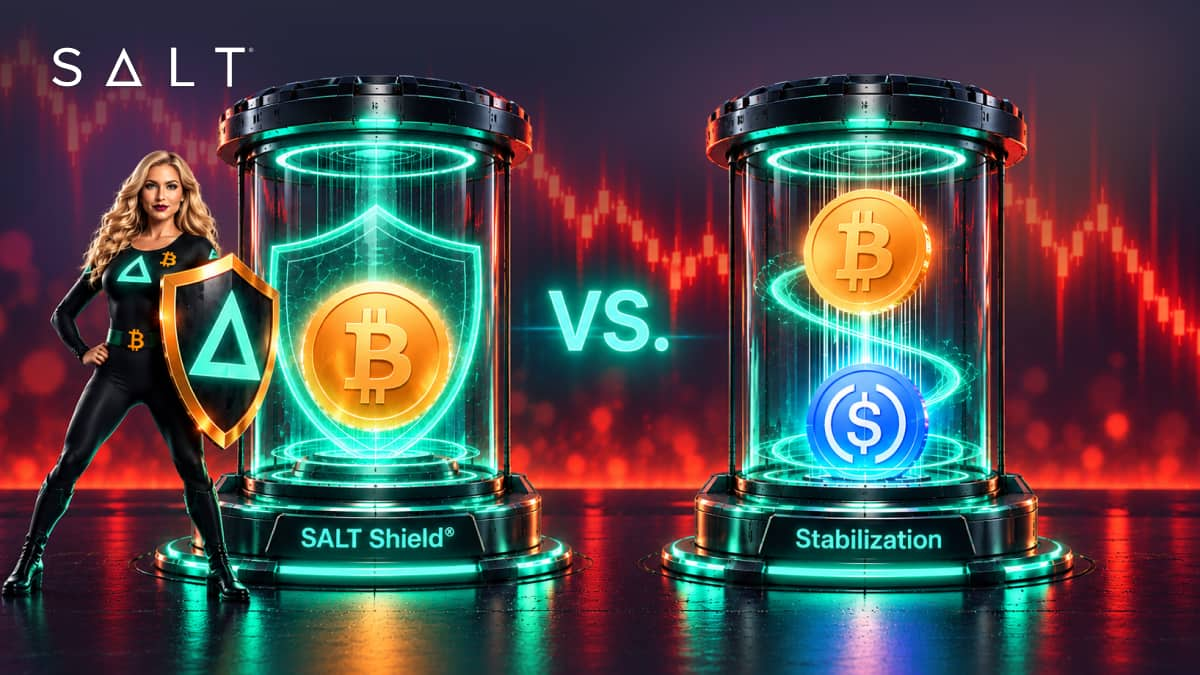

Short answer: SALT Shield® and Stabilization both help keep your bitcoin from being sold in a market crash, but they work in very different ways. SALT Shield® is protection you put in place up front. It is designed to eliminate margin calls and forced liquidations for the rest of your loan term, in exchange for a one-time fee and a lock on collateral withdrawals. Stabilization is an optional feature you turn on for your loan, and it acts only if things go wrong. Once it is on, if your loan-to-value ratio (LTV) reaches 90.91% during a decline, your collateral is converted to USDC to preserve its dollar value, and you can move back into crypto once your LTV is at 83.33% or below. Margin calls still apply to loans using Stabilization.
Most crypto lenders offer one answer to a falling market: sell the borrower’s collateral. SALT offers two alternatives, and choosing between them comes down to how much you value certainty, how much flexibility you need with your collateral, and how much volatility you can stomach. Neither one is on by default, so it is worth deciding before the market moves. This guide compares them side by side so you can choose the one that fits your loan.
Why Downside Protection Matters on a Bitcoin Loan
When bitcoin’s price falls, the value of your collateral falls with it, and your LTV rises. On many platforms, liquidation happens somewhere between 65% and 85% LTV, which means a routine correction can force the sale of your bitcoin near a market low. You lose the asset, you miss the recovery, and the sale may create a taxable event you never planned for.
How likely is that? Based on three years of market data, SALT’s own modeling estimates the likelihood of a liquidation event over a one-year loan term at roughly 67% for a loan starting at 70% LTV, 49% at 50% LTV, and 8% at 30% LTV. Those are historical averages, and individual results vary, but the pattern is clear. The higher your starting LTV, the more a protection plan matters. For background on what happens when LTV rises, see our guide to margin calls on crypto-backed loans.
How SALT Stabilization Works
Stabilization is SALT’s proprietary response to a sharp decline. It is not on by default. You need to turn it on for your loan to be protected by it. It also does not replace margin calls. As your LTV rises, you can still receive margin calls asking you to add collateral or pay down your loan. Stabilization is the backstop if your LTV keeps climbing to the conversion threshold. Once it is on, it works in three stages:
- The trigger. If your LTV reaches 90.91% during a market drop, your crypto collateral is converted to USDC, a U.S. dollar stablecoin. That threshold corresponds to collateral worth roughly 110% of your loan balance.
- The hold. Your collateral now holds its dollar value, so further price drops no longer push your LTV higher. Your loan stays open and your payments continue as usual.
- The re-entry. Once you bring your LTV to 83.33% or below, by paying down principal or adding collateral, you choose when to convert back into your crypto. Re-entry is subject to market prices at the time, and transaction fees apply.
The key difference from liquidation is that your position is paused, not ended. If you re-enter while prices are still low, the same dollar value can buy back more bitcoin than you started with, though prices can also keep falling after you convert back. For a full walkthrough, read How SALT Stabilization Works.
How SALT Shield® Works
SALT Shield® takes a different approach. Rather than reacting to a decline, it is a no-liquidation upgrade you put in place before the market moves. It is structured as an overcollateralization buffer backed by SALT’s treasury and customer-supplied assets, and it is designed to eliminate margin calls and prevent forced liquidations due to market volatility for the remainder of your loan term.
Here is what to know before you enroll:
- Cost. SALT Shield® carries a one-time fee, and the lower your LTV, the lower that fee.
- Eligibility. For the paid upgrade, your loan funding amount must be over $50,000 and your current LTV must be under 70%. Eligible borrowers see a SALT Shield® banner when they log in to their active loan.
- Duration. Protection lasts until your loan’s maturity date, unless you refinance or repay early. When the loan matures, you can refinance or take out a new loan and re-enroll.
- Collateral access. Withdrawals of collateral are not allowed while you are enrolled, which keeps the buffer intact.
Full details are in the SALT Shield® Terms and Conditions, and current fees are listed on the Rates & Fees page.
SALT Shield® vs. Stabilization at a Glance
| SALT Shield® | Stabilization | |
|---|---|---|
| What it is | A no-liquidation upgrade you activate in advance | An opt-in feature that responds to a sharp decline |
| On by default? | No, you enroll | No, you must turn it on |
| When it acts | For the full remaining loan term | When LTV reaches 90.91%, if turned on |
| What happens to your BTC | Stays in place through volatility | Converted to USDC until you re-enter |
| Margin calls | Designed to eliminate them | Yes, margin calls still apply |
| Cost | One-time fee, lower at lower LTVs | Transaction fees on conversions |
| Collateral withdrawals | Not allowed while enrolled | Standard loan terms apply |
| Eligibility | Loans over $50K with LTV under 70% (paid upgrade) | Available to turn on for SALT loans, subject to your loan agreement |
| Best for | Long-term holders who want certainty | Borrowers who want flexibility and active control |
Which Protection Is Right for You?
The right choice depends on your loan size, your LTV, and how you plan to manage the loan. These scenarios can help you decide.
You Want to Set It and Forget It
If you are a long-term holder who does not want to watch the chart or keep extra BTC on standby for a margin call, SALT Shield® is the stronger fit. You pay once, and your bitcoin is protected from forced liquidation for the rest of the term. This is especially valuable if a forced sale would trigger a large capital gain, since avoiding that sale also avoids an unplanned taxable event.
You Need Access to Your Collateral
If you expect to withdraw excess collateral when bitcoin rises, SALT Shield® may not suit you, because withdrawals are paused while you are enrolled. Turning on Stabilization instead keeps your collateral flexible, with the understanding that you will still receive margin calls in a decline and should be ready to add collateral or pay down the loan.
You Borrowed at a Higher LTV
Higher LTV loans carry the most liquidation risk. If your LTV is under 70% and your loan is over $50,000, SALT Shield® can remove that risk for the term, and the fee is the price of certainty. If you are not eligible or prefer not to pay the fee, turn on Stabilization and keep a reserve of cash or BTC you can deploy to answer margin calls and bring your LTV back down.
Your Loan Is Under $50,000
Smaller loans may not qualify for the paid SALT Shield® upgrade, but you can still turn on Stabilization. Make sure it is on, since it does not protect your loan by default. Choosing a conservative starting LTV gives you the most room before a conversion ever happens.
Your First Line of Defense Is Your Starting LTV
Neither feature replaces sensible loan sizing. The single most effective way to protect your bitcoin is to borrow less relative to your collateral. A loan at 30% LTV can absorb a much larger price drop than a loan at 70% LTV before any protection is needed. Use the bitcoin loan calculator to compare LTV levels, and the BTC Margin Event Calculator to see the bitcoin price that would move your loan toward Stabilization. Our guide to how much you can borrow against your bitcoin covers the tradeoffs in more detail.
Frequently Asked Questions
What is the difference between SALT Shield® and Stabilization?
SALT Shield® is protection you activate in advance for a one-time fee. It is designed to eliminate margin calls and forced liquidations for the rest of your loan term. Stabilization is an opt-in feature that, once turned on, converts your collateral to USDC if your LTV reaches 90.91% during a decline, preserving its dollar value until you choose to re-enter. Margin calls still apply with Stabilization. One is prepurchased protection, and the other is a safety net you switch on that acts when needed. Neither is on by default.
Does SALT Shield® prevent liquidation?
SALT Shield® is designed to eliminate margin calls and prevent forced liquidations due to market volatility for the remainder of your loan term. Terms are governed by the SALT Shield® Terms and Conditions and your loan agreement.
How much does SALT Shield® cost?
SALT Shield® carries a one-time fee that is lower for loans with lower LTVs. Current pricing is listed on the SALT Shield® page and the Rates & Fees page.
Who is eligible for SALT Shield®?
For the paid upgrade, your loan funding amount must be over $50,000 and your current LTV must be under 70%. If your loan is eligible, you will see a SALT Shield® banner when you log in to your active loan.
Can I withdraw bitcoin while enrolled in SALT Shield®?
No. Collateral withdrawals are not allowed while you are enrolled in SALT Shield®, which keeps the protective buffer in place for your loan term.
Is Stabilization turned on automatically?
No. Stabilization is not on by default. You must turn it on for your loan to be protected by it. If you are not sure whether it is on for your loan, contact SALT Loan Support at +1 (800) 931-1259.
Do I still get margin calls with Stabilization?
Yes. Stabilization does not eliminate margin calls. As your LTV rises during a decline, you can still receive margin calls asking you to add collateral or pay down your loan. Stabilization acts as a backstop if your LTV reaches 90.91%, converting your collateral to USDC instead of selling it. If you want protection from margin calls themselves, SALT Shield® is designed for that.
At what LTV does Stabilization trigger?
If you have turned it on, Stabilization triggers when your LTV reaches 90.91% during a market decline. Your collateral is then converted to USDC. To convert back into crypto, you bring your LTV to 83.33% or below by paying down principal or adding collateral.
Is Stabilization the same as liquidation?
No. Liquidation sells your collateral and ends your position. Stabilization converts your collateral to a stablecoin while your loan stays open and gives you a defined path back into your original crypto.
Does a Stabilization conversion have tax consequences?
Converting one digital asset into another can have tax consequences depending on your jurisdiction and circumstances. Talk with a tax advisor about your situation.
Protect Your Bitcoin Before the Market Moves
The best time to choose your protection is before you need it. Neither SALT Shield® nor Stabilization protects your loan unless you enroll or turn it on. Compare your options, model your LTV, and talk with a SALT loan manager about which approach fits your plans for your bitcoin.
Descriptions of SALT Shield® and Stabilization in this article are summaries and are qualified in full by your loan agreement and the SALT Shield® Terms and Conditions. Eligibility, pricing, and features are subject to change. Liquidation likelihood estimates are based on SALT’s modeling of historical market data over a three-year period; individual results vary based on collateral type, loan terms, borrower maintenance, and other factors. Stabilization conversions and re-entry are subject to market values at the time of the transaction, and transaction fees apply.
This article is for informational and educational purposes only and does not constitute legal, tax, investment, or financial advice. Consult your own legal, tax, or financial advisors before making any borrowing decisions.
SALT loans are originated by SALT Lending LLC (f/k/a SALT Master Fund II, LLC), NMLS 1711910. Loan terms and features may vary or may not be available in your jurisdiction, for your requested loan amount, and/or preferred collateral type. SALT Loans are subject to jurisdictional limitations and other restrictions; see saltlending.com/map-list for where SALT lends. SALT does not offer loans to all prospective borrowers. Additional terms, conditions, requirements, suitability, and screenings may apply at the sole discretion of SALT. SALT Lending LLC’s loans are issued pursuant to private agreements, and you should review the representations, warranties, and other terms and conditions described in the loan agreement.
Borrowing against collateral entails risk and may not be appropriate for your needs. Rates for SALT products are subject to change. Digital currency is not legal tender, is not backed by the United States or any other government, and SALT accounts are not subject to FDIC or SIPC protections. Digital assets are highly speculative, and anyone considering investing in or with digital assets should be prepared to lose their entire investment.
California: Loans will be arranged or made pursuant to California Financing Law. Idaho: SALT Lending LLC is a licensed regulated lender (License No. RRL-11258). Michigan: Regulatory Loan License No. RL-0025865. See saltlending.com/salt-lending-licenses for additional license information.