

Key Takeaway
Selling bitcoin ends your exposure and may trigger capital gains tax. Borrowing against it preserves exposure, defers realization, and provides liquidity — but introduces interest costs and volatility risk. The right choice depends on your conviction, time horizon, and how the capital will be used.
For long-term bitcoin holders, the hardest financial decision often isn’t whether to buy—it’s whether to sell.
Bitcoin-backed lending introduces a third option: borrow against your BTC instead of liquidating it. The decision is not purely tactical. It’s philosophical. It reflects how you view long-term exposure, tax efficiency, liquidity timing, and capital strategy.
So when does borrowing make more sense than selling?
This guide explores the tradeoffs clearly—including capital gains considerations, opportunity cost, maintaining BTC exposure, and how liquidity timing fits into a broader bitcoin reserve strategy.
The Core Decision: Sell the Asset or Unlock Its Value?
When you sell bitcoin, you:
- Realize gains (or losses)
- Reduce your exposure
- Potentially trigger a taxable event
- Convert a volatile asset into fiat liquidity
When you borrow against bitcoin, you:
- Maintain exposure
- Use BTC as collateral
- Access liquidity without selling
- Repay capital over time
Neither path is universally correct. The right decision depends on your goals, risk tolerance, and time horizon.
Important — Not Tax Advice
Tax treatment of digital assets varies significantly by jurisdiction and individual circumstance. Nothing in this article should be relied upon as tax, legal, or financial advice. Always consult a qualified tax professional before making decisions about selling or borrowing against your digital assets.
Capital Gains Considerations
One of the primary reasons borrowers consider bitcoin-backed lending is capital gains management.
In many jurisdictions, selling appreciated bitcoin may trigger capital gains tax, which reduces net proceeds and crystallizes gains.
Because ownership is retained when BTC is pledged as collateral, borrowing against bitcoin is generally not treated as a sale in many jurisdictions, though tax treatment varies and rules continue to evolve. Borrowers should always consult a qualified tax professional regarding their specific situation.
This creates a strategic choice for holders: sell now and realize the tax outcome, or borrow and preserve optionality. For long-term holders with continued conviction in BTC, avoiding an immediate taxable sale may factor into their broader capital strategy.
Maintaining Bitcoin Exposure
Selling bitcoin reduces your exposure to future price movement. Borrowing allows you to maintain that exposure while accessing liquidity.
Consider a simple scenario.
An investor holds 5 BTC purchased years ago at significantly lower prices. They need liquidity for a business investment. If they sell 1 BTC, they permanently reduce their bitcoin position.
If instead they use that BTC as collateral for a loan, they retain upside exposure on the full 5 BTC. Provided they manage their loan risk responsibly, they continue to participate in any subsequent price appreciation.
This is the core argument for borrowing: preserve long-term exposure while unlocking short-term liquidity.
However, maintaining exposure also means maintaining volatility risk. Borrowing against bitcoin requires comfort with market swings and structured risk management.
The Opportunity Cost of Selling
Selling bitcoin may provide immediate liquidity, but it introduces opportunity cost.
Opportunity cost is not abstract—it is measurable. Consider a holder who sells 1 BTC at $60,000 to fund a project. If BTC subsequently rises to $100,000, the difference between the sale price and the future price is upside the original position no longer captures. (Of course, if BTC declined instead, the sale would have been the better outcome—which is exactly why this decision is so individual.)
Borrowing creates a different tradeoff. Instead of giving up potential appreciation, you incur:
- Interest costs
- LTV exposure (the risk of margin calls if BTC declines)
- Ongoing collateral management responsibility
The question becomes: is the cost of interest, weighed against volatility risk, an acceptable tradeoff for retaining your position?
For long-term conviction holders, that calculation often leans toward borrowing—especially when capital is being deployed into productive opportunities such as business growth, asset acquisition, or investment diversification.
Liquidity Timing Matters
Liquidity is rarely about long-term ideology. It is often about timing.
You may need capital for:
- A business expansion
- Real estate acquisition
- Tax payments
- Strategic investments
- Unexpected expenses
If liquidity needs are short- to mid-term, selling a long-term asset may not align with your broader strategy.
Borrowing allows you to access capital now while preserving long-term positioning. The key is structuring the loan carefully—selecting an appropriate Loan-to-Value (LTV) tier, understanding volatility thresholds, and ensuring repayment capacity aligns with your cash flow.
Liquidity timing is not about maximizing capital at all costs. It is about aligning liquidity access with long-term asset conviction.
When Selling May Make More Sense
Borrowing is not always the better choice. There are scenarios where selling bitcoin is the more rational decision.
Selling may make sense when:
- You no longer have long-term conviction in holding BTC
- The asset has appreciated beyond your intended allocation
- You prefer to eliminate volatility exposure entirely
- Interest costs outweigh the value of retaining the position
- You are simplifying financial structures
If your goal is to reduce risk and lock in gains, selling provides clarity and finality. Borrowing requires ongoing management and acceptance of market volatility.
Risk Awareness: Borrowing Requires Structure
Borrowing against bitcoin is not free capital. It is secured lending.
That means:
- Your BTC serves as collateral
- LTV fluctuates with price movement
- Volatility thresholds may require action
- Interest accrues over time
- Loan terms govern outcomes if LTV is not maintained
The decision to borrow should include:
- A clear understanding of your volatility tolerance
- An adequate collateral buffer
- A liquidity plan for repayment
- Awareness of refinancing options if market conditions change
Structured borrowing can be strategic. Unstructured borrowing can be stressful.
Borrowing Within a Bitcoin Reserve Strategy
For long-term holders, bitcoin is often viewed as a reserve asset—closer to digital collateral than to speculative inventory.
Within that framework, borrowing functions as a capital layer. Instead of selling reserves during liquidity events, you temporarily unlock value while maintaining core holdings.
A disciplined reserve strategy may include:
- Conservative LTV tiers
- Clear collateral management rules
- A defined volatility response plan
- Periodic reassessment of exposure
This approach treats borrowing as capital optimization, not speculative leverage.
Structured bitcoin-backed lending platforms like SALT Lending are built around this kind of disciplined framework. LTV tiers, monitoring systems, SALT Stabilization, and the SALT Shield™ upgrade let borrowers choose conservative or higher-liquidity structures depending on their goals and risk tolerance.
Key Questions to Ask Before Borrowing Instead of Selling
Before choosing to borrow against bitcoin, consider:
- Do I have long-term conviction in holding BTC?
- Am I comfortable with short-term volatility?
- Does the use of funds justify interest costs?
- Is my LTV conservative enough for my risk tolerance?
- Do I have a repayment or refinancing strategy?
These questions transform the decision from emotional to strategic.
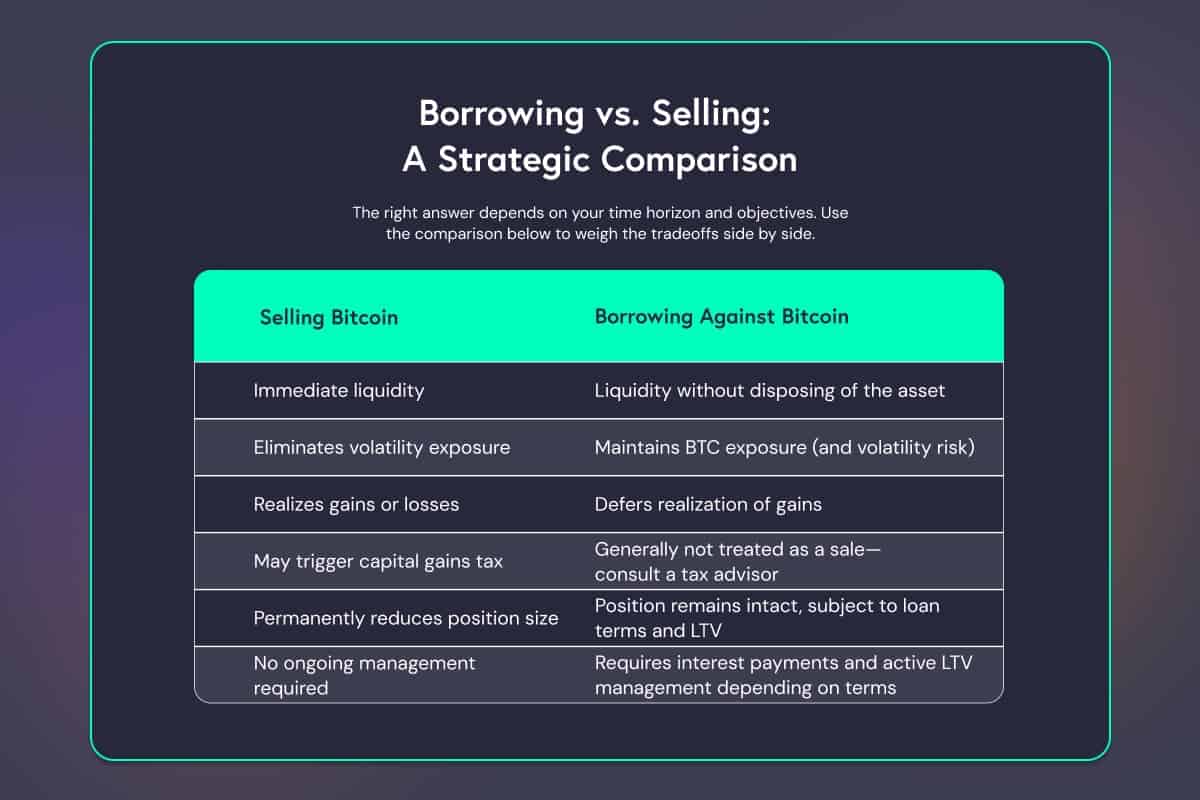
Borrowing vs. Selling: A Strategic Comparison
The right answer depends on your time horizon and objectives. Use the comparison below to weigh the tradeoffs side by side.
| Selling Bitcoin | Borrowing Against Bitcoin |
|---|---|
| Immediate liquidity | Liquidity without disposing of the asset |
| Eliminates volatility exposure | Maintains BTC exposure (and volatility risk) |
| Realizes gains or losses | Defers realization of gains |
| May trigger capital gains tax | Generally not treated as a sale — consult a tax advisor |
| Permanently reduces position size | Position remains intact, subject to loan terms and LTV |
| No ongoing management required | Requires interest payments and active LTV management |
Frequently Asked Questions
Is borrowing against bitcoin taxable?
In many jurisdictions, borrowing itself is generally not considered a taxable event because you are not selling the asset. However, tax treatment varies significantly by jurisdiction and individual circumstance. Consult a qualified tax professional for advice specific to your situation.
Is borrowing always better than selling?
No. Borrowing preserves exposure but introduces interest costs and volatility risk. Selling eliminates exposure but may trigger taxes and opportunity cost. The right decision depends on your conviction, time horizon, and use of funds.
Can I refinance a bitcoin-backed loan later?
Yes, depending on platform policies and market conditions, refinancing may allow adjustment of LTV, terms, or rates.
What is the biggest risk of borrowing instead of selling?
Market volatility. If bitcoin’s price declines significantly, LTV rises and may require collateral management—adding collateral, paying down principal, or, in the absence of corrective action, the consequences defined in your loan agreement, which may include the sale or conversion of collateral.
How does SALT manage volatility on a bitcoin-backed loan?
SALT loans include continuous LTV monitoring, configurable loan health alerts, and SALT Stabilization, which converts BTC collateral to USDC at a defined LTV threshold in lieu of liquidation. Eligible loans can also add SALT Shield™, an optional upgrade that forbears margin call enforcement for the loan term.
The Strategic Perspective
The decision to borrow against bitcoin instead of selling is ultimately about alignment.
If your long-term conviction is strong and your liquidity need is temporary, borrowing may help you preserve your position while accessing capital. If your goal is to reduce volatility exposure and simplify holdings, selling may be more appropriate.
Bitcoin does not force one answer. It demands structured thinking.
Liquidity is temporary. Conviction is long-term.
The question is not simply “borrow or sell.” The question is how each choice fits into your broader financial strategy.
Explore Bitcoin-Backed Loan Options
If maintaining exposure while unlocking liquidity aligns with your strategy, explore SALT’s loan structures, LTV tiers, and pricing to see what fits your risk tolerance.
Important Disclosures
This content is for informational and educational purposes only and does not constitute financial, investment, tax, or legal advice. Tax treatment of digital assets varies significantly by jurisdiction and individual circumstance; readers should consult a qualified tax professional before making any decision involving the sale of, or borrowing against, digital assets.
Borrowing against bitcoin involves risk, including the potential loss of collateral. Past performance and historical market behavior are not indicative of future results. Loan products, LTV options, interest rates, fees, and terms are subject to change and are governed by your loan agreement.
SALT products and services are not available in all jurisdictions. For the most current list of supported jurisdictions, please visit saltlending.com/map-list.