
If you are shopping for a loan against your Bitcoin, the first number you look for is the rate. It is also the number most likely to be quoted out of context. Two lenders can advertise nearly identical numbers and deliver very different costs, because one may be quoting a simple interest rate and the other a true APR, and neither figure captures the fees you only pay if the market moves against you.
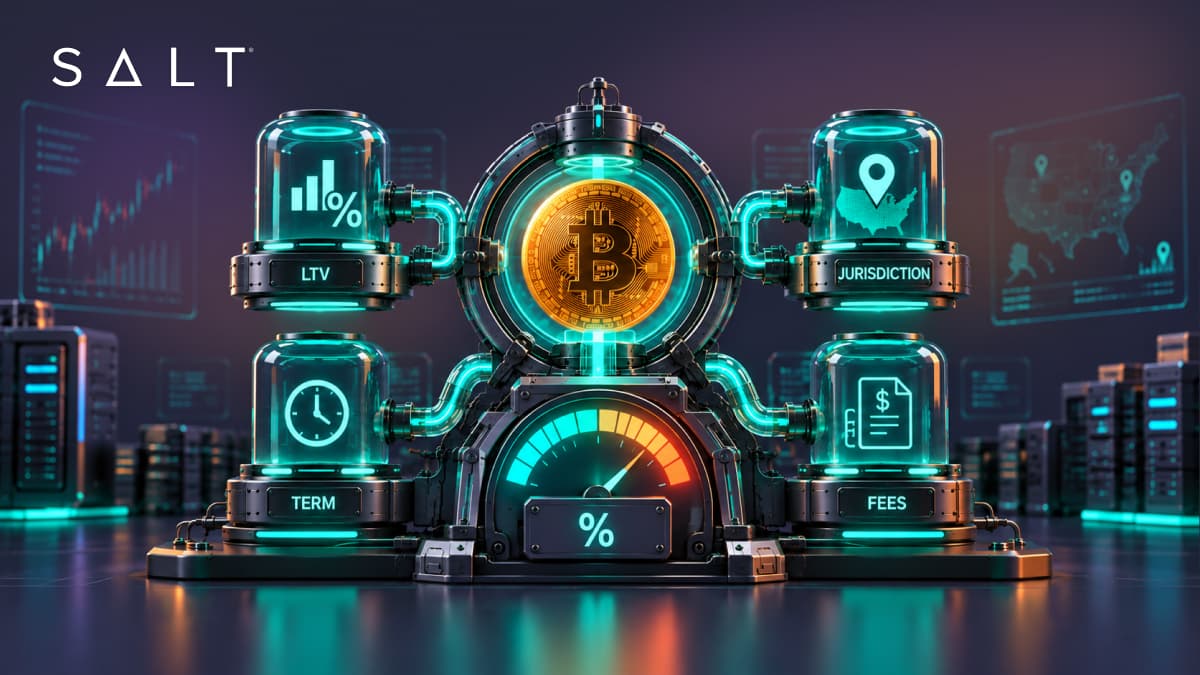
Here is the short version. Bitcoin-backed loan rates in 2026 generally fall between roughly 7% and 15% APR for centralized lenders in the United States. At SALT, published rates start at 7.49% APR at 30% LTV on a one-year term and top out at 10.50% APR at 70% LTV, with the same published rate available at every loan size we offer. Your specific rate depends on four things: your LTV, your term, your jurisdiction, and the fee structure the lender layers on top.
This guide breaks down each of those levers, shows the arithmetic on what they actually cost, and gives you a short list of questions to ask any lender before you transfer collateral.
What “Rate” Actually Means on a Bitcoin-Backed Loan
On a crypto-backed loan, the rate is the annual cost of borrowing against collateral you already own. It is not a credit-based rate in the traditional sense. Because the loan is secured by your Bitcoin rather than by your income or credit history, the lender is pricing collateral risk, not borrower risk.
That distinction explains a lot about how these loans are priced:
- Your credit score usually does not move the number. Most crypto-backed lenders, including SALT, do not run a hard credit inquiry as part of underwriting, so a 780 score does not earn you a discount and a 620 score does not cost you a premium.
- Collateral quality matters more than income. Deeply liquid assets with mature markets support lower pricing than thinly traded ones.
- The cushion you leave sets the price. The more collateral you pledge relative to the amount you borrow, the less exposed the lender is to volatility, and the lower your rate.
If you want the mechanics before the pricing, start with our overview of how bitcoin-backed loans work and then come back to this page.
SALT Published Rates in 2026
SALT publishes its full rate card rather than quoting privately, and the same rate applies at every loan size we offer. There are no volume tiers and no relationship pricing thresholds you have to clear before the headline number applies.
| LTV Tier | 1-Year | 3-Year Fixed | 5-Year Fixed |
|---|---|---|---|
| 30% LTV | 7.49% APR | 8.24% APR | 8.49% APR |
| 50% LTV | 8.75% APR | 9.50% APR | 9.75% APR |
| 70% LTV | 10.50% APR | Not offered | Not offered |
Two details in that table are worth pausing on. First, the 70% LTV tier is only available on a one-year term, because a higher LTV loan leaves less room for a multi-year price commitment. Second, the three- and five-year tiers are fixed for the full term. Most crypto lenders write twelve-month papers, which means renegotiating at whatever the market rate happens to be when your loan matures.
SALT also charges no origination fee, no prepayment penalty, and no custody fee. That matters more than most borrowers expect, and the next few sections show why.
The Four Levers That Set Your Rate
Loan-to-Value Ratio
LTV is the size of your loan relative to the value of your collateral. Pledge $100,000 of Bitcoin and borrow $30,000 and your LTV is 30%. Borrow $70,000 against the same collateral and your LTV is 70%.
LTV is the single largest driver of your rate because it determines how far Bitcoin can fall before the lender is exposed. A 30% LTV loan can absorb a much deeper drawdown before a margin call becomes relevant than a 70% LTV loan can. Lenders price that difference, and at SALT it is worth roughly three percentage points between the lowest and highest tier.
Term Length
Longer fixed terms usually price slightly higher than short ones, because the lender is committing to a rate through an unknown future. At SALT the premium for locking five years instead of one is 100 basis points at 30% LTV, which is a small price for removing five years of refinancing risk. If you expect to repay in under a year, the one-year rate is the cheaper choice. If you are a long-term holder using liquidity for something structural, the fixed multi-year rate is usually the better trade.
Jurisdiction
Crypto-backed lending is licensed state by state in the United States and country by country elsewhere. Those rules govern who is permitted to lend, what can be charged, and how it must be disclosed. The practical result is that the same product may carry different terms in different places, or may not be offered at all where you live. Availability and minimums are confirmed at application, and you can check current jurisdictional availability at saltlending.com/map-list.
Fee Structure
This is the lever borrowers most often overlook. Some costs belong inside the APR and some never appear there at all, which is why two quotes that look alike on paper can settle out very differently. The next section separates the two.
Interest Rate Versus APR, and the Fees Neither One Captures
Start by confirming which number you are being quoted. A properly calculated APR already includes prepaid finance charges such as an origination fee, which is the whole point of the figure: it expresses interest and mandatory upfront costs as one annualized number so that two loans can be compared directly. A simple interest rate does not. Crypto-backed loans are frequently written as private agreements, and business-purpose loans sit outside consumer lending disclosure requirements entirely, so the industry is inconsistent about which number gets advertised.
That inconsistency is where comparison shopping goes wrong. Take two $50,000 loans, both on a one-year term with interest-only monthly payments and principal due at maturity:
- Lender A: a true 8.75% APR with no origination fee. Interest over twelve months is about $4,375, and that is the whole cost.
- Lender B: a quoted 8.25% interest rate with a 2% origination fee. Interest is about $4,125, the fee takes $1,000 off the top, and you have paid roughly $5,125 for $49,000 of usable cash. Disclosed as an APR, with the fee treated as a prepaid finance charge, that is about 10.4%.
Lender B advertises the lower number and costs about 17% more. Structure matters here too: if that loan amortized instead, the APR would be higher still, because you would be paying down principal while the fixed fee stayed the same size. So the first question is simple: is that an APR or an interest rate, what is included in it, and what payment structure is it based on?
The second question is harder, because there is a whole category of cost that no APR captures. APR is calculated on the assumption that the loan runs as scheduled. It says nothing about what you pay when it does not. On a loan secured by a volatile asset, those contingent costs are not edge cases:
- Fees to add collateral, stabilize a position, or cure a margin call
- Liquidation fees, and how the liquidation price is determined
- Prepayment penalties or minimum interest periods if you repay early
- Custody or storage fees charged against pledged collateral
- Withdrawal or network fees when collateral is returned to you
- Refinance or extension fees at maturity, including origination charged a second time
A lender with a slightly higher APR and none of the above can easily be the cheaper loan, particularly if Bitcoin has a volatile year. Ask for the fee schedule in writing, not just the rate. SALT charges no origination fee, no prepayment penalty, and no custody fee, and publishes the full schedule on the rates and fees page.
What the Same Collateral Costs at Three Different LTVs
Assume you hold $100,000 of Bitcoin and you want cash without selling it. Using SALT one-year pricing, and assuming interest-only payments for simplicity:
- 30% LTV: borrow $30,000 at 7.49% APR. Annual interest is about $2,247. You keep a very large volatility cushion.
- 50% LTV: borrow $50,000 at 8.75% APR. Annual interest is about $4,375.
- 70% LTV: borrow $70,000 at 10.50% APR. Annual interest is about $7,350, and your cushion before a margin event is much thinner.
Moving from 30% to 70% LTV roughly doubles your cash but more than triples your interest cost, while cutting the room you have to absorb a drawdown. That is the real trade in crypto-backed lending, and it is a risk decision as much as a pricing one. Our loan calculator and margin event calculator will run the numbers on your own collateral and target loan size.
For an amortizing example, a $100,000 loan at 8.49% APR on a five-year fixed term runs about $2,051 per month, or roughly $23,070 in total interest over the full term.
How Crypto Loan Rates Compare to Other Borrowing Options
Crypto-backed loans usually sit between mortgage-type secured credit and unsecured consumer credit. Mortgages and home equity lines price lower because real estate moves slowly, and lenders price Bitcoin volatility accordingly. The trade runs the other way too: Bitcoin collateral can be verified on a public ledger and settled in minutes, where a mortgage takes weeks to close and a foreclosure takes months to resolve. Credit cards and cash advances price far higher, often north of 20% APR, because there is no collateral at all.
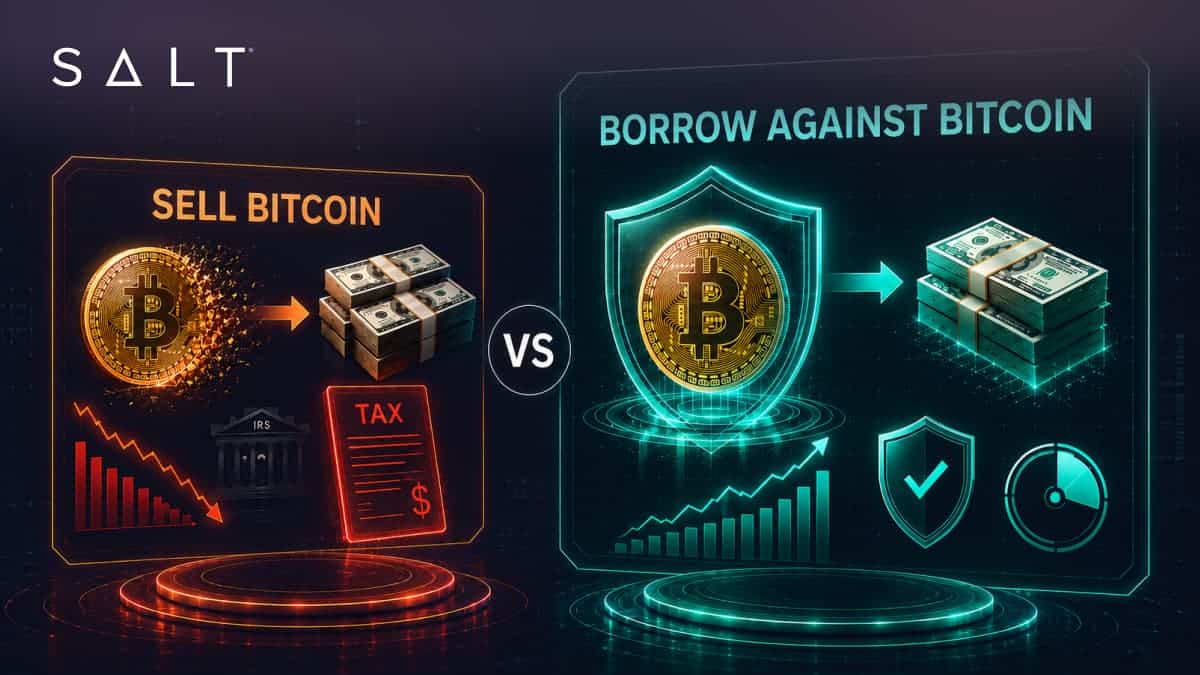
Where a bitcoin-backed loan wins is not usually the raw rate. It is speed, the absence of a credit check, and the fact that you do not trigger a taxable disposal of an appreciated asset. If your Bitcoin has a low cost basis, the capital gains tax you avoid by borrowing instead of selling can dwarf the interest you pay. We walk through that comparison in our posts on borrowing versus selling and on bitcoin-backed loans versus a HELOC or personal loan.
Six Questions to Ask Before You Accept a Rate
Use these as a script. A lender that answers all six clearly and in writing is telling you something about how it operates.
- 1. Is that an APR or an interest rate, and what is my all-in dollar cost? Ask for the total cost of the loan at your LTV and term, including anything due at signing.
- 2. Is the rate fixed or variable? Variable-rate products can reprice on you mid-loan. Fixed means fixed for the full term.
- 3. Is this rate available at my loan size? Many lenders reserve their headline number for large balances.
- 4. Where is my collateral held, and is it rehypothecated? Collateral that gets lent out to generate yield is collateral exposed to someone else failing. SALT holds collateral with qualified institutional custodians and does not rehypothecate it.
- 5. What is the margin call process? Ask for the specific LTV thresholds, how much notice you get, and what your cure options are.
- 6. What happens at maturity? Confirm whether you can refinance, extend, or repay early without a penalty.
If you want the deeper version of question four, our guide on whether bitcoin-backed loans are safe covers custody and rehypothecation in detail, and our margin call explainer covers question five.
Frequently Asked Questions
What is a good interest rate for a bitcoin-backed loan in 2026?
For a centralized US lender, anything in the high single digits at a lower LTV is competitive, and low double digits is normal at higher LTV. Always compare at the same LTV and term, because a 7% rate at 20% LTV and a 12% rate at 70% LTV are not the same product. Confirm you are comparing APR to APR as well, since a quoted interest rate with an origination fee attached can cost more than a higher APR with no fees.
Why are crypto loan rates higher than mortgage rates?
Bitcoin is more volatile than real estate, and the collateral can lose a large share of its value in weeks rather than years. Lenders price that volatility, plus the operational cost of holding digital assets in qualified custody and monitoring positions in real time. The offsetting benefits are speed, no credit check, and no taxable sale.
Does my credit score affect my bitcoin loan rate?
At SALT, no. Underwriting is based on the collateral you pledge rather than your credit file, and there is no hard credit inquiry as part of the process. Your rate is set by your LTV, your term, and your jurisdiction.
Are bitcoin-backed loan rates fixed or variable?
It depends on the lender and the product. DeFi lending protocols are typically variable and can move sharply with pool utilization. SALT rates are fixed for the term you select, including on three- and five-year loans, so the rate you sign is the rate you pay through maturity.
Can I get a lower rate by pledging more collateral?
Yes, and this is the most direct control you have. Pledging more collateral for the same loan amount lowers your LTV, which moves you into a lower-priced tier and simultaneously increases your cushion against a margin call. It is one of the few decisions in lending that improves both your cost and your risk profile at the same time.
Do I pay a fee to originate or prepay a SALT loan?
No. SALT charges no origination fee, no prepayment penalty, and no custody fee. Certain fees may be treated differently in certain jurisdictions, and origination fees may apply to refinances where required by local rules, so review the full rates and fees page and your loan agreement.
How quickly can I get funded once I accept a rate?
Applications typically take under ten minutes including identity verification, and funds are usually disbursed within 24 to 48 business hours of loan approval to a bank account or stablecoin wallet.
The Bottom Line
The advertised rate is a starting point, not an answer. What you actually pay is a function of the LTV you choose, the term you lock, the jurisdiction you borrow in, and every fee that sits outside the APR. Compare lenders at identical LTV and term, insist on all-in dollar costs, and treat custody and margin call policy as part of the price, because both determine what happens to your Bitcoin in the scenario that matters most.
SALT publishes its full rate card, starting at 7.49% APR, with the same rate at every loan size we offer and no origination or prepayment fees. You can run your own numbers with the loan calculator or review the complete rate and fee schedule before you apply.
Disclosures
Interest rates, terms, and fees posted herein are subject to change at any time without notice and may not reflect current offerings. Any rates or promotions may be modified or discontinued at any time. Restrictions apply. Rates shown are the published rates at the time of writing; your actual rate will be confirmed at application.
Loan terms, minimums, maximums, and product availability vary by jurisdiction and may not be available in your jurisdiction, for your requested loan amount, or for your preferred collateral type. SALT loans are subject to jurisdictional limitations and other restrictions, and SALT does not offer loans to all prospective borrowers. For current jurisdictional availability, see saltlending.com/map-list. Certain fees described herein may not be applicable in all jurisdictions or may apply at a reduced amount in certain jurisdictions. Origination fees may be applicable to refinances and may be deemed an administrative fee in applicable jurisdictions.
All payment, interest, and cost figures in this article are illustrative examples calculated for the purpose of comparison only. They assume the stated rate, term, and payment structure, do not include any applicable third-party costs, and do not represent an offer of credit or a quote. Actual costs will vary. A loan inquiry does not constitute an offer, availability, or application for a loan.
Borrowing against collateral entails risk and may not be appropriate for your needs. Digital assets are highly volatile and a decline in collateral value may result in a margin call, the requirement to post additional collateral, or the liquidation of collateral. Digital currency is not legal tender, is not backed by the United States or any other government, and SALT accounts are not subject to FDIC or SIPC protections.
Nothing in this article constitutes investment, financial, trading, legal, or tax advice, and nothing herein should be construed as an offer, sale, endorsement, or recommendation regarding any security or digital asset. Tax treatment of borrowing against digital assets depends on your individual circumstances and may change. You are encouraged to conduct your own research and to consult your financial, tax, or legal advisors before making any decisions.
SALT loans are originated by SALT Lending LLC (f/k/a SALT Master Fund II, LLC), NMLS 1711910. Loans are issued pursuant to private agreements. You should review the representations, warranties, and other terms and conditions described in the loan agreement.