
A clear-eyed plan from SALT’s Chief Revenue Officer — the math, the mindset, and the mistakes to avoid.

Prefer to watch instead of read? Hunter walks through the full framework in his video.
Let’s start with honesty. What follows is a plan — not a promise. It carries real risk, the kind that compounds in both directions over a decade. But after nearly 30 years working at the intersection of credit, analytics, and emerging technology, I haven’t found a more repeatable framework for thinking about long-term financial freedom with Bitcoin.
I’m Hunter Albright. I’m the Chief Revenue Officer at SALT, a former banking executive, and a professor at the University of Colorado Boulder. This is how I’d approach a 10-year Bitcoin retirement plan if I were starting today — the math, the mindset, and the mistakes I’d refuse to make.
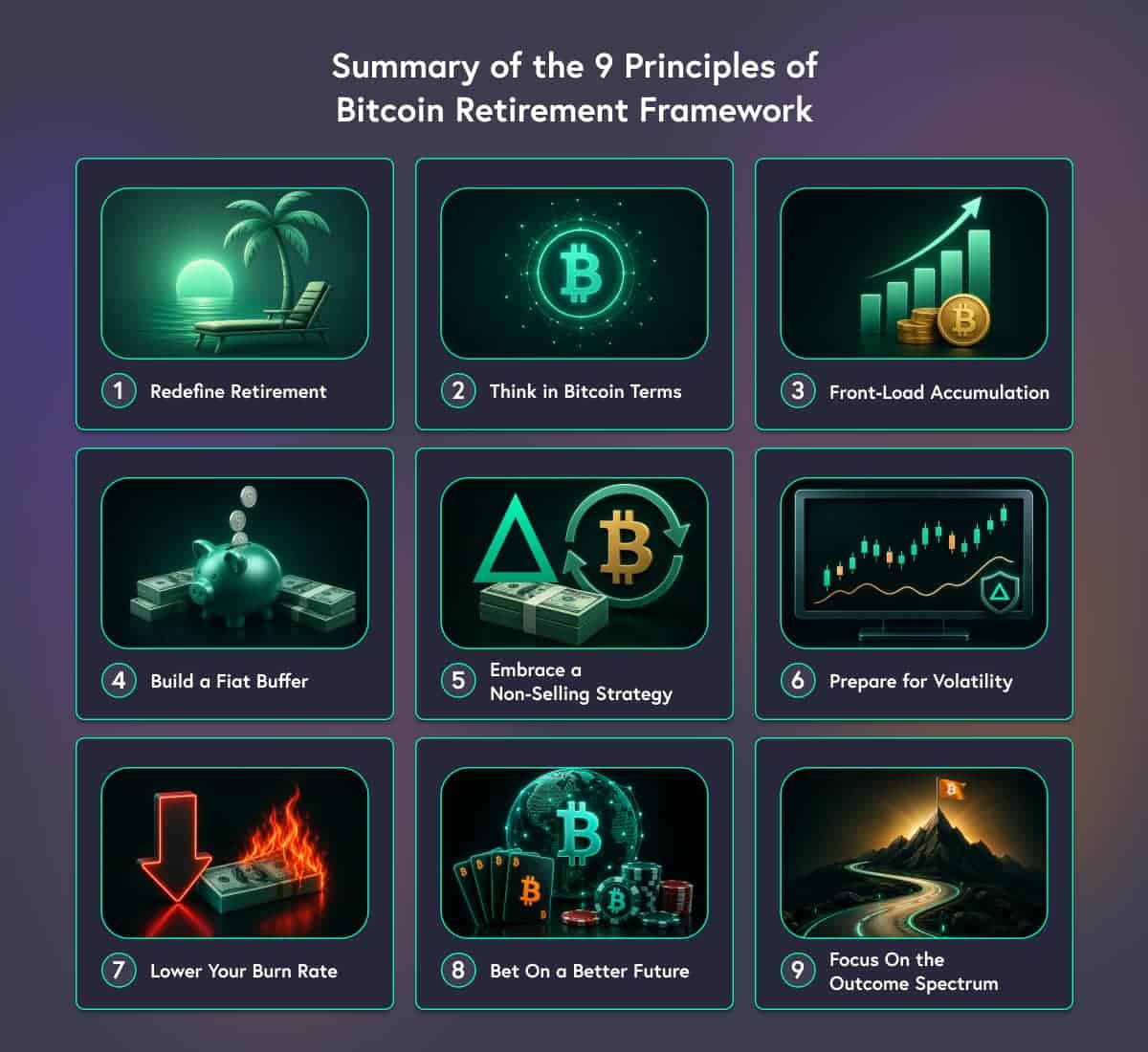
1. Redefine What “Retirement” Actually Means
Before any numbers, get the definition right.
Retirement isn’t an off-switch. It’s a structural condition where your assets generate enough resilience and flexibility that you’re no longer required to sell your time to cover living expenses — and work becomes optional rather than mandatory.
From there, the question becomes practical: what does your life actually cost in a year? Not your aspirational life. Not the version of you that’s been overtaken by lifestyle creep. The real, sustainable annual number.
Let’s call it $120,000.
Traditional finance would tell you to multiply that by 25 — the inverse of the well-known 4% rule. That’s $3 million invested.
Bitcoin changes the question.
2. Think in Bitcoin Terms, Not Just Dollar Targets
If you’re serious about retiring on Bitcoin, anchor on supply instead of price.
There will only ever be 21 million BTC. That fixed denominator matters more than next quarter’s chart. One Bitcoin today represents one twenty-one-millionth of the total supply that will ever exist.
So instead of asking, “How many dollars do I need?”, a more useful question is: “What share of the total supply gives me confidence relative to long-term global adoption?”
This reframe forces longer-term thinking. It also keeps you from selling at lows just because dollar targets feel distant. Retiring on Bitcoin is, at its core, a thesis that the asset’s purchasing power increases over time — and your plan should reflect that thesis, not contradict it.
3. Front-Load the Accumulation Phase (Years 1–5)
In a 10-year plan, the first five years do most of the structural work. They’re for accumulating, not optimizing.
To compress a 30-year retirement timeline into a 10-year one, the lever isn’t speculation — it’s savings rate.
- A 10% savings rate over 10 years? Mathematically, retirement isn’t realistic.
- A 40–60% savings rate? Now you’re working with a structurally different curve.
This phase usually requires three things at once: converting a meaningful share of income into Bitcoin, cutting unnecessary expenses, and — often — intentionally growing income.
It also requires reframing volatility. During accumulation, a 50% drawdown isn’t a threat; it’s a discount. But only if your conviction is built on something deeper than price action.
4. Build a Fiat Stability Buffer
This is the part most plans skip — and it’s where most plans break.
Bitcoin can draw down 50–80% during cycles. That’s historically true. If your only source of liquidity is the asset that just lost half its value, you’re not retired. You’re fragile.
Before treating Bitcoin as a retirement asset, build:
- 12–24 months of living expenses in cash or highly liquid, low-volatility assets.
- Optional structured income streams (consulting, part-time work, equity cash flow).
The function of this buffer is simple: it prevents forced selling. The biggest risk to retiring on Bitcoin isn’t the asset’s price — it’s bad liquidity timing.
5. Design a Non-Selling Strategy
If your goal is to retire on Bitcoin, it’s worth asking why your plan would default to selling it.
Every coin liquidated permanently reduces your exposure to the scarce asset you spent a decade accumulating. A serious plan minimizes that — it doesn’t maximize it.
What “non-selling” can look like in practice:
- Strategic, partial liquidation only during strong market conditions.
- Yield generated from other productive assets layered on top of the Bitcoin position.
- Staggered withdrawal strategies that smooth out cycles.
- Borrowing against Bitcoin to access liquidity without surrendering it.
That last one is why SALT exists. Bitcoin-backed loans let holders unlock cash from their stack without triggering a sale — which can also mean preserving long-term upside and, in many situations, deferring a taxable event. Whether that’s the right tool for any individual depends on jurisdiction, tax situation, and risk tolerance, but the principle is consistent: the goal is sustainability, not one perfectly timed exit.
6. Stress-Test Your Volatility Tolerance
Most plans don’t fail on a spreadsheet. They fail emotionally.
Imagine Bitcoin drops 60% in year eight of your 10-year plan. What actually happens — to your decisions, your sleep, your spouse, your portfolio?
Three honest questions to sit with now:
- Can I handle a multi-year drawdown without abandoning the plan?
- Can I continue accumulating during downturns instead of freezing?
- Can I avoid over-leveraging during euphoria?
Retiring on Bitcoin requires emotional durability more than market timing. If conviction breaks during volatility, the rest of the math doesn’t matter.
7. Design a Life That Doesn’t Require Constant Capital Depletion
A retirement plan is also a lifestyle plan.
The lower your burn rate, the less Bitcoin you need to be free. That math is unforgiving — and freeing.
Useful questions to sit with:
- Can I reduce fixed expenses without lowering quality of life?
- Can I be geographically flexible?
- Can I design income streams aligned with my interests rather than my obligations?
- Can I separate status from spending?
Intentional expenses are the leverage point almost no one talks about. They scale freedom faster than returns do.
8. Be Honest About the Macro Bet You’re Making
A 10-year Bitcoin retirement plan is, by definition, a directional thesis. It assumes:
- Continued global adoption of Bitcoin.
- Increasing institutional recognition.
- A growing monetary premium.
- Expanding liquidity infrastructure.
That may happen. It may happen faster than expected. It may happen more slowly. None of it is guaranteed.
Conviction should come from research and structural reasoning — supply mechanics, institutional behavior, regulatory direction — not from social media narratives. The plan has to survive being wrong about the timing.
9. The 10-Year Outcome Spectrum
Over a decade, one of three broad outcomes is likely:
- Bitcoin’s purchasing power significantly increases.
- Bitcoin moderately appreciates and stabilizes.
- Bitcoin underperforms expectations.
A well-built plan benefits from all three.
- If Bitcoin outperforms, retirement arrives early.
- If results are moderate, your flexibility expands.
- If Bitcoin underperforms, you still have a high savings rate, a buffer, a lower burn rate, and discipline — every one of which leaves you better off than before.
A good plan improves your life regardless of outcome. That’s how you know it’s a plan and not a wager.
What I Would — and Wouldn’t — Do
If I were trying to retire on Bitcoin in 10 years, here’s what I’d avoid:
- Gambling on short-term price swings.
- Over-leveraging during the upside.
- Relying on perfect timing.
Here’s what I’d do:
- Save aggressively.
- Think in Bitcoin terms.
- Build liquidity buffers.
- Stress-test volatility.
- Design a lower burn-rate life.
- Stay disciplined for a full decade.
Retirement — especially accelerated retirement — isn’t about predicting the future. It’s about building enough margin that the future has less control over you.
Bitcoin, for many people, represents a new monetary foundation. But foundations only work if you build carefully on top of them.
The real question isn’t “Will Bitcoin let me retire in 10 years?”
It’s “Am I willing to live in a way that makes that possible?”
KEEP GOING
If this framework clicks with you, the next conversation in the series tackles the question every long-term holder eventually faces: should you ever sell your Bitcoin?
Watch and subscribe to Hunter’s channel to keep building the foundation: https://www.youtube.com/watch?v=5KoNhxEROmQ
Want to access cash from your Bitcoin without selling it? Explore Bitcoin-backed loans at saltlending.com.
Frequently Asked Questions
How much Bitcoin do I need to retire?
There’s no single answer. The honest approach starts with your real annual expenses, not a fixed dollar target. Traditional planning suggests roughly 25× your annual expenses in invested assets. For Bitcoin specifically, many holders also think in terms of share of total supply, since only 21 million BTC will ever exist.
Is it realistic to retire on Bitcoin in 10 years?
It depends primarily on your savings rate, your time horizon, your risk tolerance, and what Bitcoin’s purchasing power does over that decade. A 10-year plan is realistic only with aggressive savings, strong conviction, and a willingness to handle volatility — and it remains a directional thesis, not a guarantee.
What’s the biggest risk to a Bitcoin retirement plan?
Forced selling during drawdowns. Bitcoin’s cycles can include 50–80% drawdowns. Without a fiat liquidity buffer, holders may be forced to sell at the worst possible time. That’s why a 12–24 month buffer is foundational.
Can I access cash without selling my Bitcoin?
Yes. Bitcoin-backed loans, such as those offered by SALT, allow holders to borrow against their Bitcoin to access fiat or stablecoin liquidity without selling the underlying asset. Eligibility, terms, and availability vary by jurisdiction.
Is this financial advice?
No. This article is educational and reflects the author’s framework, not personalized financial, legal, or tax advice. Consult a qualified professional before making decisions about your individual situation.
About the Author
Dr. Hunter Albright is the Chief Revenue Officer at SALT, a former banking executive, and a professor at the University of Colorado Boulder. For nearly 30 years, he has worked at the intersection of credit, analytics, and emerging technology — leading global portfolios in traditional finance and building Bitcoin-backed lending infrastructure today.
Important Disclosures
This content is for informational and educational purposes only and does not constitute financial, investment, tax, or legal advice. Tax treatment of digital assets varies significantly by jurisdiction and individual circumstance; readers should consult a qualified tax professional before making any decision involving the sale of, or borrowing against, digital assets.
Borrowing against bitcoin involves risk, including the potential loss of collateral. Past performance and historical market behavior are not indicative of future results. Loan products, LTV options, interest rates, fees, and terms are subject to change and are governed by your loan agreement.
SALT products and services are not available in all jurisdictions. For the most current list of supported jurisdictions, please visit saltlending.com/map-list.