
Bitcoin was once dismissed as speculative, volatile, and disconnected from the traditional financial system. That framing no longer reflects reality. Today, Bitcoin is increasingly evaluated alongside gold, real estate, and other hard assets as a store of value — not because it lacks volatility, but because its fixed supply and transparent monetary policy offer a form of scarcity that fiat systems cannot replicate.
This article explains why Bitcoin’s store-of-value narrative has endured, how Bitcoin compares to traditional wealth-preservation assets, and how long-term holders use Bitcoin strategically — often without selling it — to preserve purchasing power over time.
Key Takeaways
- Bitcoin is increasingly evaluated alongside gold and other hard assets because its supply is fixed at 21 million coins and governed by transparent, rules-based monetary policy.
- Volatility does not disqualify an asset from being a store of value. Long-term purchasing power, not short-term price stability, is the defining characteristic.
- Long-term Bitcoin holders can access liquidity without selling by using Bitcoin-backed loans with conservative loan-to-value ratios.
- Risk management is essential. Conservative LTVs, liquidity reserves, and features like SALT Shield™ are designed to reduce forced-liquidation risk.
What Is a Store of Value?
A store of value is an asset that preserves purchasing power over time. It does not need to generate income or remain stable day to day. It needs to maintain its value across economic cycles, inflationary periods, and market shocks.
Historically, strong stores of value share several characteristics:
- Scarcity — limited or difficult-to-expand supply
- Durability — resistant to decay or degradation
- Divisibility — can be broken into smaller units
- Portability — easy to move and transfer
- Liquidity — can be exchanged when needed
- Credibility — trusted over time
Gold earned its role as a store of value not because it was exciting, but because it has consistently preserved value through inflationary periods, currency failures, and geopolitical shocks. Bitcoin is now being evaluated by the same standards.
Bitcoin’s Built-In Scarcity
Of the characteristics above, scarcity is often the most important. An asset that can be created easily or endlessly has difficulty holding value over the long term. Bitcoin introduced a new concept: digital scarcity.
Although Bitcoin exists entirely online, its supply is strictly limited by code. Bitcoin’s total supply is capped at 21 million coins, and its issuance schedule is predetermined and transparent. New bitcoin is released at a fixed rate that slows over time through a process known as the halving, and the total supply will never exceed that 21 million cap.
This makes Bitcoin structurally different from most traditional assets. Gold is scarce, but when prices rise, mining companies often increase production and higher prices can bring more supply to market. Bitcoin’s supply schedule does not change based on demand or market conditions. It is governed by the protocol, not by a producer’s response to price.
Fiat currencies can be expanded by central banks. Bitcoin cannot. The network is maintained by a decentralized group of computers that validate transactions through proof-of-work, which makes Bitcoin’s monetary policy extremely difficult to change or manipulate.
Why Bitcoin Entered the Store-of-Value Conversation
Bitcoin was not created to replace fiat currencies overnight. It was designed to address a different problem: monetary debasement and reliance on centralized trust. Several forces pushed Bitcoin into the store-of-value discussion.
1. Fixed Supply in an Inflationary World
Bitcoin has a hard cap of 21 million coins. No central bank, government, or emergency policy can change that. As global money supply expanded aggressively over the last decade, assets with provable scarcity became more valuable to investors focused on preserving purchasing power.
2. Monetary Policy Uncertainty
Persistent inflation, rising interest rates, expanding sovereign debt, and geopolitical instability have weakened confidence in long-term fiat purchasing power. Bitcoin offers an alternative: a rules-based monetary asset with transparent issuance and predictable supply.
3. Institutional Market Maturity
Bitcoin markets today are materially more developed than they were a few years ago:
- Spot and futures ETFs
- Institutional-grade custody solutions
- Regulated Bitcoin-backed lending
- Deeper liquidity and improved price discovery
These developments have not removed volatility, but they have solidified Bitcoin’s role as a long-term financial asset.
4. Demographic and Wealth Transfer Tailwinds
A large intergenerational wealth transfer is already underway. Cerulli Associates projects that roughly $124 trillion will pass from older generations to heirs and charities in the United States by 2048, placing increasing financial influence in the hands of Millennials and Gen Z — demographics that surveys consistently show are more comfortable holding digital assets than their parents. As this shift unfolds, Bitcoin’s role in the global financial system may continue to grow alongside it.
Volatility Does Not Disqualify Bitcoin as a Store of Value
A common objection to Bitcoin as a store of value is volatility. Volatility alone does not disqualify an asset from preserving value, though. It changes how that asset must be used.
Gold experienced significant volatility during periods of monetary transition. Emerging market currencies, equities, and even government bonds fluctuate sharply during regime shifts. Bitcoin’s volatility reflects its relatively short history, rapid global adoption cycles, sensitivity to global liquidity, and speculative activity layered on a scarce asset. Over longer time horizons, volatility tends to compress, and the ability to preserve purchasing power becomes more visible. Time horizon matters.
Bitcoin vs. Gold: An Evolution in Store-of-Value Design
Bitcoin is often referred to as “digital gold,” but it is better understood as an evolution of store-of-value design.
| Attribute | Gold | Bitcoin |
|---|---|---|
| Supply | Finite but expandable | Hard-capped at 21M |
| Portability | Physical, slow | Instant, global |
| Verifiability | Physical assays | Cryptographic proof |
| Divisibility | Limited | Near-infinite (to 0.00000001 BTC) |
| Custody | Physical vaulting, shipping, and insurance | Self-custody or qualified digital custodian |
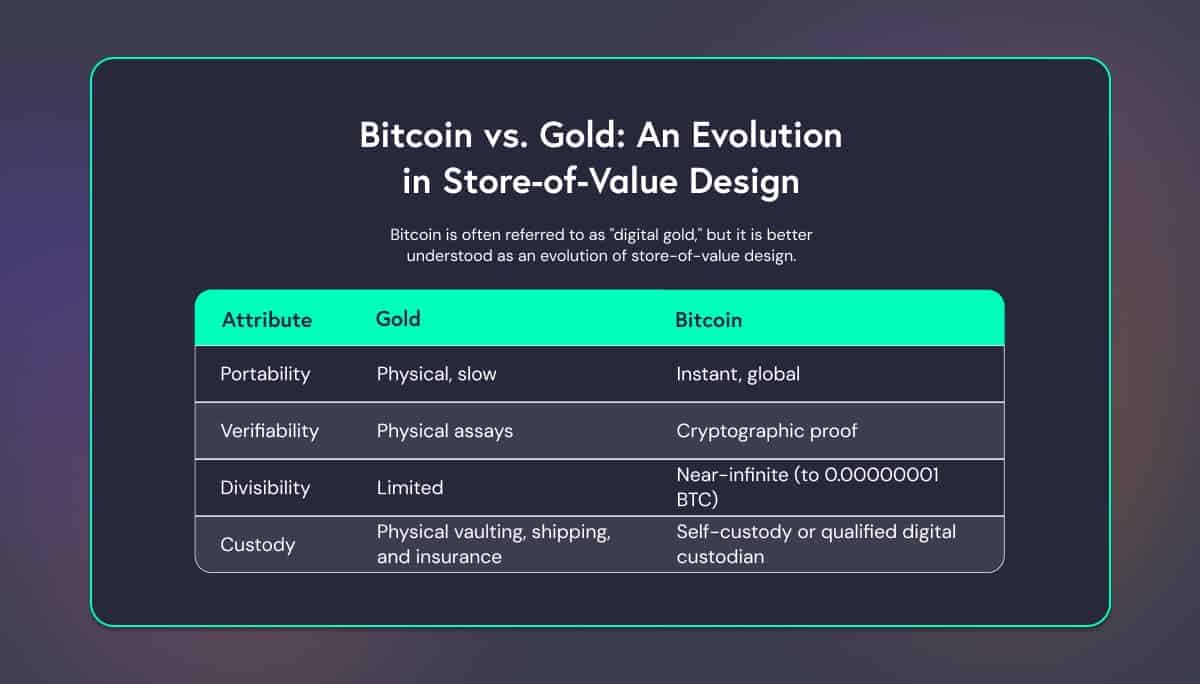
Gold still plays a role in wealth preservation. Bitcoin adds programmable scarcity, which is increasingly relevant in a digital-first global economy.
SALT’s View: A Store of Value Should Not Be Idle Capital
At SALT, Bitcoin is viewed not just as something to hold, but as a long-term balance-sheet asset. A true store of value should not force a sale when liquidity is needed. It should let owners preserve long-term exposure, access capital conservatively, and manage volatility without being forced to sell.
That philosophy is why SALT was built around Bitcoin-backed lending with conservative loan-to-value (LTV) structures, transparent risk thresholds, and optional no-liquidation features designed to support long-term holders.
“A true store of value should not force liquidation when liquidity is needed.” — SALT Lending
Using Bitcoin as a Store of Value Without Selling
One misconception about store-of-value assets is that they must remain untouched. In practice, the most effective strategies allow for liquidity without forced sale. Rather than selling Bitcoin — which may trigger capital gains taxes and end future exposure — long-term holders increasingly use Bitcoin-backed loans to access liquidity.
Through structured, low-LTV borrowing, Bitcoin holders can retain ownership of their BTC, maintain exposure to long-term price appreciation, and access capital for real-world needs. This mirrors how high net worth individuals borrow against real estate or public equities: access liquidity from the asset instead of selling it.
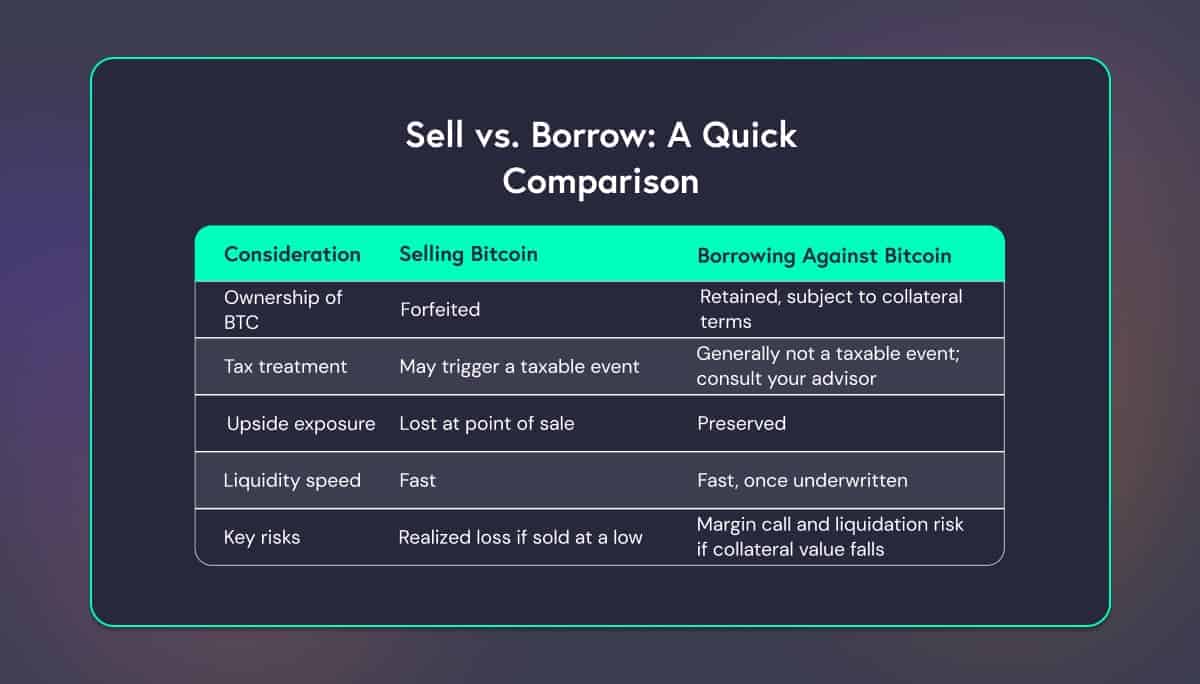
Sell vs. Borrow: A Quick Comparison
| Consideration | Selling Bitcoin | Borrowing Against Bitcoin |
|---|---|---|
| Ownership of BTC | Forfeited | Retained, subject to collateral terms |
| Tax treatment | May trigger a taxable event | Generally not a taxable event; consult your advisor |
| Upside exposure | Lost at point of sale | Preserved |
| Liquidity speed | Fast | Fast, once underwritten |
| Key risks | Realized loss if sold at a low | Margin call and liquidation risk if collateral value falls |
Why Conservative LTV Matters for Value Preservation
Not all Bitcoin-backed borrowing is the same. Risk management is essential. SALT offers conservative starting LTV tiers designed to give borrowers a larger collateral buffer during market volatility. Lower LTVs mean a greater buffer against price declines, fewer margin call events, and more time to respond during market stress. For long-term holders, conservative LTV is often the difference between navigating short-term volatility and experiencing a realized loss.
SALT Shield™: A No-Liquidation Option for Qualifying Loans
For borrowers who qualify, SALT Shield™ is designed to remove one of the biggest threats to long-term value preservation: forced liquidation. Once activated, SALT Shield™ is designed to remove margin calls and market-triggered liquidation for the duration of the loan term, subject to the product’s terms and conditions. Borrowers are still responsible for interest payments and keeping the loan current.
For long-term Bitcoin holders, this is intended to turn borrowing into a stability tool rather than a source of forced-sale risk during volatility.
Risk Still Exists and Must Be Managed
Bitcoin-backed strategies require discipline. Effective long-term holders typically:
- Use conservative starting LTVs
- Maintain liquidity reserves outside their Bitcoin position
- Monitor macroeconomic and market conditions
- Avoid over-leveraging their BTC
- Understand margin mechanics and loan terms before borrowing
Bitcoin’s store-of-value thesis does not remove volatility. It requires structured risk management.
Why the Store-of-Value Narrative Is Not Going Away
Bitcoin does not need universal adoption to function as a store of value. It requires credible holders, mature infrastructure, and time. Those conditions now exist. Bitcoin has evolved into a globally traded scarce asset, a macro hedge considered by a growing number of institutions, a balance-sheet asset for long-term holders, and a collateral base for modern lending. This is not a passing trend — it is a structural response to monetary uncertainty.
Conclusion: Optionality in an Uncertain World
Bitcoin as a store of value is not about short-term price predictions. It is about preserving financial optionality in an uncertain world. For holders who manage risk carefully, think long term, and use conservative structures, Bitcoin has increasingly been evaluated alongside traditional stores of value — and it does not need to be sold to be useful.
Talk to SALT About Bitcoin-Backed Lending
If you are a long-term Bitcoin holder exploring how to access liquidity without selling, SALT can help you evaluate whether a Bitcoin-backed loan fits your broader strategy. Contact SALT to learn more about our conservative LTV options and SALT Shield™.
Frequently Asked Questions
Is Bitcoin considered a store of value?
Many investors view Bitcoin as a store of value because of its fixed supply, durability, global liquidity, and growing adoption. While Bitcoin is volatile in the short term, long-term holders use it to help preserve purchasing power over time.
Can Bitcoin be a store of value if it is volatile?
Yes. Store-of-value status depends on long-term purchasing power preservation, not short-term price stability. Volatility can be managed with conservative position sizing, appropriate time horizons, and structured borrowing.
How do Bitcoin holders access liquidity without selling?
Long-term holders often use Bitcoin-backed loans at conservative loan-to-value ratios. These loans let borrowers retain ownership of their Bitcoin while accessing capital for other uses.
Is borrowing against Bitcoin risky?
Borrowing against Bitcoin carries market and liquidation risk, particularly when high leverage is used. Conservative LTVs and features such as SALT Shield™ are designed to reduce — but not remove — that risk. Borrowers should carefully review all loan terms before borrowing.
Why do long-term holders avoid selling Bitcoin?
Selling Bitcoin may trigger capital gains taxes and end future exposure to price appreciation. Borrowing against Bitcoin can preserve ownership and upside while providing access to liquidity. Tax treatment depends on your jurisdiction and personal situation — consult a qualified tax advisor.
How is Bitcoin different from gold as a store of value?
Gold’s supply is finite but can expand with mining output. Bitcoin’s supply is hard-capped at 21 million coins and cannot expand in response to price. Bitcoin is also more portable, more divisible, and verifiable cryptographically rather than physically.
Disclaimer:This content is provided for informational purposes only and does not constitute tax, legal, investment, or financial advice. SALT does not provide tax, legal, or financial advice. Readers should consult their own qualified advisors before making decisions based on this content.
Availability. SALT products and services are not available in all jurisdictions. For a current list of jurisdictions where SALT operates, please visit saltlending.com/map-list.